
The Best Astronomical Events of 2026

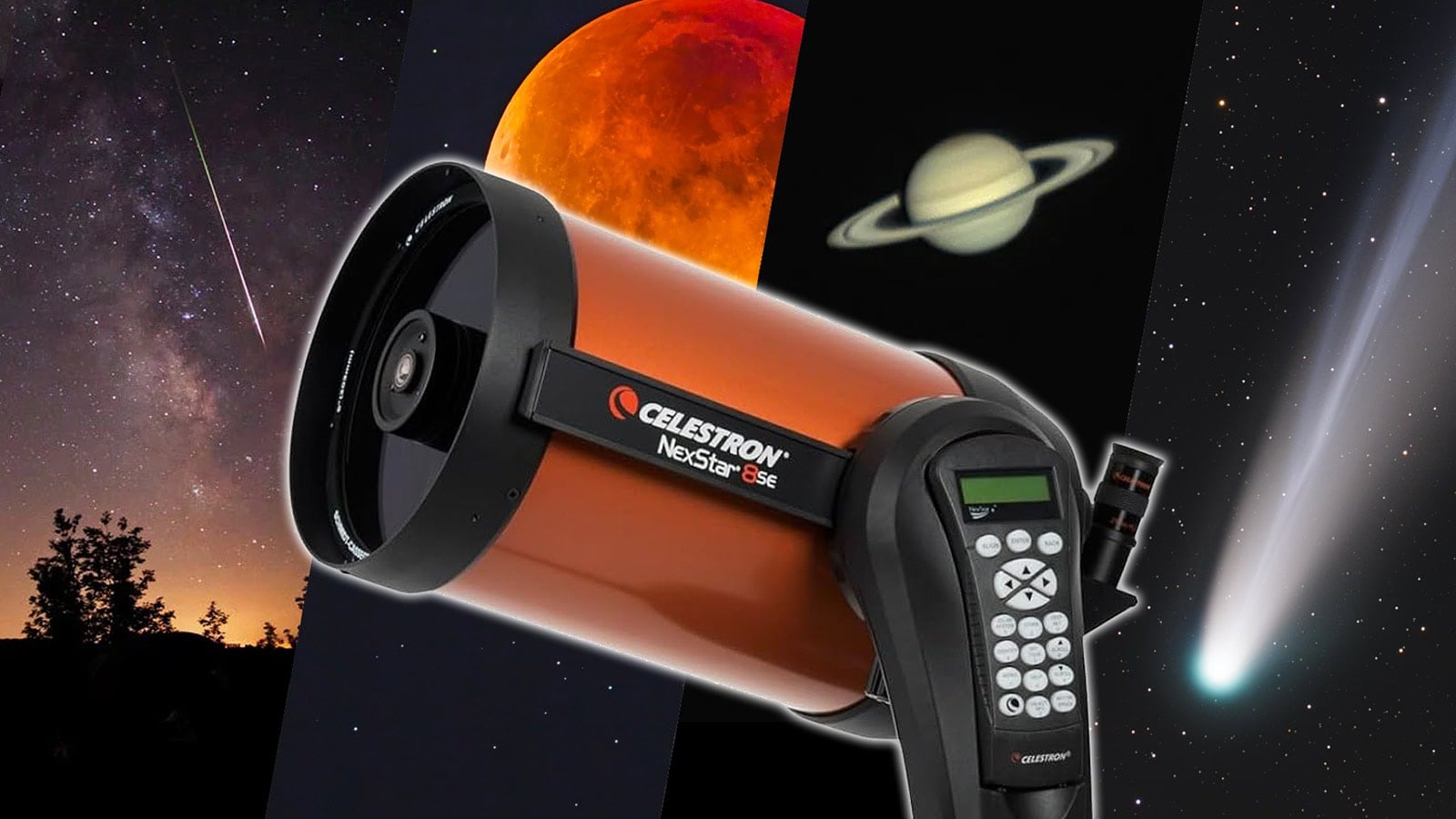
There’s a lot to look forward to in the night sky, and this astronomy calendar 2026 highlights the best astronomical events you won’t want to miss.
From dramatic eclipses to rare planetary alignments, vibrant meteor showers, and potential comet appearances, 2026 is packed with opportunities for visual observers and astrophotographers alike.
This guide walks you through the best astronomical events of 2026 month by month, with practical observing tips and realistic gear suggestions so you can plan your sessions, capture each celestial spectacle, and build your own astronomy calendar for the year ahead.
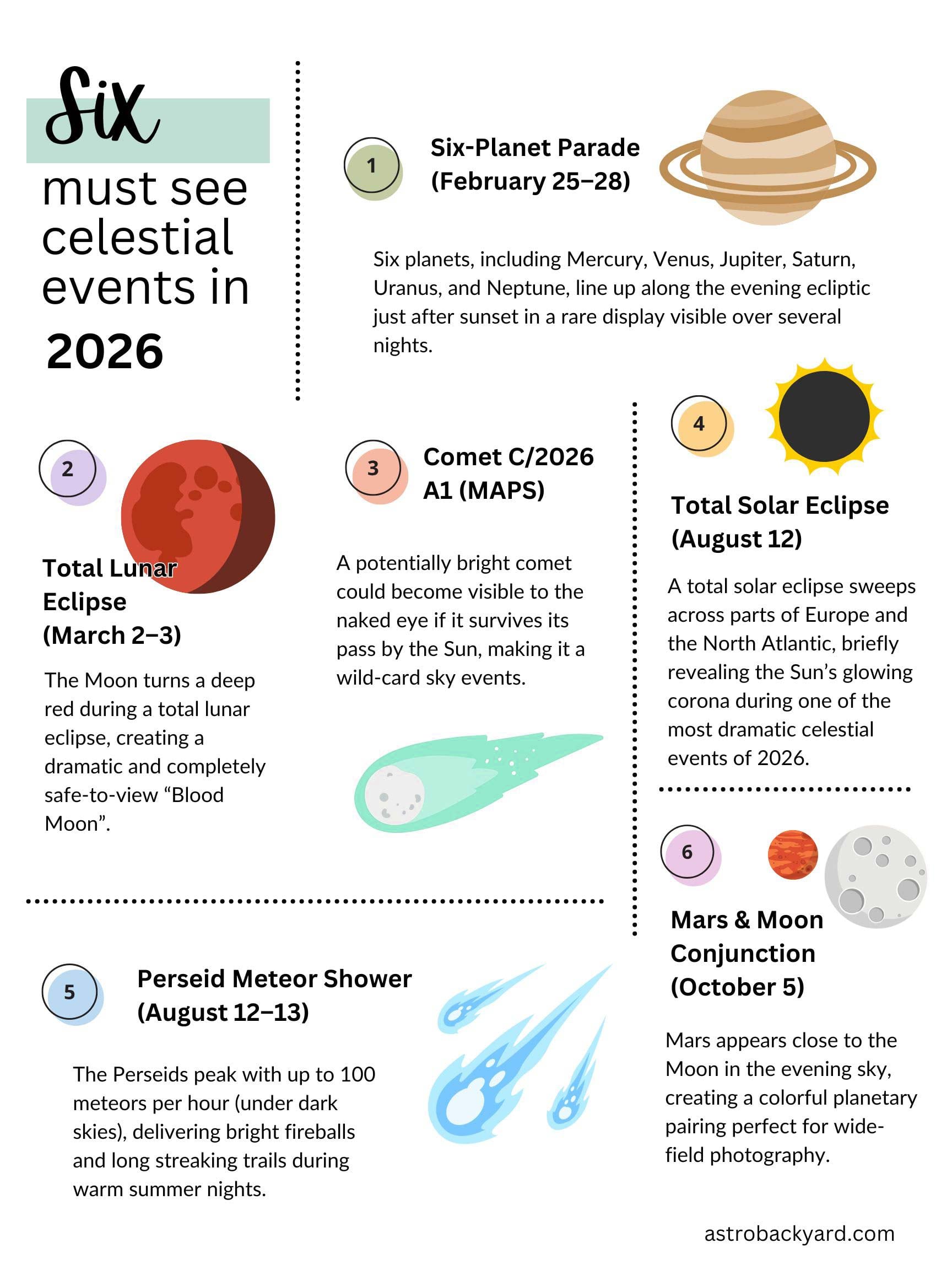
Table of Contents
- January: Quadrantids & Jupiter at Opposition
- February: Annular Solar Eclipse & Planet Parade
- March: Total Lunar Eclipse
- April: Lyrid Meteor Shower
- May: Eta Aquarids
- June: Planet Pairing and Summer Solstice
- July: Comets & Opposition Season
- August: Total Solar Eclipse & Perseids
- September: Harvest Moon
- October: Saturn at Opposition
- November: Planetary Conjunctions
- December: Geminids & Christmas Supermoon
Astronomy Events 2026 (Quick Overview)
| Event | Date (2026) | Type | Best For | General Visibility* |
|---|---|---|---|---|
| Quadrantid Meteor Shower | Jan 3–4 | Meteor shower | Visual observing, wide-field imaging | Northern Hemisphere (best) |
| Jupiter at Opposition | Jan 10 | Planetary opposition | High-resolution planetary imaging | Visible all night where skies are clear |
| Annular Solar Eclipse | Feb 17 | Annular solar eclipse | Solar imaging (with filters) | Annularity over Antarctica; partial from parts of Southern Hemisphere |
| Six-Planet Alignment (“Planet Parade”) | Feb 28 | Planetary alignment | Wide-field astrophotography, visual observing | Visible shortly after sunset (best from low-light locations) |
| Total Lunar Eclipse | Mar 2–3 | Total lunar eclipse | Visual observing, telephoto imaging | Much of North America, Pacific, parts of South America, Asia, and Australia |
| Eta Aquariids Meteor Shower | May 5–6 | Meteor shower | Pre-dawn meteor imaging | Both hemispheres (Southern Hemisphere favored) |
| Venus–Jupiter Conjunction | June 8–9 | Planetary conjunction | Telephoto imaging, twilight observing | Visible low in the western sky after sunset |
| Total Solar Eclipse | Aug 12 | Total solar eclipse | Eclipse chasing, solar imaging | Northern Russia, Greenland, Iceland, Portugal, northern Spain |
| Perseid Meteor Shower | Aug 11–13 | Meteor shower | Nightscapes, meteor composites | Northern Hemisphere |
| Deep Partial Lunar Eclipse | Aug 27–28 | Partial lunar eclipse | Telephoto imaging, visual observing | Europe, Africa, Asia, Australia |
*Always confirm local visibility and timing with an eclipse or astronomy app for your location.
January: Kick Off the Year with the Quadrantids and Bright Planets
January wastes no time delivering action in the night sky. The year begins with one of the strongest meteor showers on the calendar, followed by prime-time views of the solar system’s largest planet.
Quadrantid Meteor Shower: January 3–4
The Quadrantids peak on the night of January 3 into the early morning of January 4 and can produce up to 120 meteors per hour under ideal, dark, moonless skies.
The radiant lies in the northern sky near the former constellation Quadrans Muralis (now part of Boötes), but meteors can appear anywhere overhead.
Unlike most meteor showers, the Quadrantids have a very sharp peak. Meteor activity rises and falls quickly, meaning your best viewing window may only last a few hours.
Why it’s special: If timed right, the Quadrantids can produce bright fireballs and impressive meteor streaks – one of the most intense short-lived displays of the year.
Viewing tips
- Head to a dark sky site after midnight local time.
- Let your eyes adapt for 30 minutes.
- Plan to observe from late night into early morning for the best rates.
Gear
- Naked eye: Best for casual observers.
- Wide-field lens on DSLR/mirrorless: 14–24 mm f/2.8 or similar for capturing meteors across the sky.
Jupiter at Opposition: January 10
Jupiter reaches opposition in early January, meaning Earth sits directly between Jupiter and the Sun. The planet rises at sunset, remains visible all night, and appears at its brightest and largest for the year.
Why it’s special: This is the best time to photograph Jupiter’s cloud bands, the Great Red Spot, and its four Galilean moons, Io, Europa, Ganymede, and Callisto.
Viewing tips
- Observe around local midnight when Jupiter is highest.
- Watch the moons shift position over a single evening.
- Use an IR-cut or planetary filter to enhance contrast.
Gear
- 4–8” telescope (the telescope I recommend)
- Planetary camera (e.g., ZWO ASI series)
- 2x–3x Barlow lens
- Stable tracking mount

A close-up view of the planet Jupiter through my telescope.
Related Article: How to Photograph Planets (With Any Camera)
February: Eclipses, Planetary Parades, and Close Encounters
February brings both a dramatic solar event and an unusual multi-planet lineup in the evening sky.
Annular Solar Eclipse: February 17
One of the year’s most dramatic events is an annular solar eclipse. On February 17, the Moon will pass directly in front of the Sun but sits too far from Earth to cover it completely, producing a brilliant “Ring of Fire.”
While the central annular path lies largely over Antarctica, many southern hemisphere observers will still see a partial eclipse.
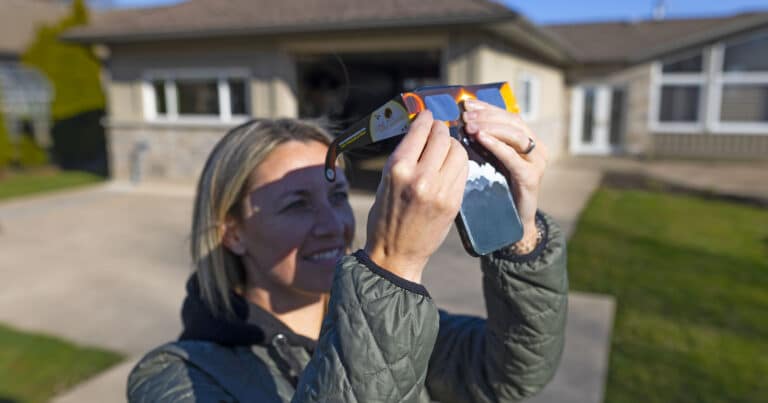
Safety first: Never observe the Sun without certified solar filters on your eyes and equipment.
Viewing tips
- Use ISO-certified solar eclipse glasses.
- Track the maximum eclipse time in your area.
- Photograph progression sequences for a composite.
Gear
- Solar filters for telescopes and binoculars.
- Dedicated solar telescope (H-alpha or white light).
- DSLR with solar filter for widefield shots.
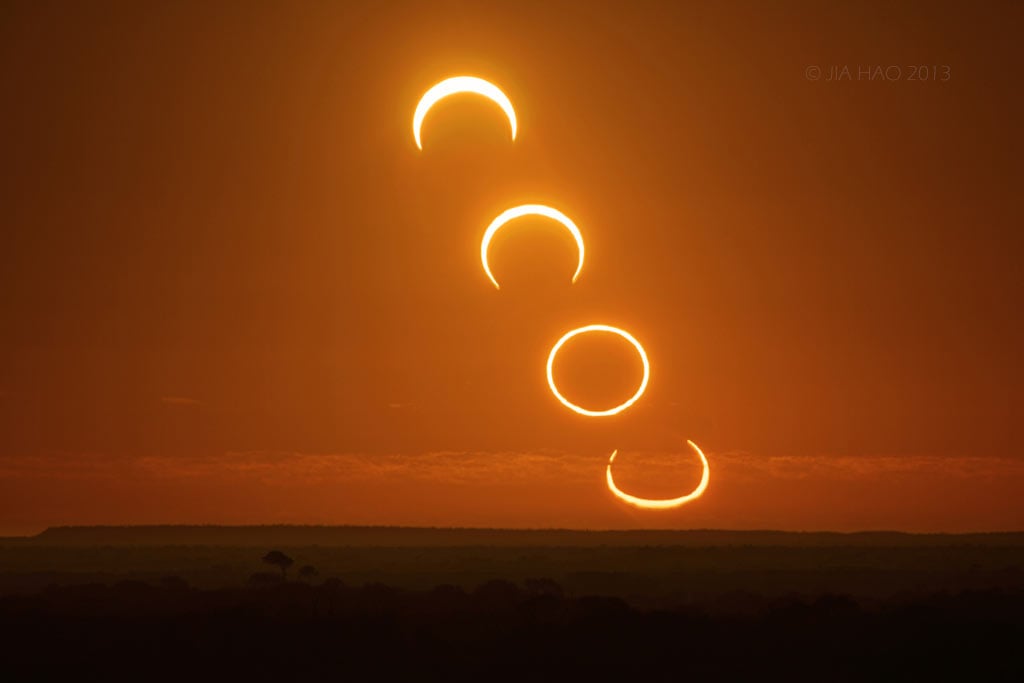
Ring of Fire Sequence by Jia Hao (Flickr)
Six-Planet Parade: February 25–28
Late February offers a rare chance to see Mercury, Venus, Jupiter, Saturn, Uranus, and Neptune stretched along the ecliptic after sunset.
Why it’s special: Seeing six planets in one evening doesn’t happen often; it’s a great opportunity for beginners to identify multiple worlds at once.
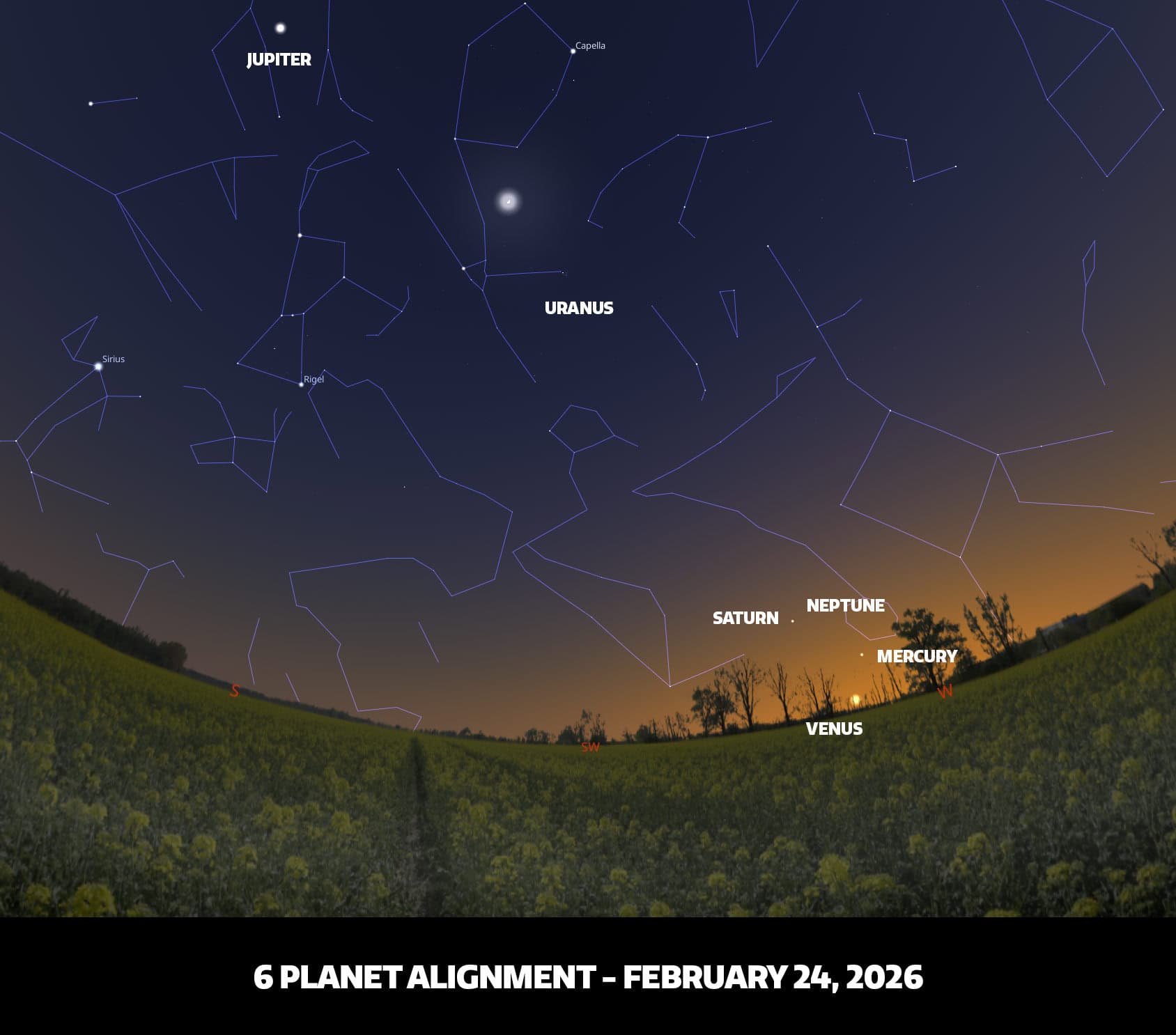
The location of the six planets in the sky on February 24, 2026. (Graphic created with Stellarium).
Viewing tips
- Find a clear west/southwest horizon
- Begin observing 30 minutes after sunset
- Use binoculars or a small telescope for Uranus and Neptune
Gear
- 10×50 binoculars or larger.
- Small telescope for outer planets.
- Tracking mount + camera for a mosaic.
Related Article: What are the planets in order from the Sun?
Observing Note: Using a Smart Telescope
If you are new to the night sky and have trouble locating objects with a star chart or a stargazing app on your smartphone, consider a smart telescope like the Seestar S50.
A smart telescope makes finding planets incredibly easy. After a quick alignment using your smartphone, the scope automatically slews to targets like Saturn or Jupiter.
Planets will appear very small, but there’s something special about watching a real planet come into view in near real time. You’re not looking at a picture; you’re seeing a distant world with your own telescope, live from your backyard.
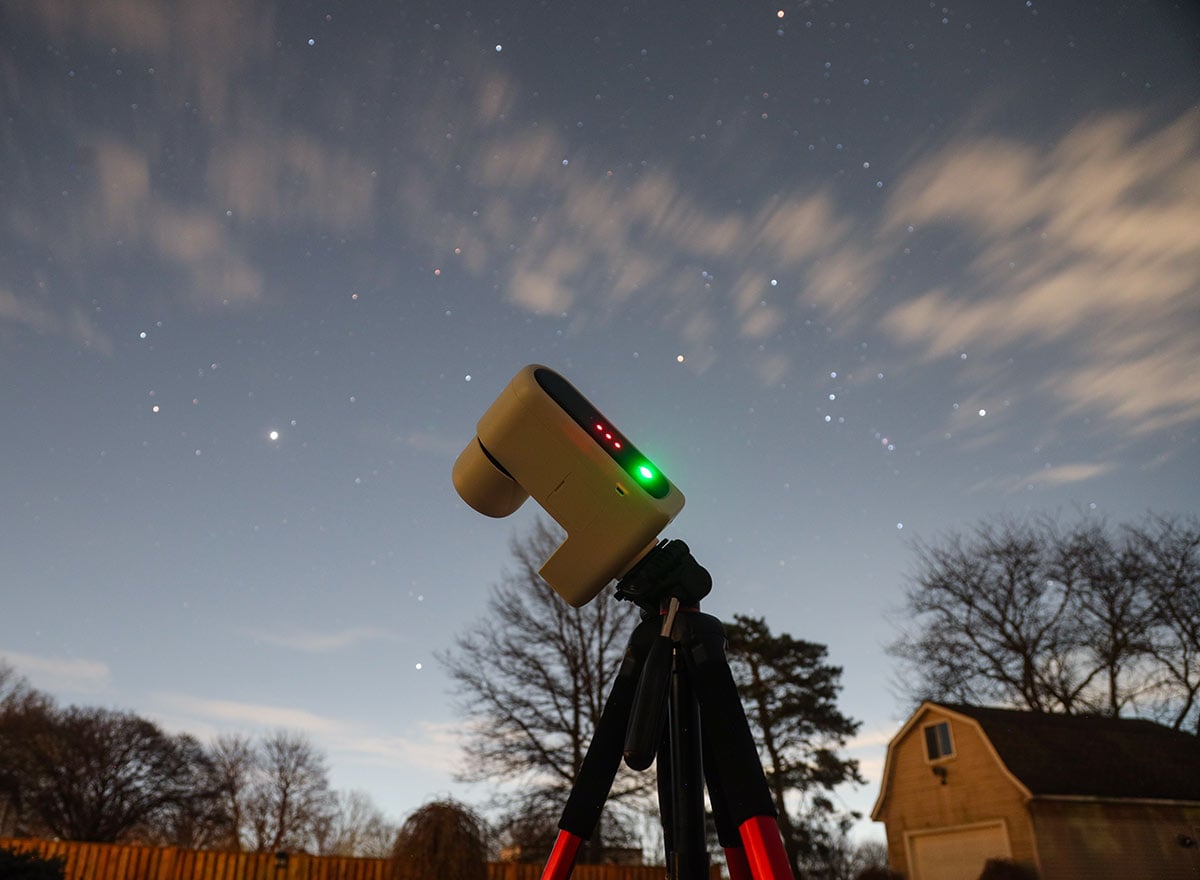
While planets appear very small, a smart telescope is a great way to explore the night sky. (Seestar S30 Pro pictured)
March: Blood Moon Total Lunar Eclipse
March delivers one of the most dramatic sky events of the year, a total lunar eclipse. It’s an easy, accessible event for observers everywhere, requiring no special filters and offering plenty of time to enjoy the show.

Related Article: How to Photograph a Lunar Eclipse (Gear Advice and Camera Settings)
Total Lunar Eclipse: March 2–3
March delivers one of the year’s defining highlights – a total lunar eclipse.
As Earth passes between the Sun and the Moon, our planet’s shadow slowly covers the lunar surface. During totality, the Moon turns a deep coppery red – earning the nickname “Blood Moon.”
The red glow happens because Earth’s atmosphere bends and filters sunlight, projecting every sunrise and sunset onto the Moon at once.
Why it’s special: Totality can last up to about an hour, giving plenty of time to observe and photograph. Best of all, it’s completely safe to view with the naked eye.
Viewing tips
- Begin observing 60–75 minutes before totality.
- Watch brightness and color changes carefully.
- Capture a time-lapse sequence of the eclipse stages.
- Frame the Moon with landscape elements for added impact.
Gear
- Naked eye or binoculars.
- 300–800mm telephoto lens.
- Tracking mount.
- Remote shutter/intervalometer.

The stages of a lunar eclipse, Fred Espenak.
April: Spring Showers and Seasonal Highlights
April marks the true arrival of spring skies in the northern hemisphere. With meteor activity picking up and winter constellations giving way to brighter seasonal targets, it’s a refreshing transition month for observers and imagers alike.
Lyrid Meteor Shower: Peak April 22
The Lyrids are one of the year’s first well-known meteor showers and usually peak around April 22. They originate from Comet Thatcher’s debris stream and can produce around 15-20 meteors per hour under dark skies.
Viewing Tips
- Best viewing in the early morning before dawn.
- Look toward the radiant in Lyra, but watch across the whole sky.
Gear
- Wide-field astrophotography setups.
- Comfortable reclining chair for all-sky viewing.
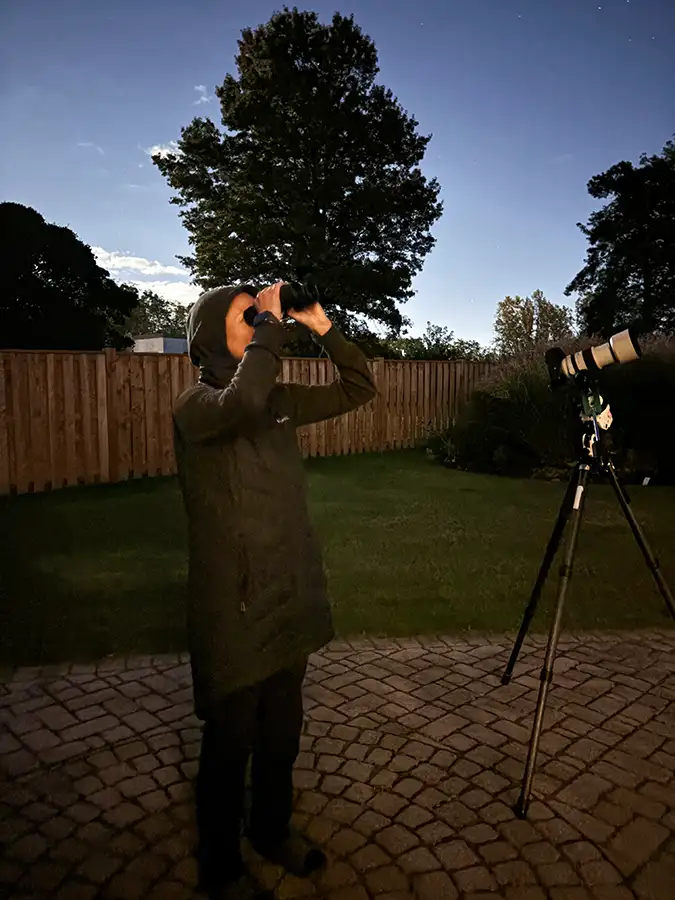
Ashley is standing in the backyard with her binoculars, hoping to catch a meteor streaking across the sky. (Naked eye is often best!)
May: Eta Aquarids and the Prelude to Summer
May bridges spring and summer with fast-moving meteors and improving late-night conditions. It’s also a reminder that some of the most famous comets in history still leave their mark on our skies.
Eta Aquarid Meteor Shower: May 5–6
The Eta Aquarids are debris from the legendary Halley’s Comet. Each May, Earth plows through this ancient material, producing fast, bright meteors that often leave glowing trains behind.
This shower favors the southern hemisphere, where rates can exceed 40 meteors per hour. Northern observers see lower counts, but dark skies can still deliver a rewarding display.
Why it’s special: You’re watching particles shed by Halley’s Comet, one of the most famous comets in history. The meteors are swift and elegant, often streaking long distances across the sky.
Viewing Tips:
- The radiant rises higher just before dawn; that’s your prime window.
- Look about 40–60° away from the radiant for longer meteor trails.
- Be patient, activity can come in bursts.
Gear:
- Naked eye for visual observing.
- Wide-field lens (14–24mm) for meteor photography.
- Interval shooting for time-lapse sequences.

A wide-field Milky Way photo with a streaking meteor. (Canon EOS Ra + Sigma 24mm F/1.4 Lens)
June: Solstice Skies and Conjunctions
June is a turning point. The summer solstice brings long days and short nights, but it also signals the return of Milky Way season and the buildup to prime deep-sky imaging months.
Venus–Jupiter Conjunction – June 8–9
One of the most eye-catching planetary events of 2026 happens on the evenings of June 8 and 9, when Venus and Jupiter appear extremely close together in the western sky after sunset.
These are the two brightest planets visible from Earth, and when they pair up this tightly, they create a brilliant double “star” that’s impossible to miss.
Look low in the west about 30 minutes after sunset. Venus will shine the brightest, with Jupiter just beside it, close enough to fit comfortably in the same binocular field of view, and easily framed together with a short telephoto lens.
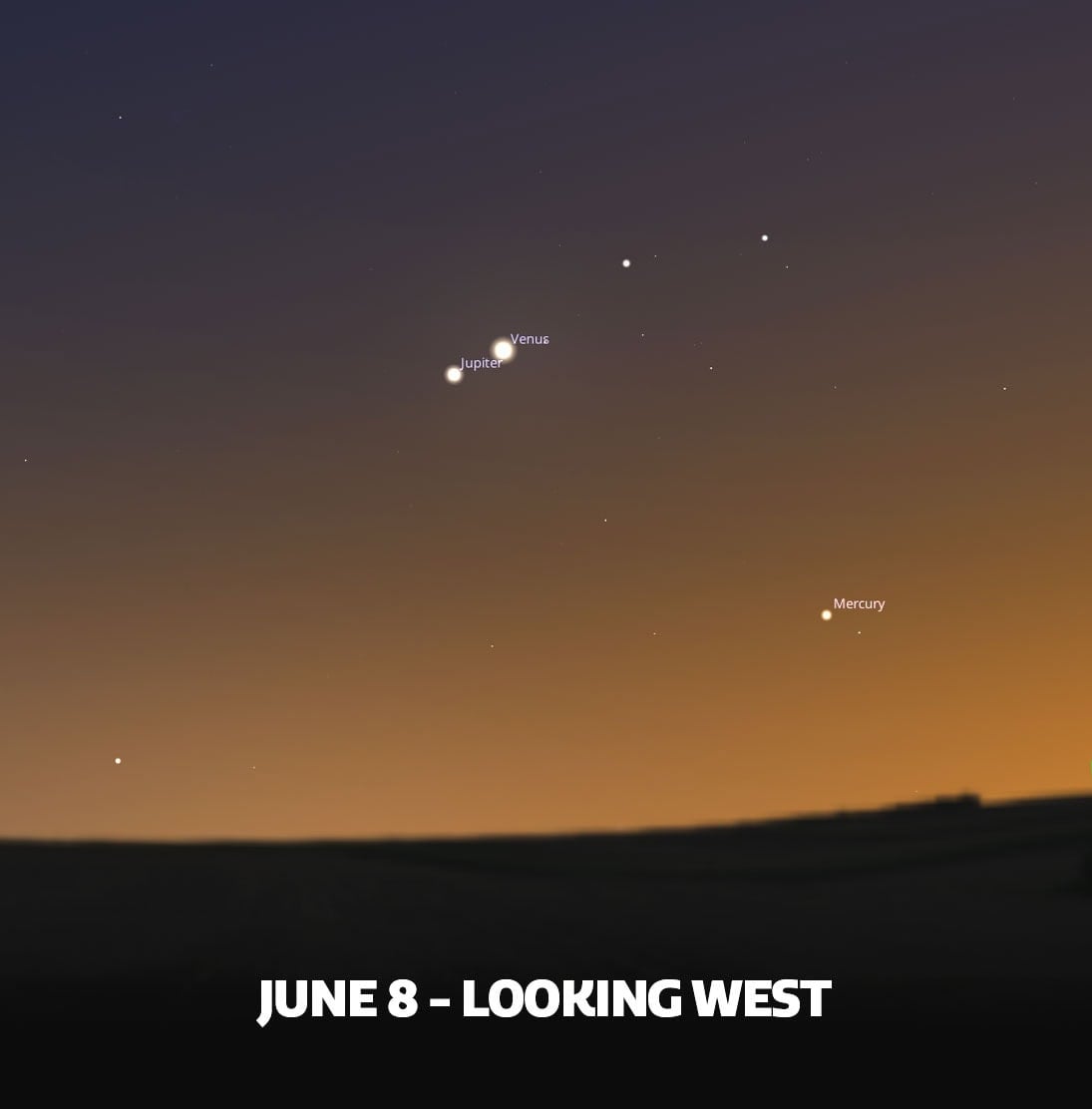
The planets Jupiter and Venus will appear as two bright ‘stars’ in the western sky at dusk on June 8th. Graphic created with Stellarium.
If you’re looking to photograph the event (I certainly am), aim to capture a twilight landscape shot with interesting foreground details, such as a city skyline or an aesthetic treeline.
You don’t need a star tracker because it will still be bright enough to use shorter exposures. Because these planets will appear very low in the sky, a clear western horizon is essential.
Summer Solstice: June 21 (Northern Hemisphere)
June marks the summer solstice in the northern hemisphere (June 21), bringing the longest day and shortest night of the year.
While darkness is limited, this month signals the return of summer showpieces: the Milky Way core, the Lagoon Nebula, the Eagle Nebula, and eventually the Veil Nebula rising in Cygnus.
Why it matters: June is a setup month. It’s the perfect time to refine your workflow before deep-sky season hits full stride.
Viewing Tips
- Image brighter nebulae that can tolerate shorter darkness windows.
- Scout Milky Way foreground compositions.
- Use twilight sessions to practice focusing and framing.
Gear Planning
- Fine-tune polar alignment and guiding accuracy.
- Revisit collimation if using reflectors.
- Build target lists for July and August.
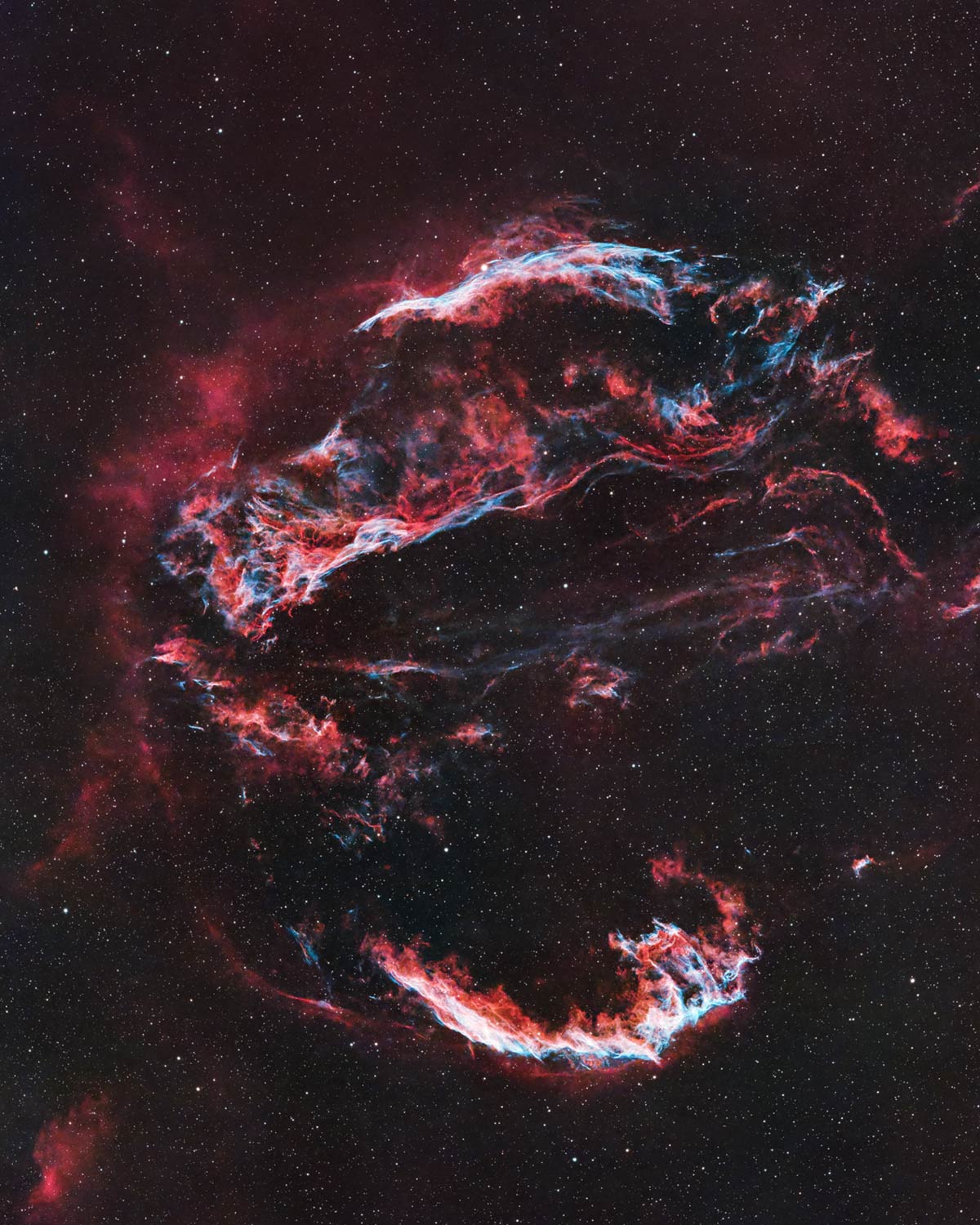
The Veil Nebula Complex in the constellation Cygnus. Trevor Jones.
July: Comets, Combinations, and Ceres at Opposition
July offers comfortable night temperatures and the potential for exciting transient objects, such as comets. It’s a month that rewards those who stay flexible and keep an eye on developing sky events.
Comet C/2026 A1 (MAPS)
A potentially bright sungrazing comet, C/2026 A1 (MAPS), may remain visible into July — if it survives its close pass to the Sun. Sungrazers are unpredictable: some disintegrate, others flare dramatically in brightness.
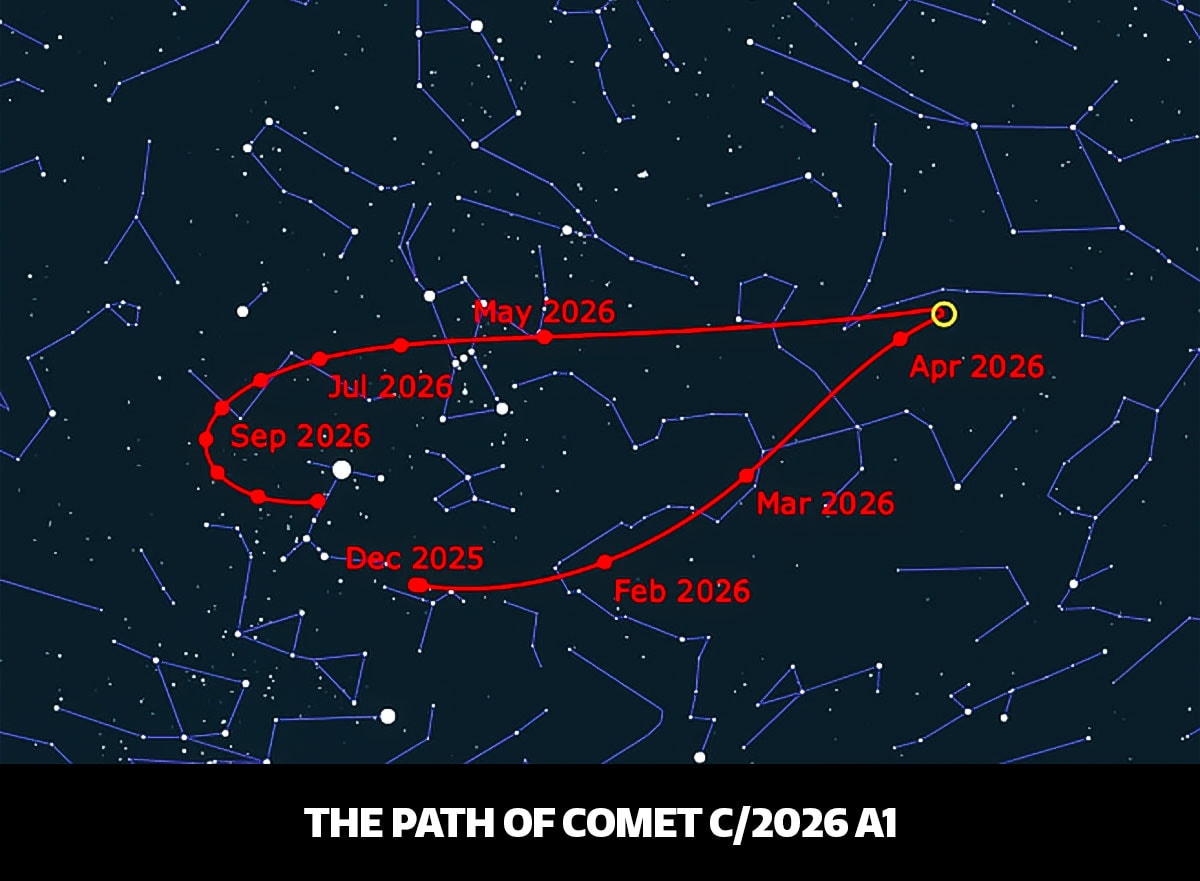
A star chart showing the path of Comet C/2026 A1 in the night sky. Gideon van Buitenen.
Why it’s exciting: Bright comets are rare and unforgettable. If it holds together, this could become one of the most photogenic targets of the year.
Viewing Tips
- Monitor brightness updates and ephemeris data.
- Image on multiple nights to capture tail evolution.
- Try wide-field compositions with the Milky Way if positioning allows.
Gear
- 135–300mm telephoto lens or small refractor.
- Star tracker for longer exposures.
- Tripod-based wide shots for comet + landscape images
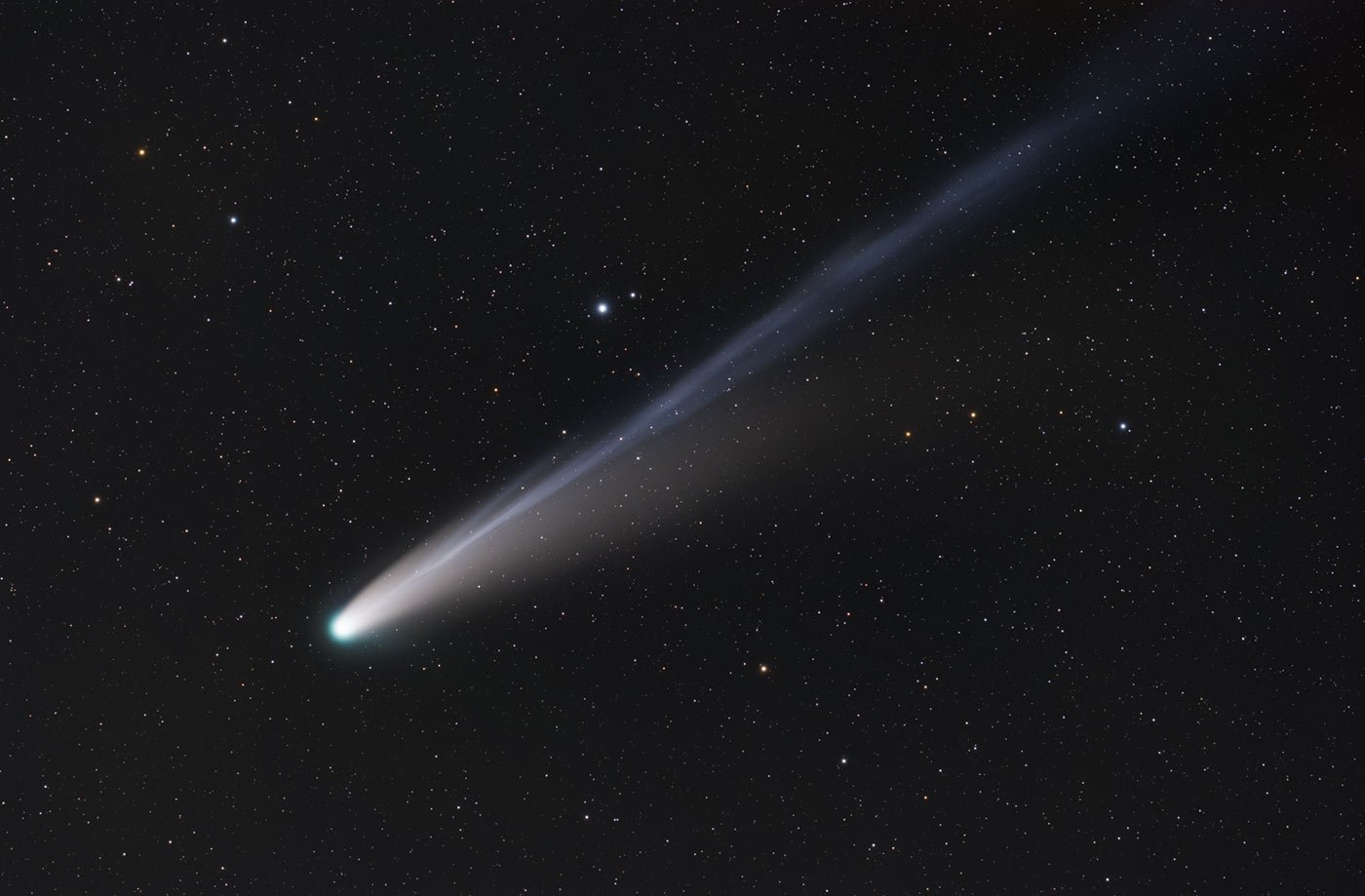
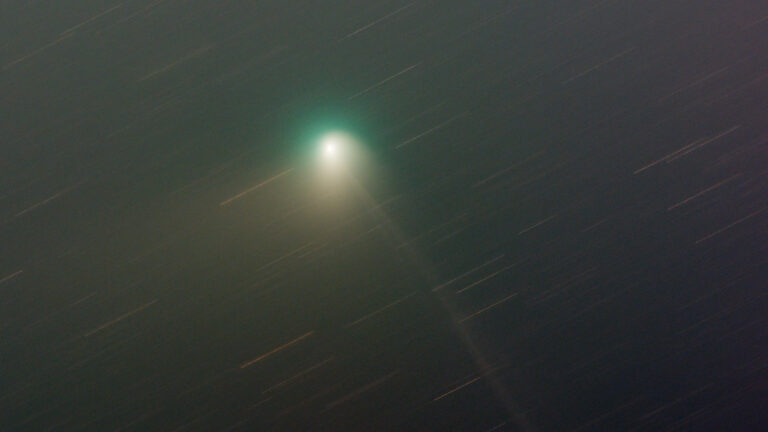
Comet Lemmon captured through a telescope in October, 2025.
August: The Grand Solar Eclipse and Perseid Shower
August is the blockbuster month of the year. With a total solar eclipse and the ever-reliable Perseid meteor shower, this is when casual skywatchers and dedicated astrophotographers alike step outside.
Total Solar Eclipse: August 12
A total solar eclipse crosses parts of Europe and the North Atlantic, offering observers along the path a chance to witness totality, when the Sun’s corona becomes visible.
Why it’s unforgettable: The sudden drop in temperature, the darkened sky, and the glowing corona create a surreal experience that photos only partially capture.
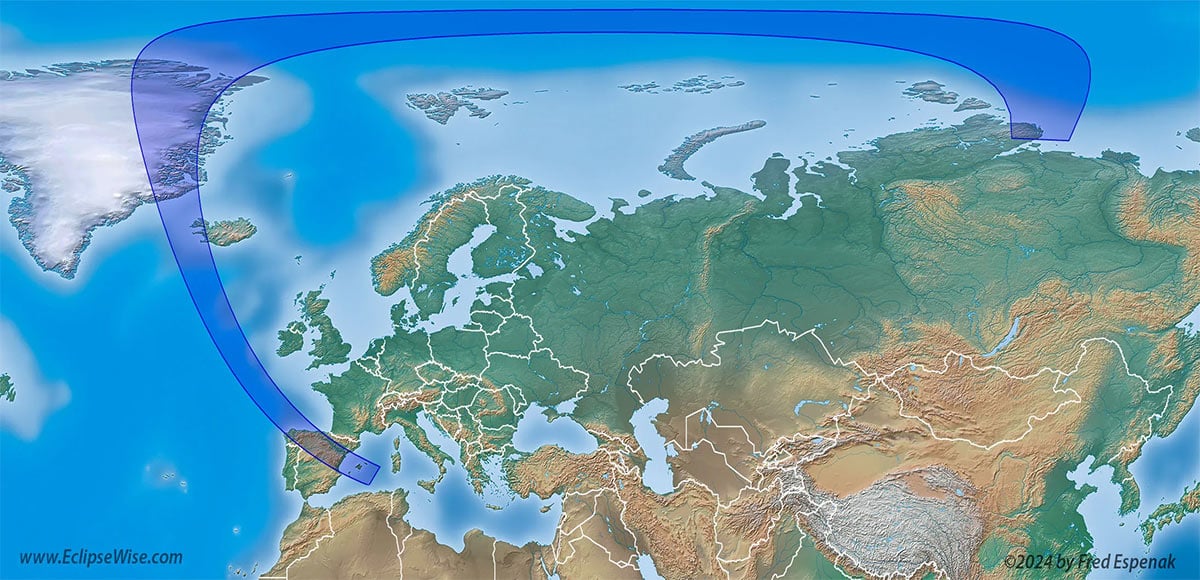
Path of Total Solar Eclipse of Aug 12, 2026, through Russia, the Arctic, Greenland, Iceland, and Spain. Fred Espenak.
Viewing Tips
- Travel to the centerline for maximum totality duration.
- Practice your camera workflow in advance.
- Remove solar filters only during totality.
Gear
- Solar eclipse glasses (partial phases).
- DSLR/mirrorless camera + solar filter.
- Tracking mount for smoother sequences.
Related Article: How to Photograph a Solar Eclipse.
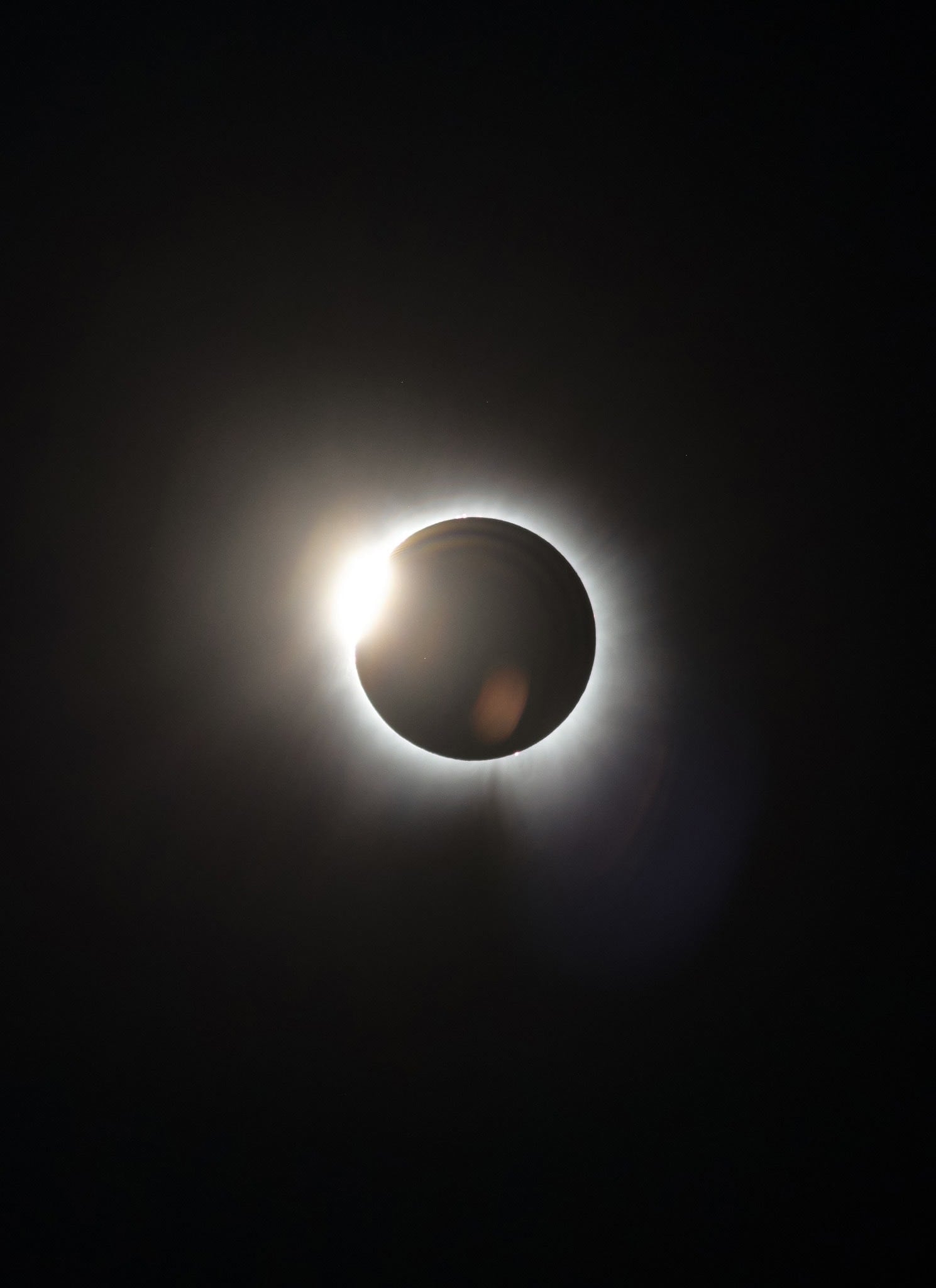
My photo of the total solar eclipse from April 2024 in eastern Canada.
Perseid Meteor Shower: Peak August 12–13
The Perseids are the most popular meteor shower of the year, and for good reason. Peaking around August 12–13, this shower can produce 80–100 meteors per hour under dark skies, with frequent bright fireballs that leave glowing smoke trails lingering for several seconds.
The Perseids originate from debris left behind by Comet 109P/Swift–Tuttle. Every August, Earth passes through this dense stream of comet material, producing one of the year’s most reliable and visually impressive displays.
The radiant lies in the constellation Perseus, which rises in the northeast during the evening and climbs higher after midnight.
Why it’s special: Unlike the sharp peak of the Quadrantids, the Perseids build gradually and remain active for several nights around maximum. Warm summer temperatures also make this one of the most comfortable meteor showers to observe, no freezing January conditions required.
Viewing Tips
- The best rates occur after midnight, when your location rotates into the densest part of the meteor stream.
- Look about 45–60° away from the radiant for longer, more dramatic streaks.
- Avoid direct moonlight if the Moon is present — position it behind a building or tree if possible.
- Allow at least 30 minutes for your eyes to adapt.
- Bring a reclining chair or blanket — comfort increases how long you’ll stay out.
Gear
- Naked eye: Perfect for casual observing.
- Wide-field DSLR/mirrorless setup: Best for capturing multiple meteors.
- All-sky camera: Maximizes sky coverage.
- Intervalometer: Essential for continuous shooting.
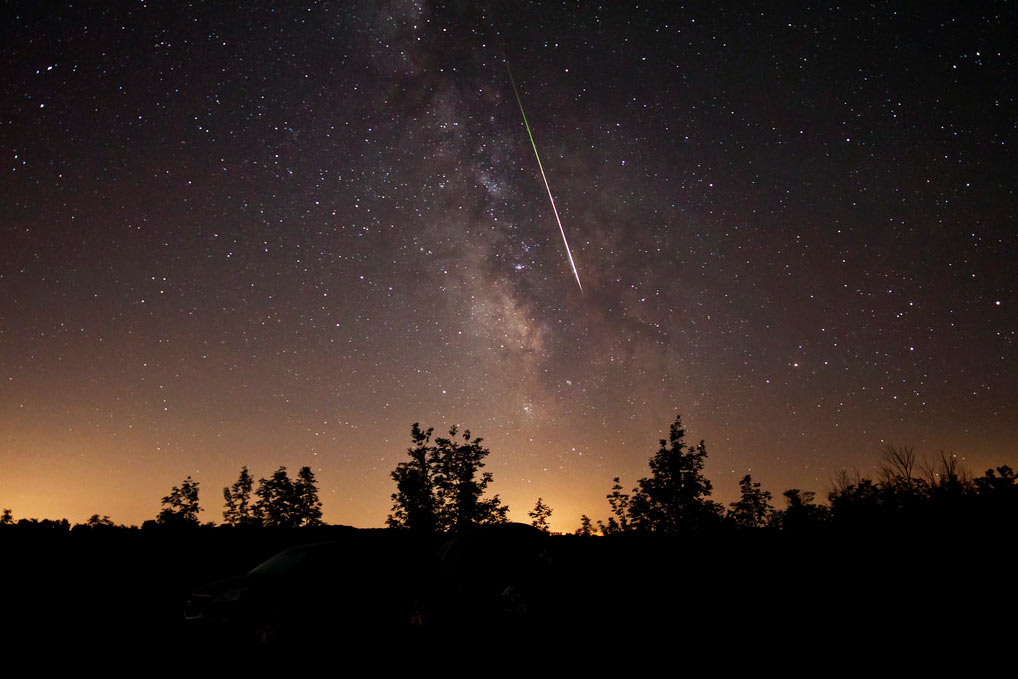
A Perseid meteor streaks across the core of the Milky Way. Photo by Rob Lenz at the Starfest Star Party.
September: Harvest Moon and Deep-Sky Season Begins
September marks the shift into darker, steadier nights. As the Harvest Moon rises and summer humidity fades, deep-sky imaging conditions begin to improve significantly.
Harvest and Supermoons
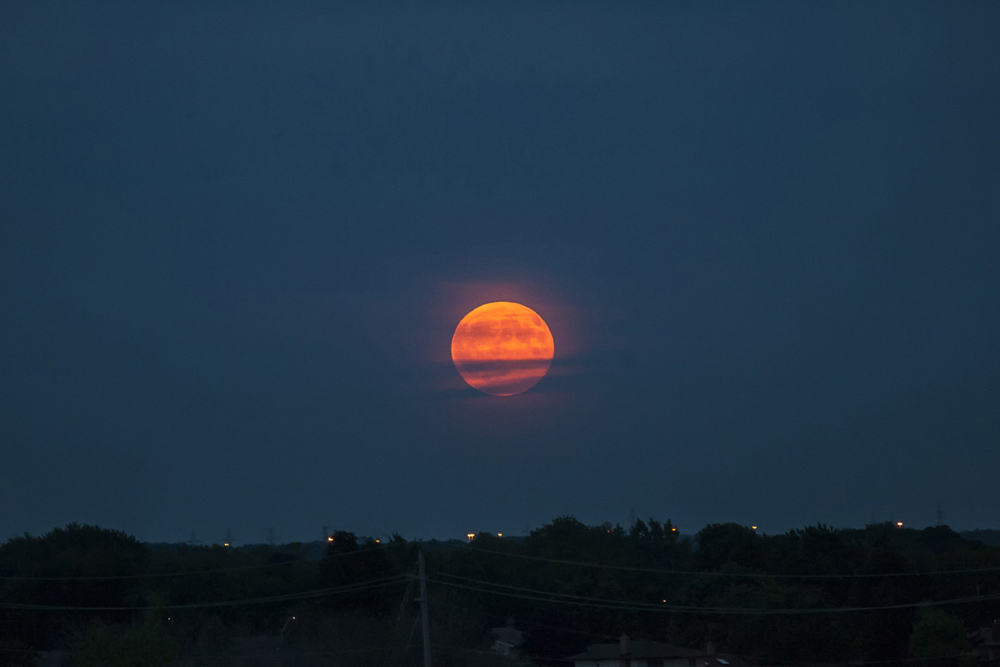
The Harvest Moon rises close to sunset for several evenings in a row, making it ideal for landscape compositions. If it coincides with perigee, it becomes a supermoon, appearing slightly larger and brighter.
Why it’s exciting: Low-altitude Moon rises create dramatic perspective effects when paired with foreground elements.
Viewing Tips
- Use apps to plan the exact direction of the moonrise.
- Shoot during moonrise for golden-hour color contrast.
- Bracket exposures to preserve lunar detail.
Gear
- 300mm+ telephoto lens.
- Tripod for sharp results.
- Full-frame camera for dynamic range.
Related Article: List of all the Full Moon Names (Each Month)
October: Saturn at Opposition and Close Conjunctions
October is prime time for planetary observers. With opposition season underway and several eye-catching conjunctions, the solar system takes center stage in the autumn sky.
Saturn at Opposition: October 4
At opposition, Saturn is visible all night and at peak brightness. The rings are fully illuminated, and moons like Titan become easier to spot.
Why it’s prime time: Opposition offers the largest apparent disk and best geometry for planetary imaging.
Viewing Tips
- Image when Saturn is highest in the sky.
- Capture long video sequences for stacking.
- Wait for steady atmospheric conditions.
Gear
- Long focal length (barlow + planetary camera).
- Good seeing conditions are essential for the best results.
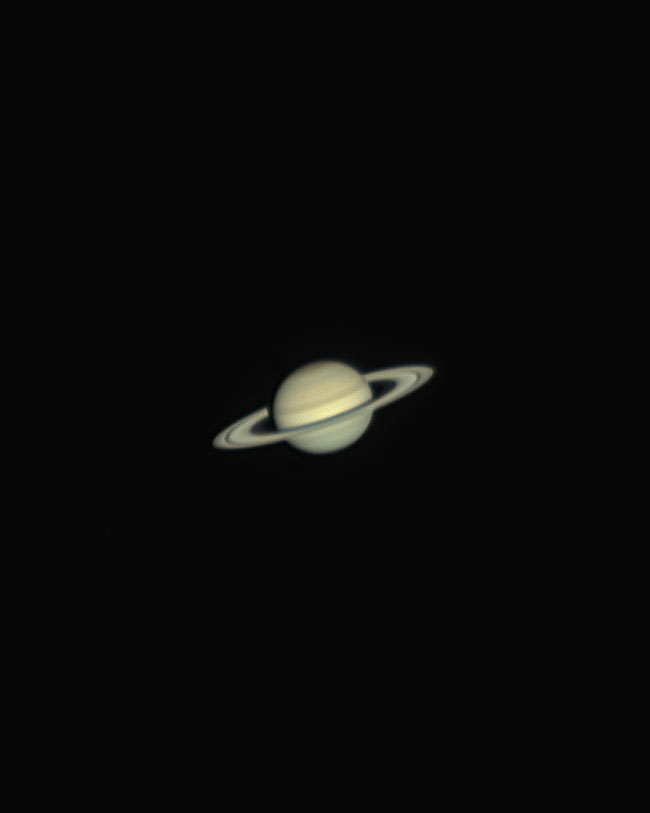
My best photo of the planet Saturn through a telescope. (Celestron Edge HD 11)
Mars and Moon Conjunctions: October 5
On October 5th, Mars will appear very close to the Moon in the evening sky. Conjunctions like this are line-of-sight alignments. Mars and the Moon aren’t actually near each other in space, but from Earth they appear side by side.
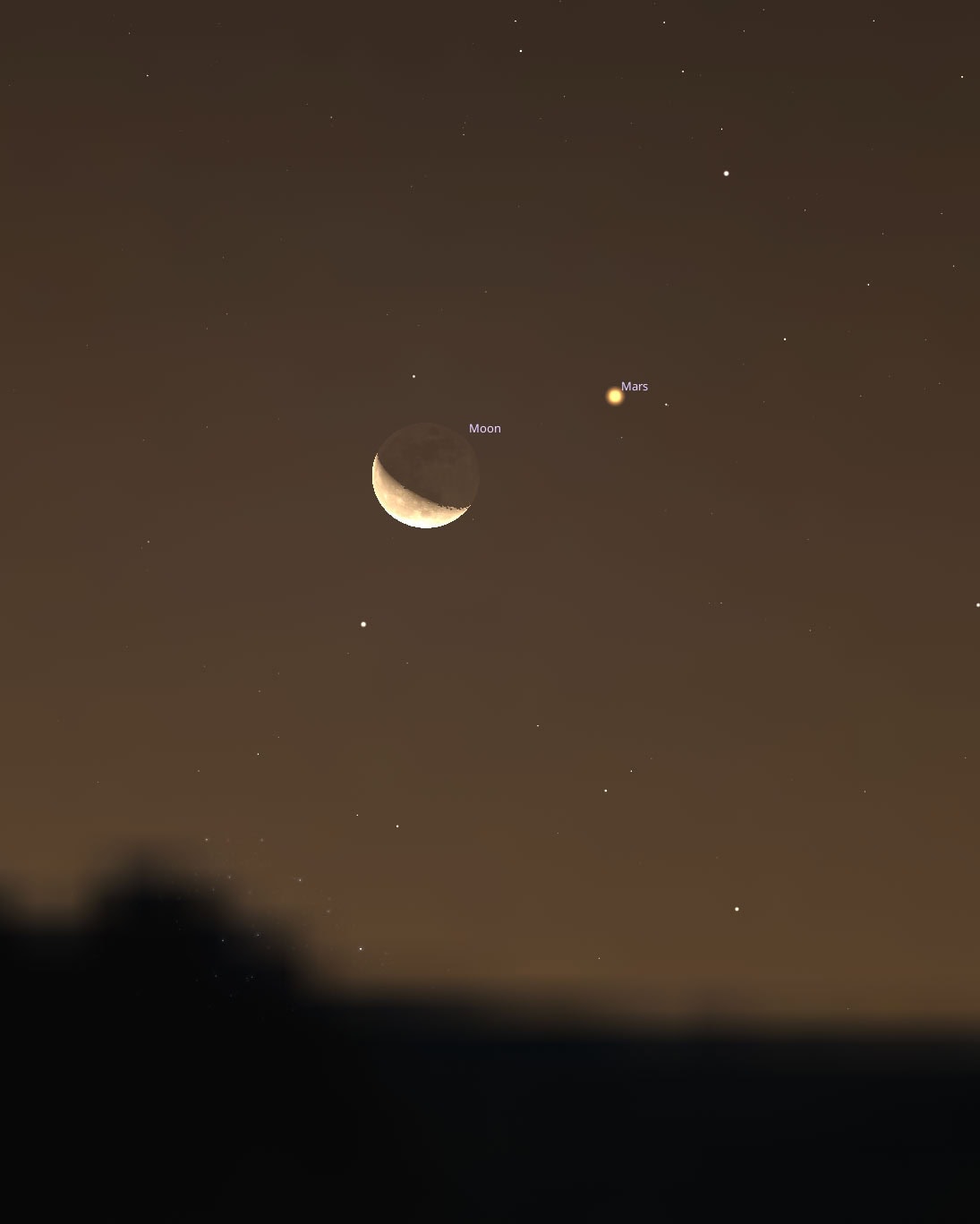
The waning crescent moon and planet Mars will appear close together in the sky on October 5th.
Why it’s special: The color contrast makes this pairing especially photogenic. The Moon’s cool gray tones next to Mars’ reddish hue create a striking visual that works beautifully. It’s also an easy event to see from suburban skies.
Viewing Tips
- Begin observing shortly after sunset once the sky darkens slightly.
- Look toward the western or southwestern sky (check exact altitude for your location).
- Capture during deep twilight for balanced sky color.
- If the Moon is a crescent, look for Earthshine on the darker portion.
Gear
- Naked eye for casual viewing.
- 50–200mm lens for tight framing.
- Tripod for stability.
- Optional tracking mount for longer twilight exposures.
Jupiter Occulted by the Moon – October 5–6
In the early morning hours of October 6, 2026 (late night October 5 for some locations), the waning crescent Moon will pass directly in front of Jupiter, briefly hiding the gas giant from view.
This rare alignment (known as a lunar occultation) is far more dramatic than a simple conjunction. Instead of merely appearing close together, Jupiter will actually disappear behind the Moon’s bright limb and then reappear minutes later from the dark edge.
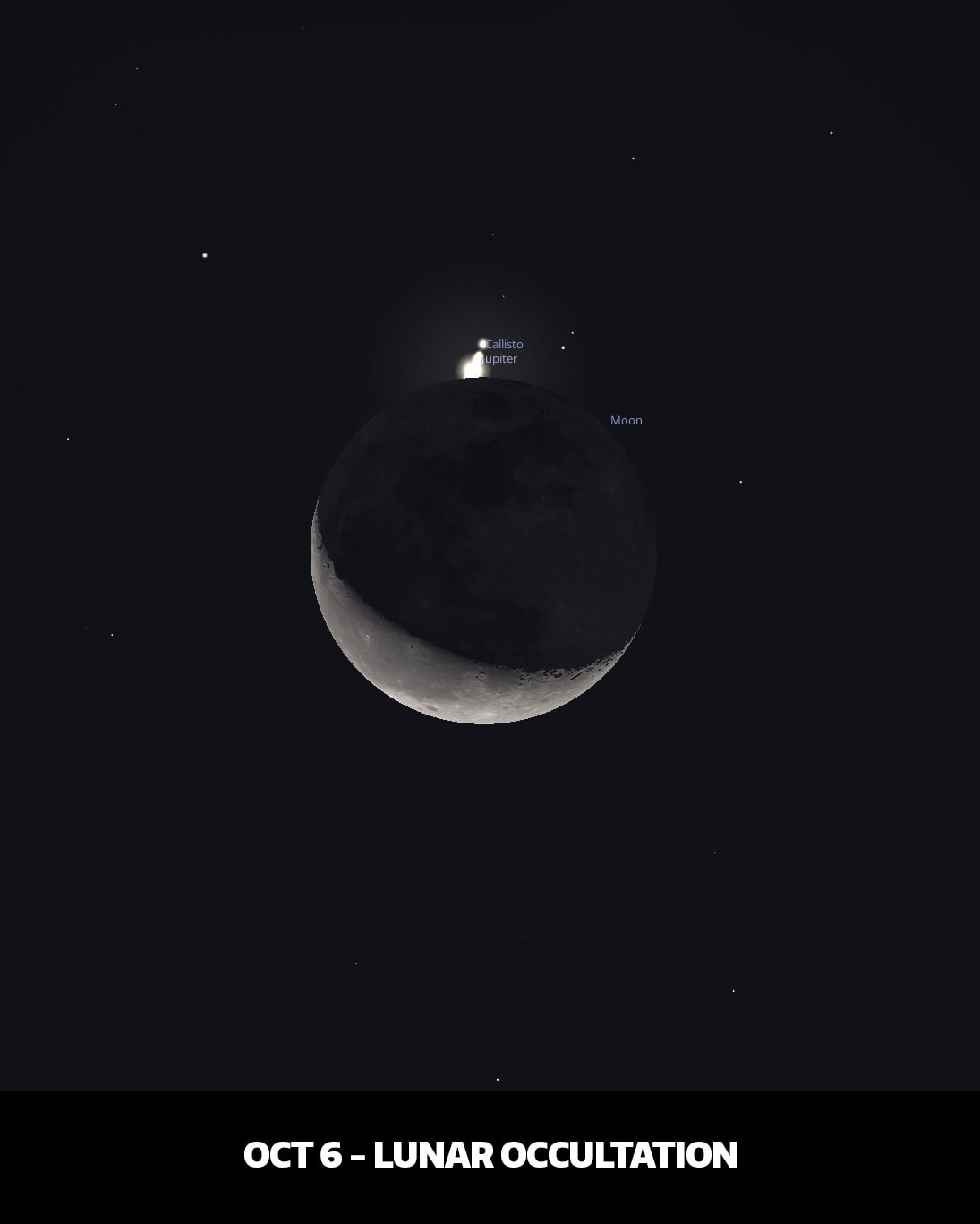
The view of the lunar occultation of Jupiter behind the moon from my location (Ontario, Canada). Graphic created with Stellarium.
Through a small telescope, the effect is striking. Jupiter vanishes almost instantly at the lunar limb, and its reappearance can feel just as sudden.
Because the Moon will be a thin crescent, the contrast between the bright and dark limbs should make the emergence especially photogenic. A tracking mount and short video capture can produce a compelling sequence.
Keep in mind that this occultation is location-dependent. The full disappearance and reappearance will be visible primarily from Eastern and Central North America, much of the United States, and Canada.
Elsewhere, observers will see a close Moon–Jupiter pairing, but not a true occultation.
November: Jupiter Conjunctions
November focuses on bright planetary conjunctions in the early evening sky. These events are easy to observe, easy to photograph, and perfect for quick weeknight sessions.
Jupiter & Moon Conjunction: November 2
In mid-November, the Moon pairs up with Jupiter in a bright and highly noticeable conjunction. Because Jupiter is so luminous, this duo will stand out even before the sky becomes fully dark.
Depending on separation, binocular users may even catch Jupiter’s Galilean moons alongside the Moon in the same field of view.
Why it’s special: Jupiter is the brightest planet in the night sky after Venus, so when it appears beside the Moon, it naturally draws attention. This is one of the easiest conjunctions of the year to spot.
Viewing Tips
- Start observing during twilight for pleasing sky color.
- Use binoculars to reveal Jupiter’s four largest moons.
- Expose carefully if photographing, the Moon brightens quickly as darkness falls.
- Try including a foreground silhouette for scale.
Gear
- Binoculars (10×50 or larger).
- 85–200mm telephoto lens.Tripod.
- Remote shutter for vibration-free shots.
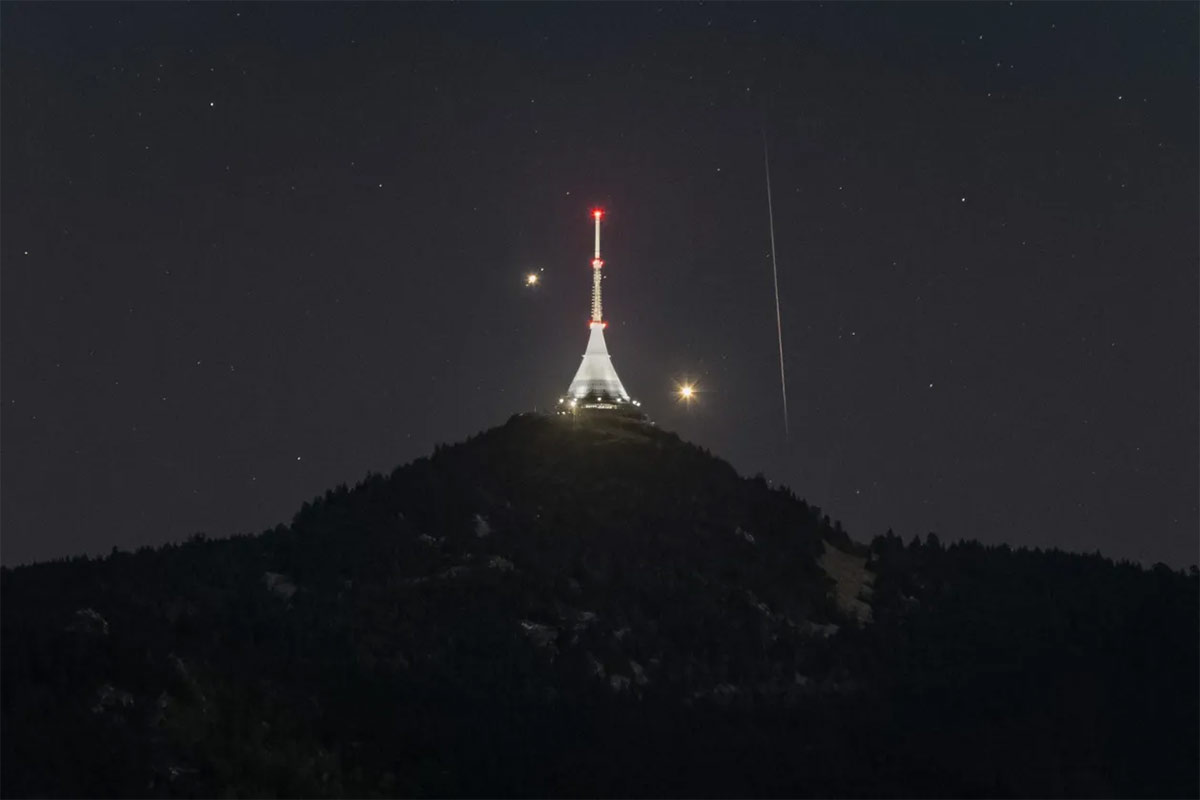
A conjunction of Venus and Jupiter behind Ještěd by Jakub K. Canon R6 Mark II & Canon 70–200 f/2.8 @ f/4, 200 mm (+ 1.6× in-camera crop). 1.6-second exposure.
Jupiter & Mars Conjunction: November 14–15
On the evening of November 14 into the predawn hours of November 15, Jupiter and Mars will appear unusually close in the sky, approaching within about 1° of each other. This pairing occurs in the early morning sky before sunrise and will be visible for several nights around the time of peak separation.
Why it’s special: Because Jupiter and Mars are both visible with the naked eye but differ in brightness and color, this conjunction creates an easy-to-see and photogenic event.
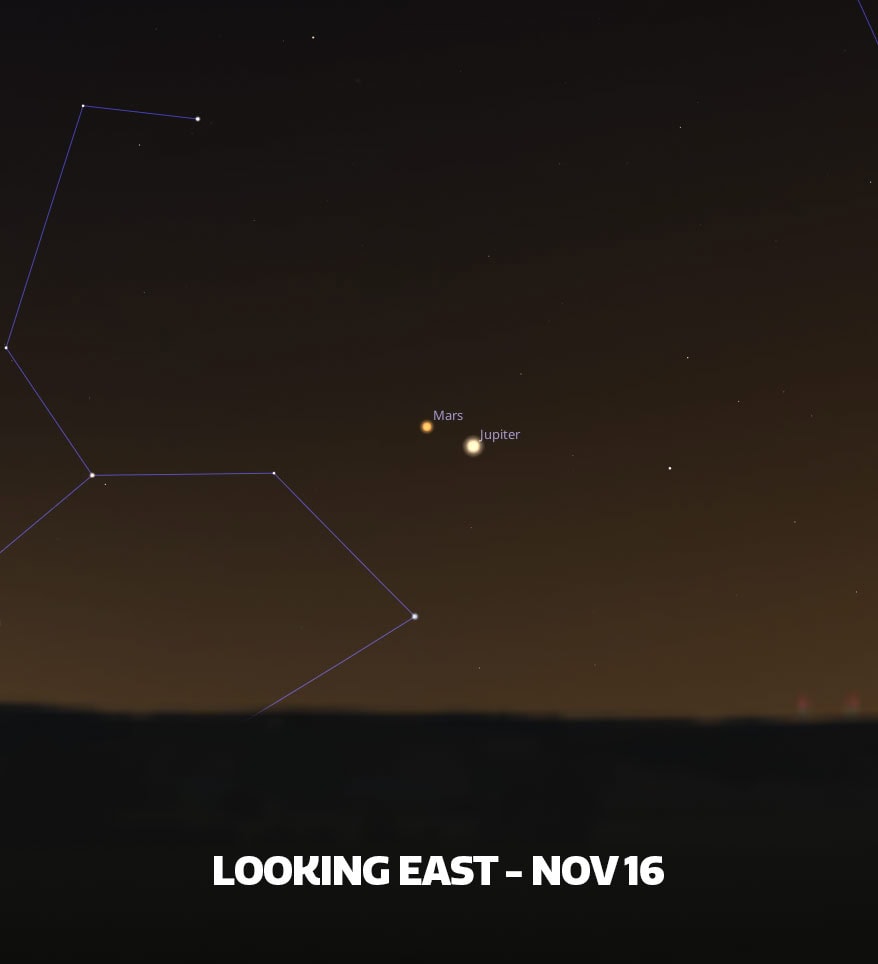
Mars and Jupiter will appear very close together in the night sky on November 15,16. This is the view just after midnight on Nov 16th on the eastern horizon.
Viewing Tips
- Use a planetarium app to confirm the exact positioning for your latitude.
- Watch over multiple mornings, and you’ll see the separation tighten and then widen.
- Try photographing during deep twilight for balanced color in the sky.
Gear
- Naked eye: Easily visible under clear skies.
- 10×50 binoculars: Enhance color contrast and help distinguish Mars’ tint.
- 85–200mm telephoto lens: Ideal for framing both planets together.
- Tripod: Essential for sharp twilight shots.
December: Geminids and a Christmas Supermoon
December closes out the year with one of the richest meteor showers on the calendar and a photogenic full Moon, a fitting finale to twelve months of celestial highlights.
Geminid Meteor Shower: Peak December 13–14
The Geminids are widely considered the most reliable meteor shower of the year. Peaking on the night of December 13 into the early hours of December 14, this shower can produce 100+ meteors per hour under dark skies.
Unlike most meteor showers that originate from comets, the Geminids come from asteroid 3200 Phaethon, making them somewhat unique.
Geminid meteors are typically bright, bold, and slightly slower-moving than Perseids, which makes them easier to follow visually and easier to photograph.
Why it’s special: The Geminids combine high meteor rates with frequent fireballs and steady activity over several nights. Because the radiant climbs high after midnight, viewing conditions can be excellent despite cold temperatures.
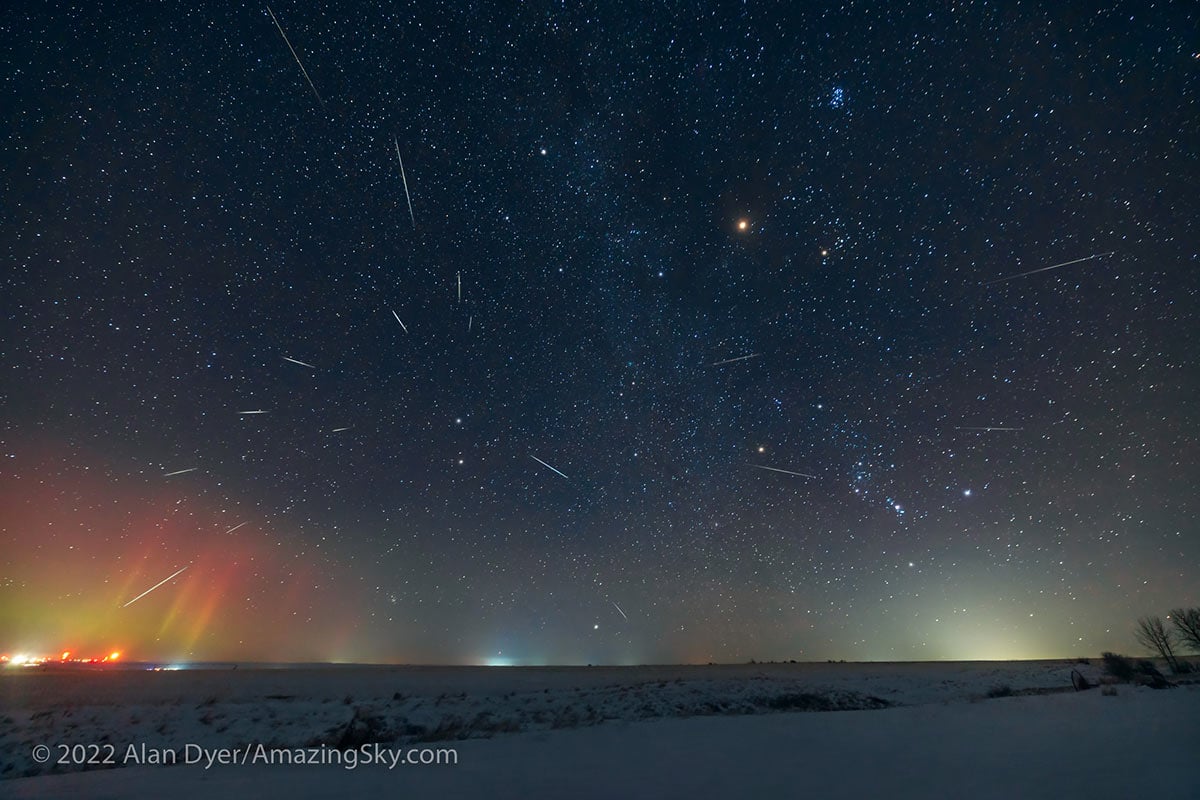
A composite photo of the Geminid Meteor Shower by Alan Dyer.
Viewing Tips
- Best viewing occurs after midnight, when Gemini is high in the sky.
- Look 45–60° away from the radiant for longer streaks.
- Dress in layers, as December can be very cold.
- Allow 20–30 minutes for full dark adaptation.
- Monitor the moon phase; the moonlight can reduce visible counts.
Gear
- Wide-angle lens (14–24mm, f/2.8 or faster): Ideal for capturing multiple meteors.
- ISO 1600–3200, 15–25 second exposures (adjust for sky brightness).
- Intervalometer: For continuous shooting.
- All-sky camera (optional): Maximizes sky coverage.
Recommended Astrophotography Lens: The Sigma 24mm F/1.4

An example of my histogram when capturing a wide-field starry sky scene with my Canon EOS R6 camera.
Christmas Supermoon: December 24
On December 24, the full Moon occurs near perigee, its closest approach to Earth, creating a Christmas Eve supermoon. While the size difference is subtle to the eye, the Moon will appear slightly larger and brighter than average.
Low winter air can make moonrise especially dramatic, with enhanced color as the Moon climbs through the atmosphere.
Why it’s special: A holiday supermoon creates a memorable skywatching moment and offers excellent opportunities for creative landscape astrophotography.
Viewing Tips
- Capture the Moon as it rises for the strongest “moon illusion” effect.
- Use foreground elements like trees, rooftops, church steeples, or holiday lights.
- Shoot during twilight for balanced sky color.
- Expose for the Moon’s surface to preserve detail (it’s brighter than you think).
- Try a time-sequence showing the Moon climbing through the sky.
Gear
- 200–400mm telephoto lens for tight lunar framing.
- Tripod for sharp images.
- Remote shutter or intervalometer to reduce vibration.
- Full-frame camera (optional): For improved dynamic range and color depth.
Related Article: How to Photograph the Moon (With Any Camera)

The full moon in the night sky. HDR composite photo for effect.
Astrophotography Gear Guide for 2026 Events
To make the most of these events, here’s a concise gear breakdown tailored for skywatching and imaging:
Widefield & Meteor Showers
- Camera: Full-frame mirrorless or DSLR.
- Lens: 14–35 mm fast lens.
- Mount: Portable star tracker.
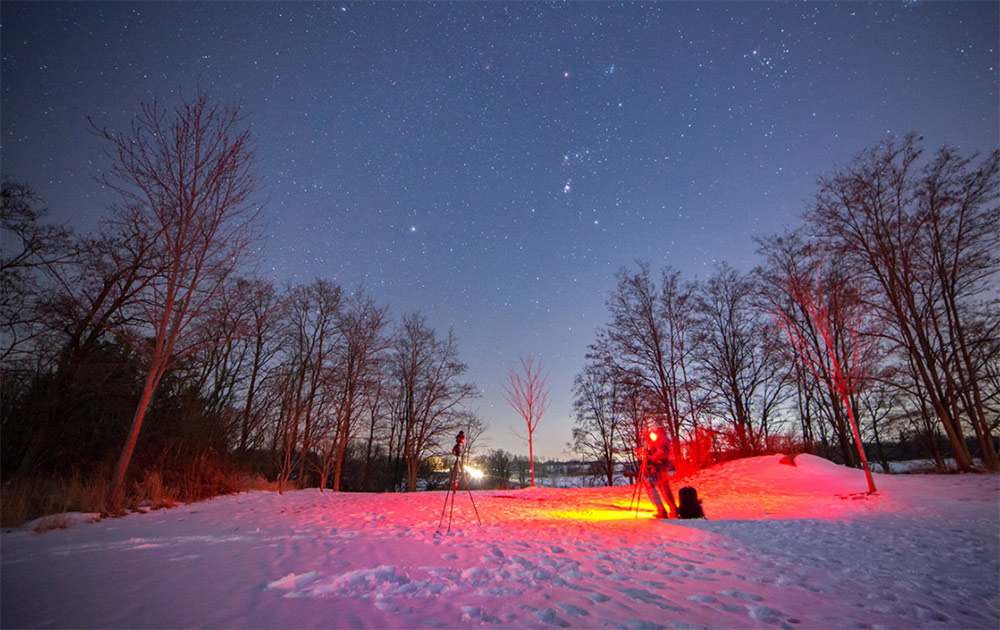
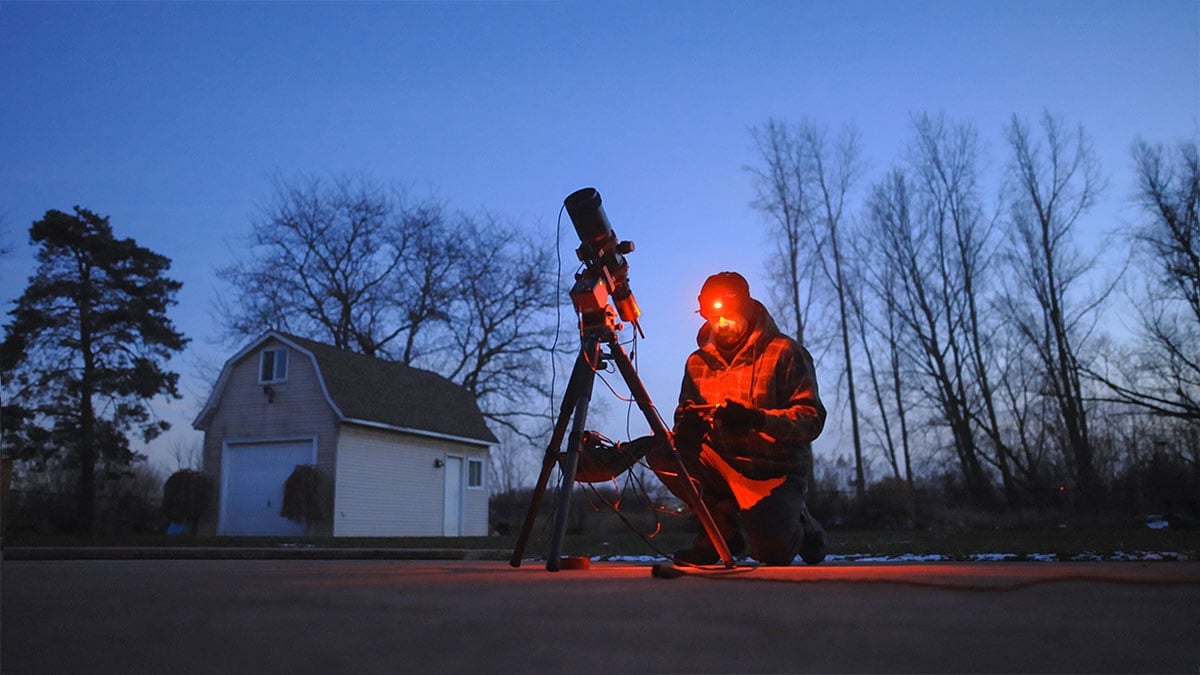
- Accessories: Intervalometer, headlamp with red light.

A star tracker and an interchangeable lens camera are the way to go for nightscapes and meteor shower photography.
Planetary Imaging
- Camera: Dedicated planetary camera (e.g., ASI series).
- Telescope: Long-focal refractor or SCT with barlow.
- Mount: Stable equatorial mount with tracking.
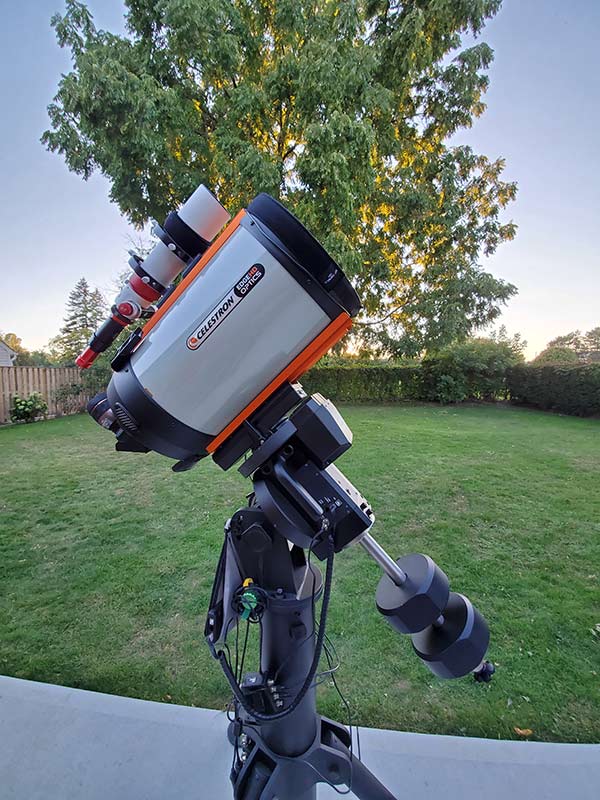
One of my solar system photography astrophotography rigs, featuring the Celestron EWdge HD 11 SCT.
Eclipses & Solar Observing
- Solar filters: Certified film/glass.
- Solar telescope: H-alpha for chromospheric detail.
- Widefield DSLR setup: for composite eclipse sequences.
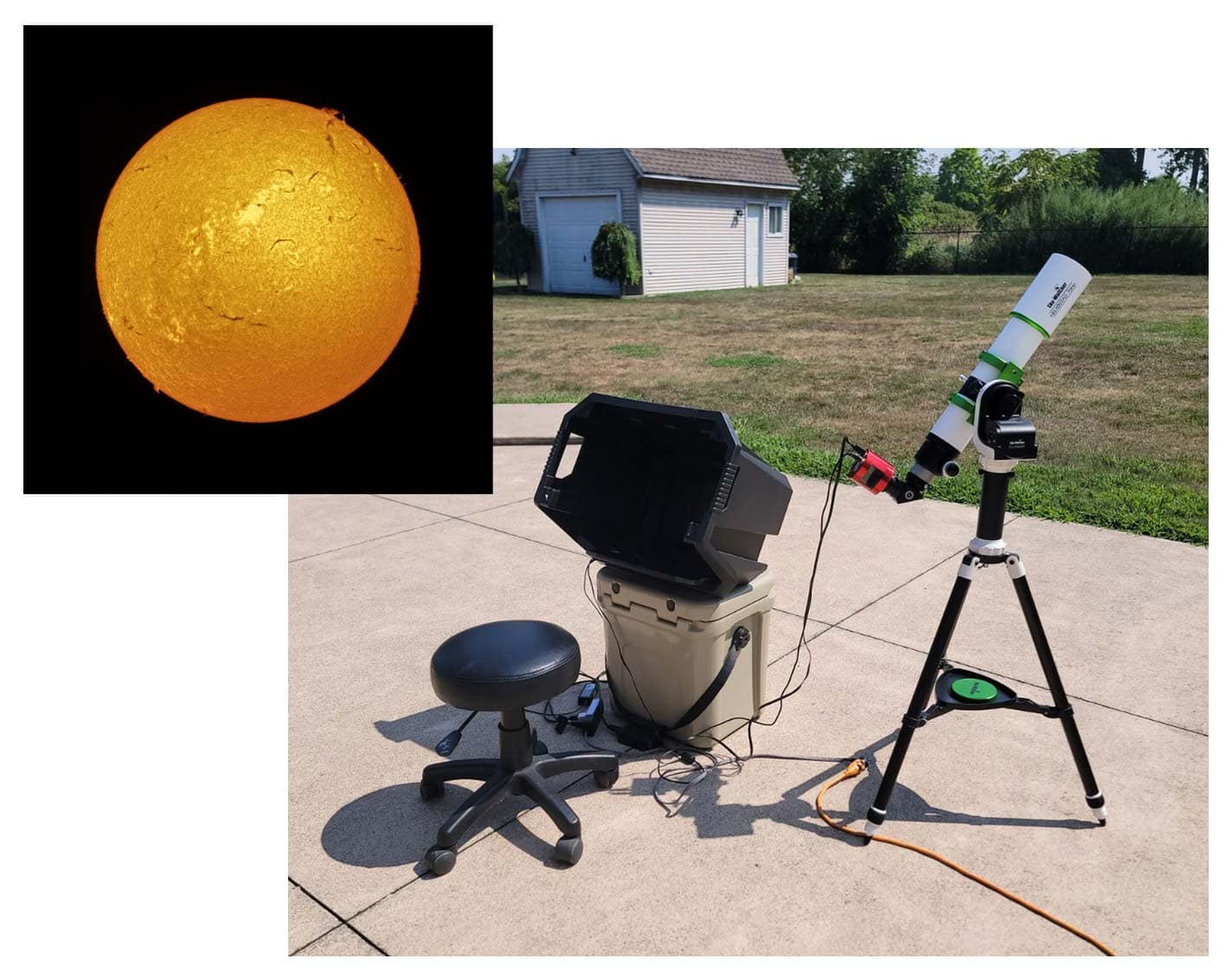
A specialized solar telescope like the Sky-Watcher Heliostar 76 allows you to view and photograph the suns surface in detail.
Deep-Sky Imaging (Seasonal)
- Telescope: APO refractor or astrograph.
- Camera: Cooled astrophotography camera.
- Guiding: Off-axis guider with autoguider (or separate guide scope)
Final Tips for a Stellar 2026
If you are new to astronomy, seeing all of these upcoming celestial events likely gets you very excited to get out and view and photograph them. A lot of these events will be ‘firsts’ for you, and that is very special because you will never forget them.
For example, Ashley and I witnessed our very first total solar eclipse in April 2024, and it was a life-changing moment for us (seriously, solar eclipses are absolutely incredible). The great thing about astronomy is that there is always something new to explore, and you will never get tired of witnessing these awe-inspiring events.
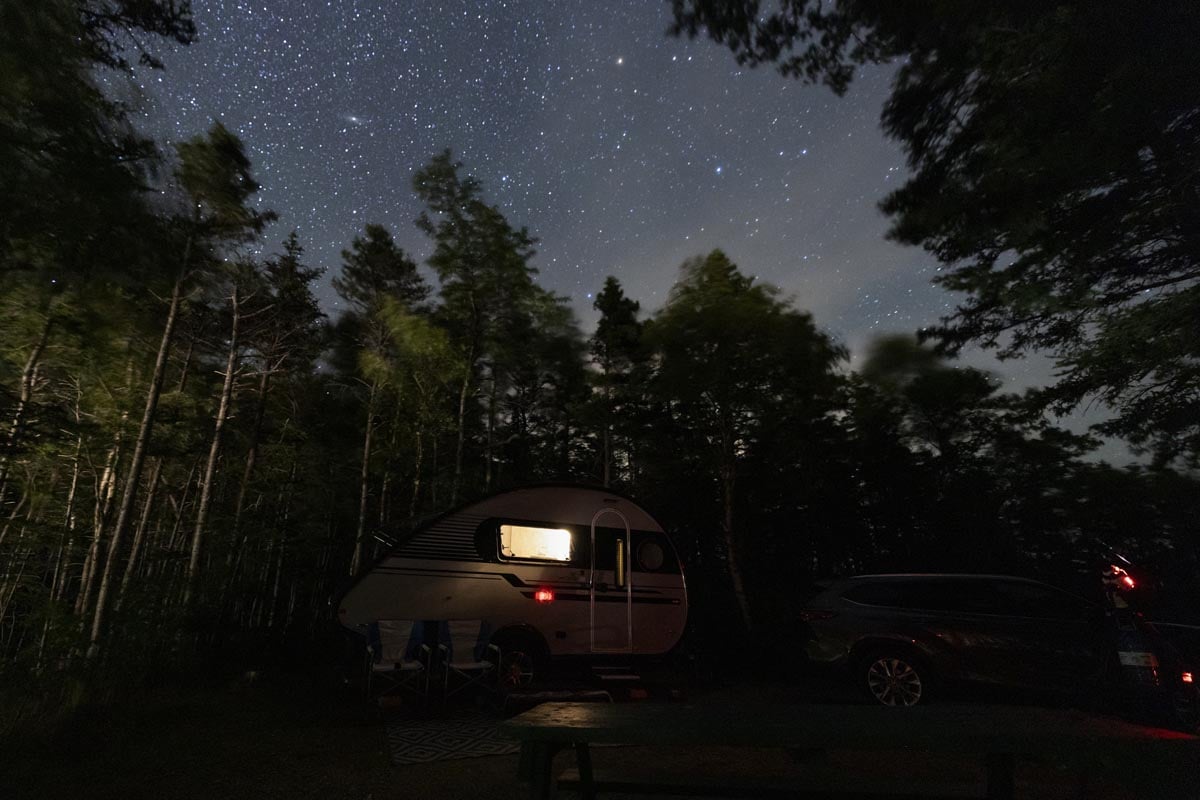
Ashley and camp under the stars every chance we get during the summer.
This year, I prepared a loose ‘bucket list’ of celestial events I want to photograph. For example, I want to capture a beautiful photo of the harvest moon over a farmer’s field using my latest photography gear, and finally capture a true meteor shower composite image with several meteors streaking across the sky.
- Plan ahead: Mark all dates on your calendar and check local visibility.
- Scout locations: Dark skies and clear horizons are game-changers.
- Practice skills early: Use quieter months to perfect polar alignment, focusing, and guiding.
- Join communities: Real-time updates on comets and rare events often come from amateur networks.
- Stay safe: Never look at the Sun without a proper solar filter.
If you’re prepared (and a little bit lucky, weather-wise), 2026 should be a rewarding year for both visual observers and astrophotographers. I wish you the best of luck in your upcoming observing and photography projects.

Trevor Jones is an astrophotographer and a valued member of the RASC. His passion is inspiring others to start their astrophotography journey on YouTube so they can enjoy the night sky as much as he does. His images can be seen in astronomy books & online publications, including the NASA Astronomy Picture of the Day.

thanks for all the info!! I just bought my first scope a few weeks ago…. and been enjoying it ever sense