
ZWO AM7 Review: Impressive Power Without a Counterweight

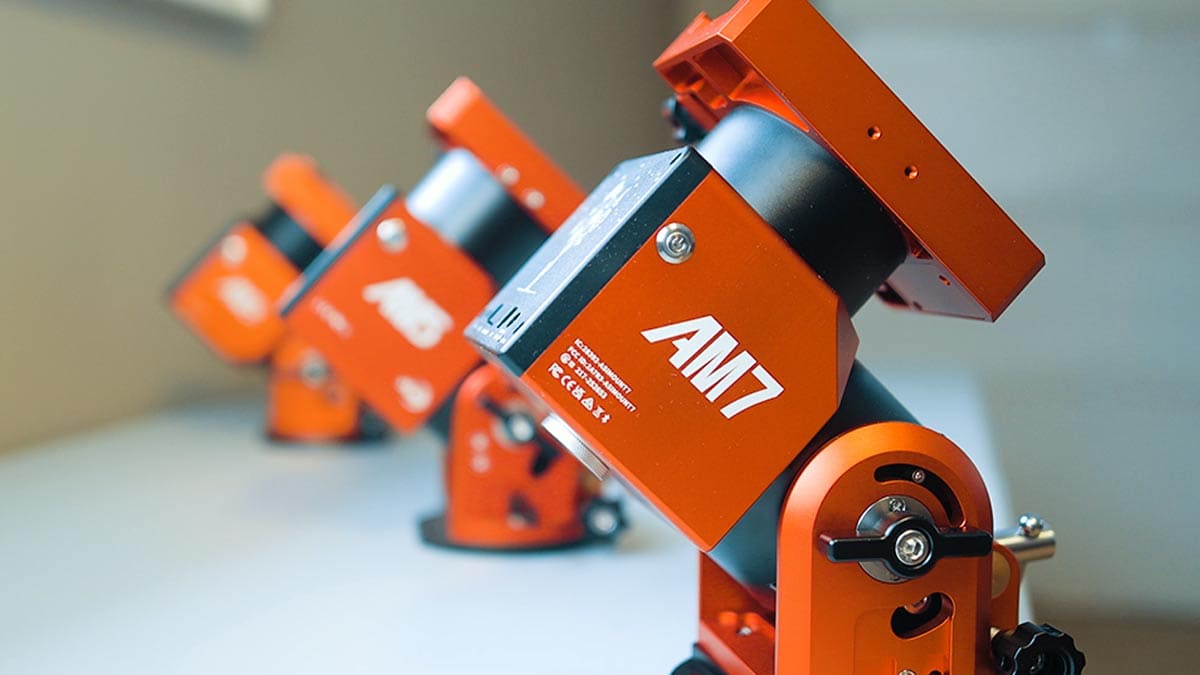
The ZWO AM7 is the largest and most capable harmonic drive mount in the AM lineup. It’s designed for astrophotographers running heavier telescopes who still want the convenience and portability these compact red mounts are known for.
If you’ve been pushing the limits of the AM5, or simply want more room to grow without jumping to a massive traditional equatorial mount, the AM7 occupies a very interesting middle ground. It promises serious payload capacity in a surprisingly compact package.
After extensive backyard use in real-world conditions, including testing it with both realistic imaging rigs and heavier optical systems, here’s how the ZWO AM7 performs, who it’s really for, and where it fits in today’s competitive mount landscape.
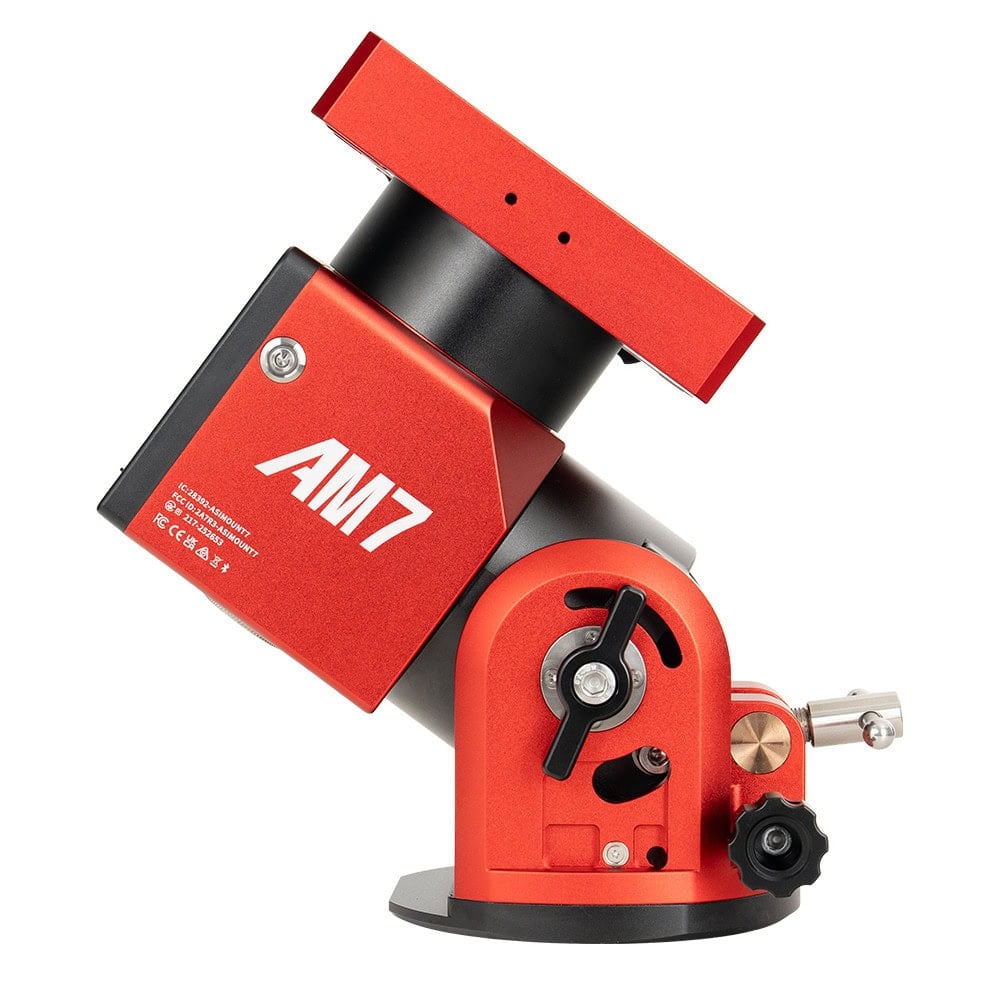
What Is the ZWO AM7?
At its core, the AM7 is built around the same harmonic drive architecture that made the AM3 and AM5 so popular, just scaled for heavier payloads.
Instead of using a traditional worm gear, the AM7 relies on a strain-wave (harmonic) gear system. Harmonic drives are known for delivering high torque in a very compact package, which is what allows this mount to carry substantial weight without requiring a large, bulky mount head or heavy counterweights.
That compact efficiency is part of the appeal. You get serious lifting capability in something that still feels manageable to transport and set up.
In addition to the harmonic gear, the AM7 uses a synchronous belt system with a 300:1 reduction ratio. This helps smooth out motion and allows for extremely fine tracking adjustments. For long-exposure astrophotography, that precision matters.
Smooth, predictable motion is what ultimately produces round stars and consistent guiding performance.
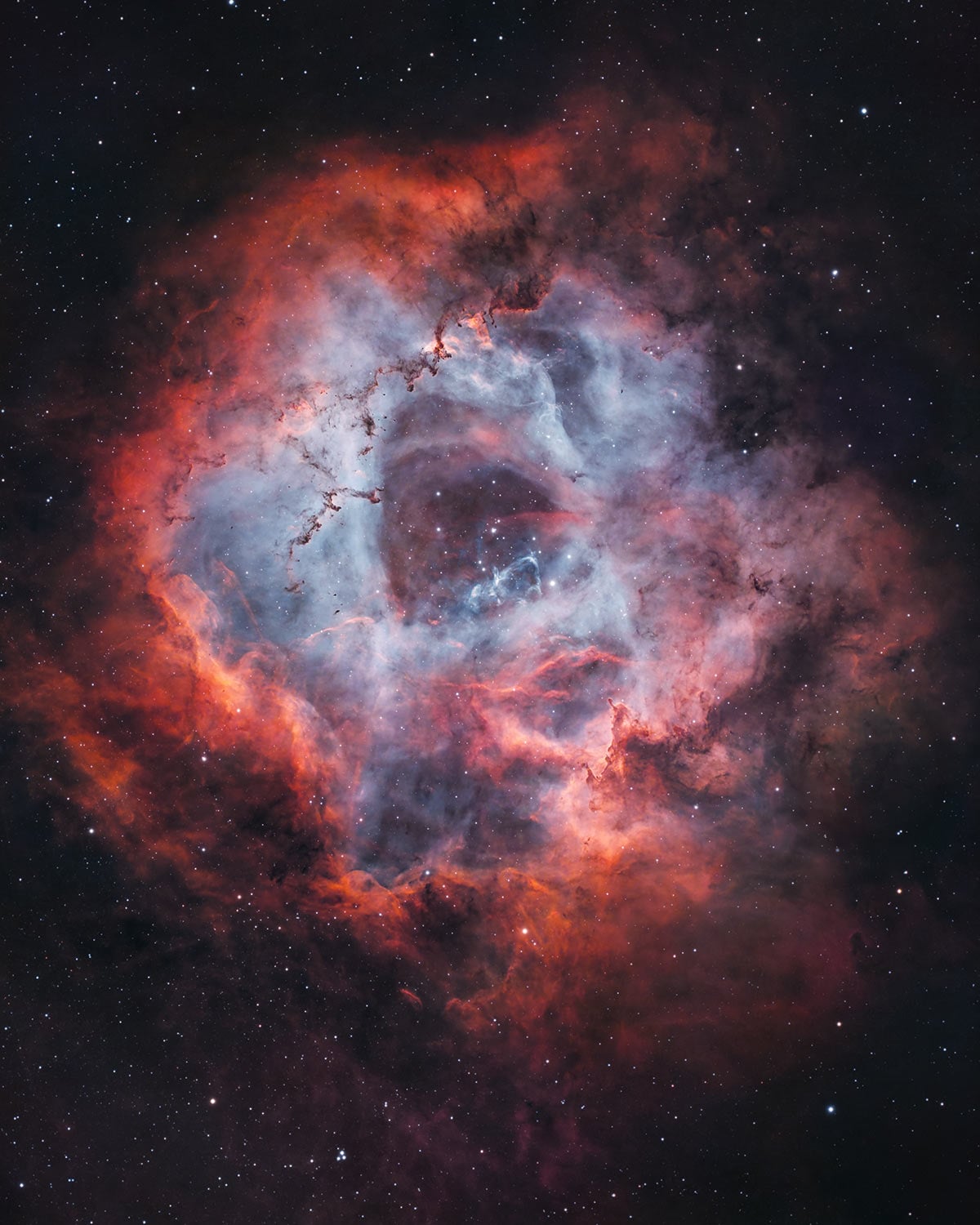
The Rosette Nebula. 5.5 Hours Total Exposure (ZWO AM7 + William Optics UltraCat 108)
Equatorial & Alt-Az Modes
The AM7 can operate in both equatorial and alt-azimuth modes. In equatorial mode, it tracks the rotation of the Earth on a single axis, which is essential for long-exposure deep-sky astrophotography. This is the configuration most imagers will use, and it’s where the mount truly shines.
It can also be configured in alt-az mode, where it behaves more like a traditional Go-To visual mount. In this setup, it’s perfectly usable for outreach events or casual observing sessions when long-exposure tracking isn’t required.
Realistically, most people buying the AM7 are doing so for astrophotography. But having the flexibility to switch modes adds versatility, especially if you occasionally want to use the same mount for visual work.
ZWO AM7 Specs
- Mount Type: Harmonic drive (strain wave)
- Mount Head Weight: 15 lbs (6.8 kg)
- Payload (No Counterweight): 44 lbs (20 kg)
- Payload (With Counterweight): 66 lbs (30 kg)
- Operating Modes: Equatorial / Alt-Az
- Drive System: Harmonic gear + synchronous belt (300:1 reduction)
- Connectivity: USB-C, DC outputs, WiFi (via ASIAIR ecosystem)
- RA Brake: Yes
- DEC Brake: No
- Polar Alignment: Manual Alt/Az adjustment (rotating center base)
- Typical Use: Guided astrophotography
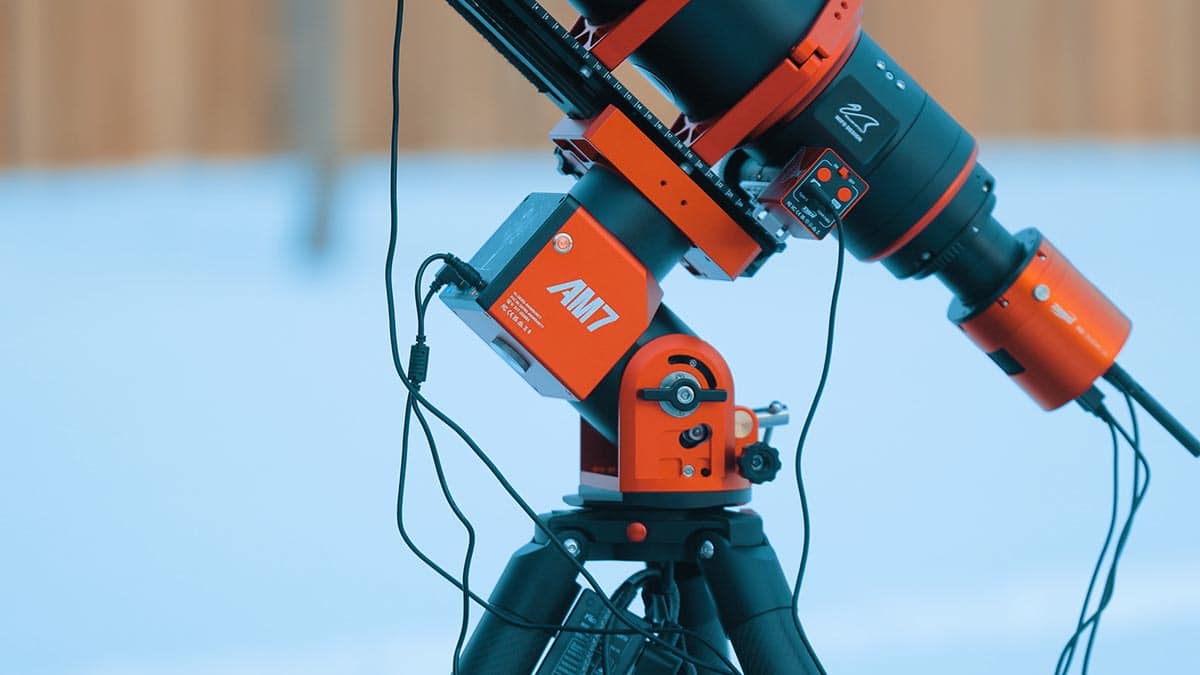
The AM7 mount head weighs only 3 pounds more than the AM5. It is hard to notice the difference in overall size.
Payload Capacity & Why It Matters
This is really the headline feature of the AM7: payload capacity.
The mount head itself weighs just about 15 pounds, which is impressively light considering what it can carry. Without using a counterweight, the AM7 is rated for 44 pounds of payload. Add a counterweight, and that number jumps to 66 pounds.
That’s a serious jump in capability. For context, heavier refractors, such as a 5″–6″ class scope or a mid-sized SCT, can run comfortably without a counterweight. Even imaging systems pushing 30+ pounds feel well within the mount’s comfort zone.
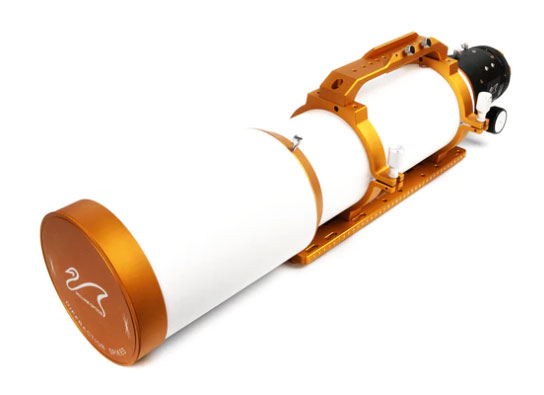
Why Over-Mounting Is Smart
If there’s one piece of advice that consistently proves true in astrophotography, it’s this: If you can afford to over-mount, do it.
Imaging trains grow. Accessories add up. Telescopes get upgraded. What feels like “plenty of mount” today can feel undersized two years from now.
The AM7 gives you breathing room without stepping into observatory-class territory. That extra 11 pounds of counterweight-free capacity isn’t just a number; it’s flexibility.
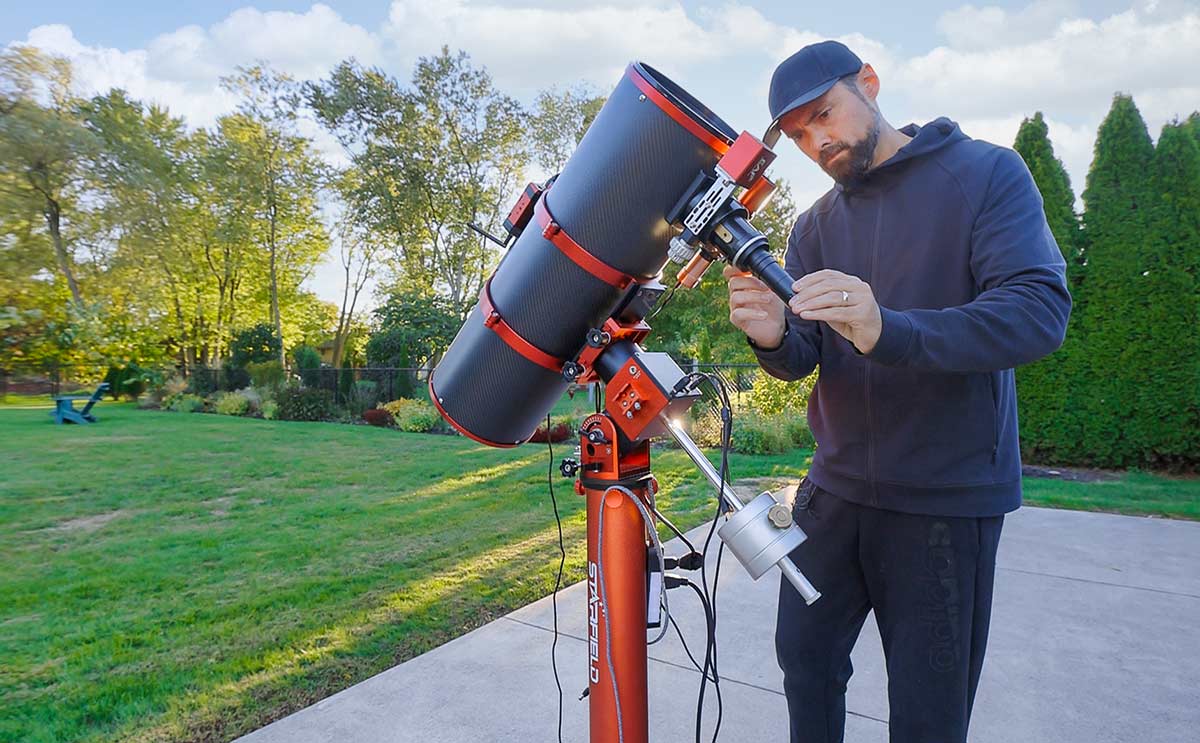
I can now comfortably run my Apertura Carbonstar 200 telescope & all accessories without a counterweight on the AM7 (AM5 pictured).
Real-World Heavy Load Testing
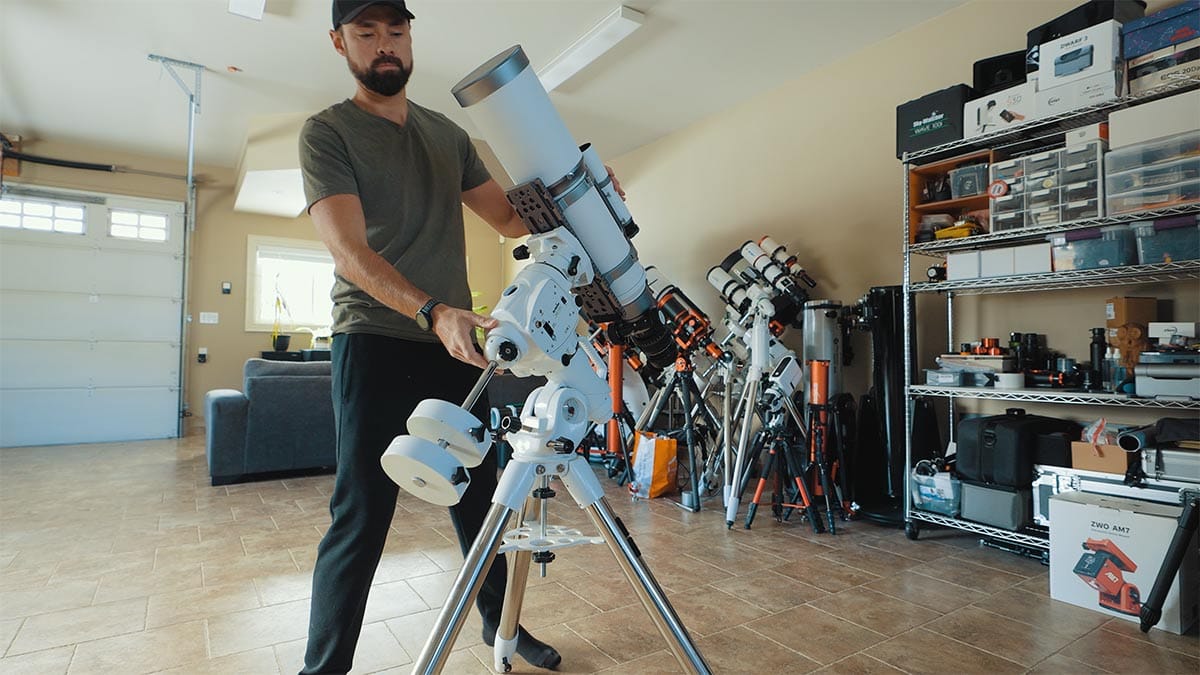
To better understand the AM7’s upper limits, I tested it indoors with significantly heavier telescope loads, including scopes like the Sky-Watcher Esprit 150mm and the Celestron EdgeHD 11. The mount handled them without issue.
That said, seeing a large, heavy telescope perched on a compact mount head is enough to make you instinctively double-check everything. It’s impressive, but it’s also a reminder: Just because a mount can handle a certain weight doesn’t mean you should live at the edge of the spec sheet.
Running comfortably below maximum capacity usually means better stability, smoother guiding, and more peace of mind.
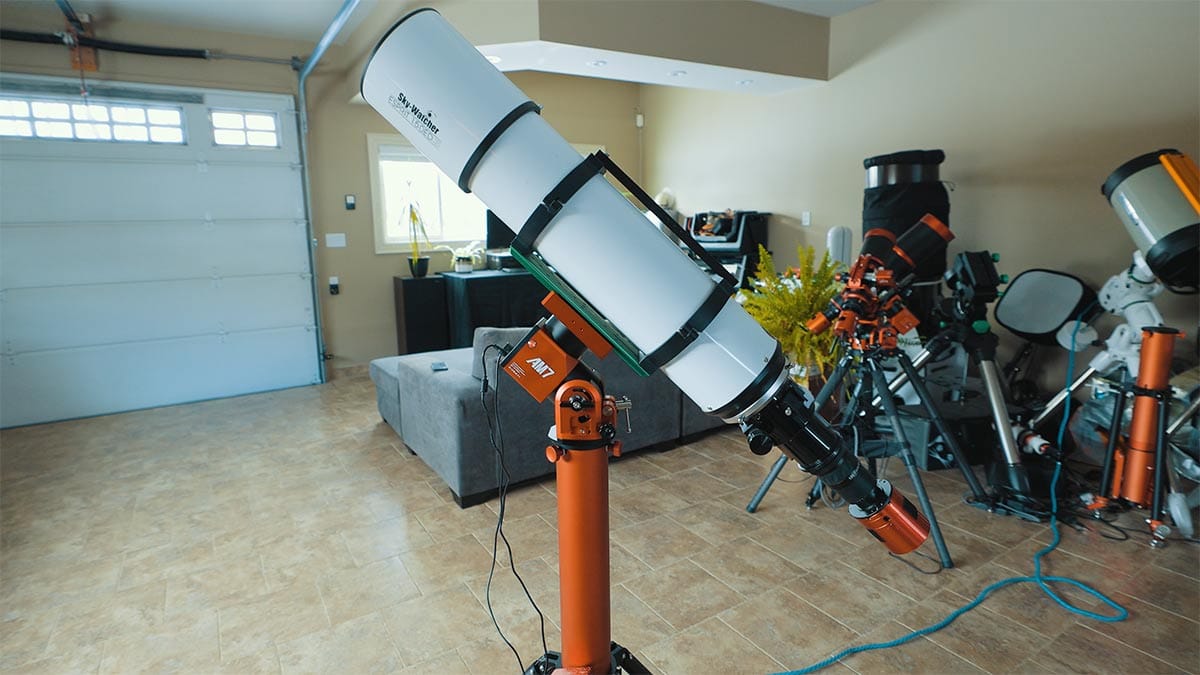
We tested the jumbo-sized Sky-Watcher Esprit 150 refractor (32 pounds) in the garage. While a little scary, the AM7 had no trouble with it.
Real-World Imaging Performance
In practical use, the AM7 performs exactly how you would expect from the ZWO lineup: stable, predictable, and easy to manage.
Setup is straightforward, slews are smooth, and once guiding is calibrated, the mount simply does its job in the background.
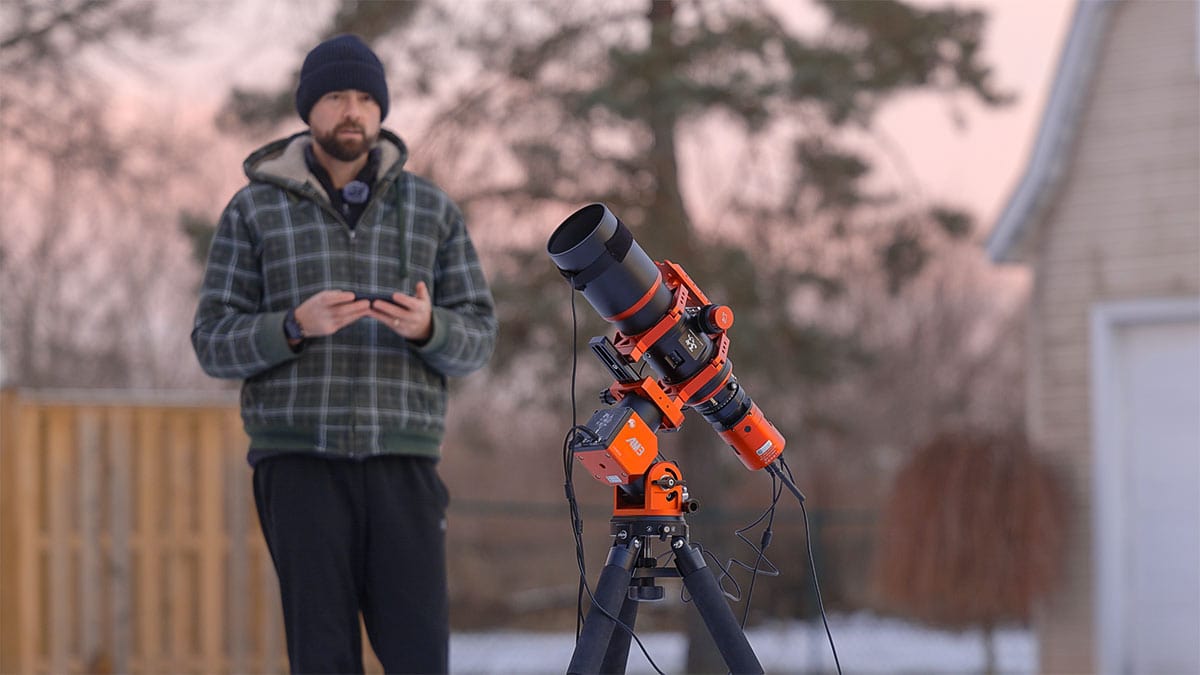
With a mid-weight imaging setup around 20 lbs at roughly 500mm focal length, five-minute exposures produced consistent, sharp stars across the frame. Total RMS guiding hovered around 0.7–0.8 arcseconds, more than sufficient for this focal length and well within the range needed for clean, round stars.
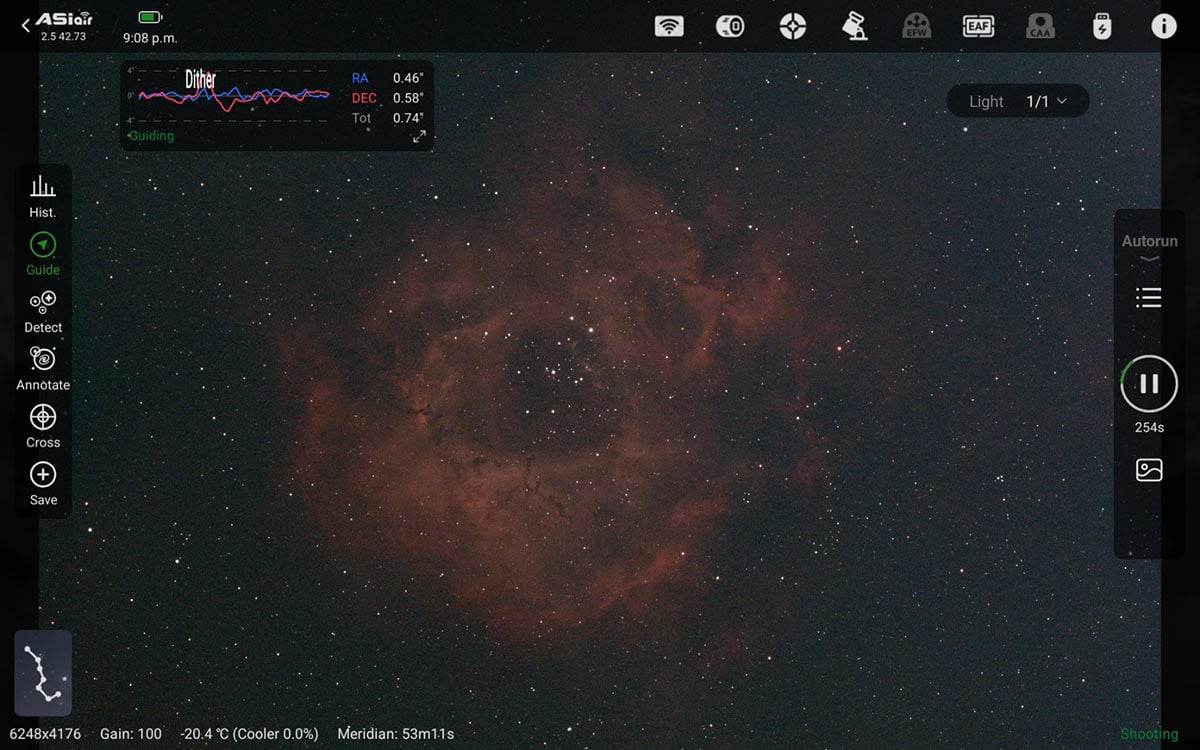
More importantly, it felt effortless. The mount never gave the impression that it was working hard or operating near its limits. That kind of margin makes a difference, especially during longer sessions or when conditions aren’t perfect.
At longer focal lengths and heavier payloads, guiding accuracy becomes even more critical. That’s where the extra headroom of the AM7 starts to show its value.
Imaging Set Up
For context, here’s the exact type of setup used to evaluate the AM7’s performance when imaging:
- Mount: ZWO AM7
- Telescope: William Optics UltraCat 108
- Focal Length: 518mm
- Total Imaging Weight: 20 lbs (including camera and accessories)
- Camera: ZWO ASI2600MC Air
- Control System: ASIAIR
- Exposure Length: 5-minute sub-exposures
- Guiding: Standard autoguiding via ASIAIR
This isn’t the absolute maximum payload the AM7 can handle, but it’s a realistic mid-weight astrophotography setup. The key takeaway is that the mount handled this configuration effortlessly, with guiding performance in the 0.7–0.8 arcsecond RMS range and consistently round stars.
When evaluating any mount, it’s important to look at the total imaging weight, not just the telescope: cameras, filter wheels, focusers, and rotators all add up quickly. The AM7 never felt stressed with this fully loaded configuration.
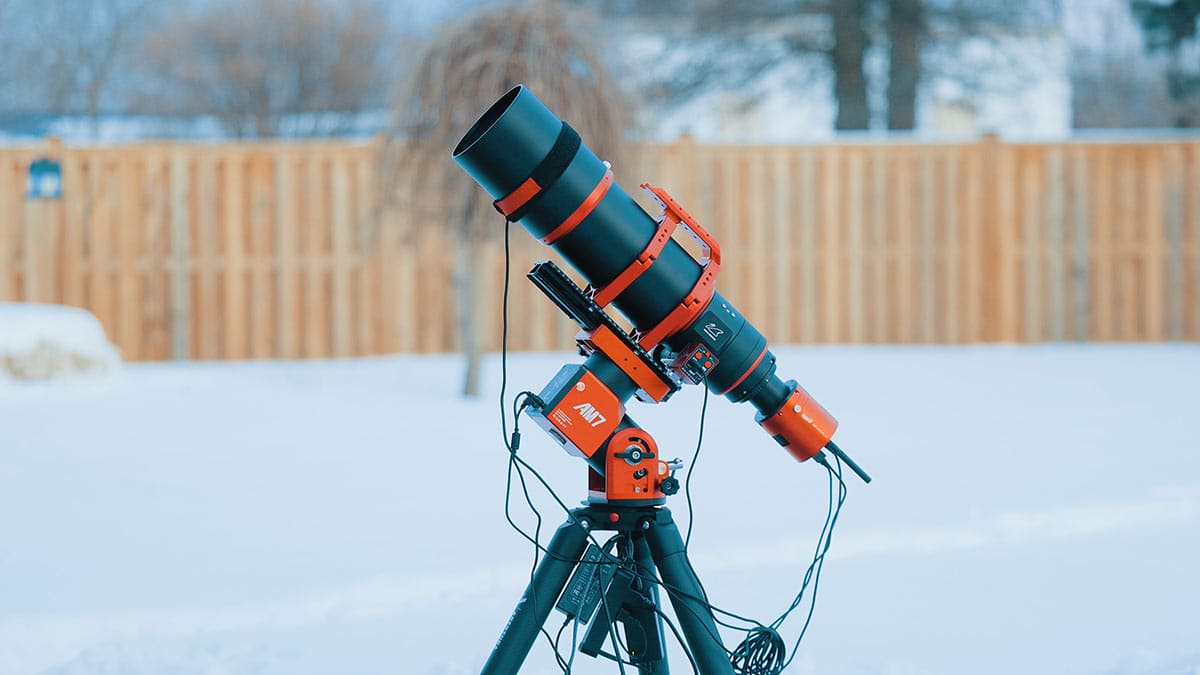
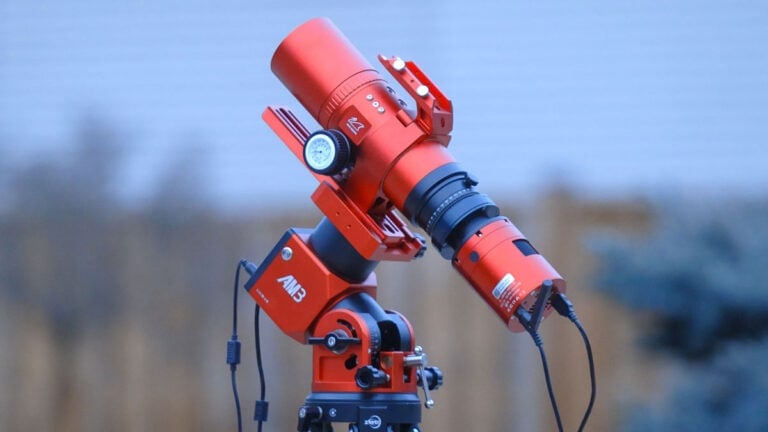
The overall profile and weight of a setup featuring the AM7 is minimal. I can easily carry the full-assembled rig in and out of the garage.
ASIAIR Integration & Automation
For those running an ASIAIR + AM mount setup, this combination continues to shine.
- Autofocus routines run smoothly
- Meridian flips are handled automatically
- Full imaging sessions can be managed remotely
- Target acquisition and plate solving are seamless
Once everything is dialed in, the workflow becomes very streamlined. You can start a session, monitor guiding, refocus as temperatures shift, and let the system run.
One of the underrated benefits of harmonic drive mounts is how little you think about autoguiding. That simplicity becomes even more valuable when you’re imaging in colder conditions (It was -20C° for much of my testing) or running the system unattended.
Rear Ports & Cable Management
The AM7 includes rear-mounted USB-C ports and DC power outputs, which can make a noticeable difference when it comes to cable management.
Powering accessories directly from the mount reduces the number of cables hanging off the telescope and running down toward the tripod or pier. Running the camera power back through the saddle creates a cleaner, more direct path and reduces the risk of cable snag during slews or meridian flips.
Having integrated power outputs built into the mount makes it much easier to create a tidy, reliable imaging setup that you can feel comfortable leaving unattended.
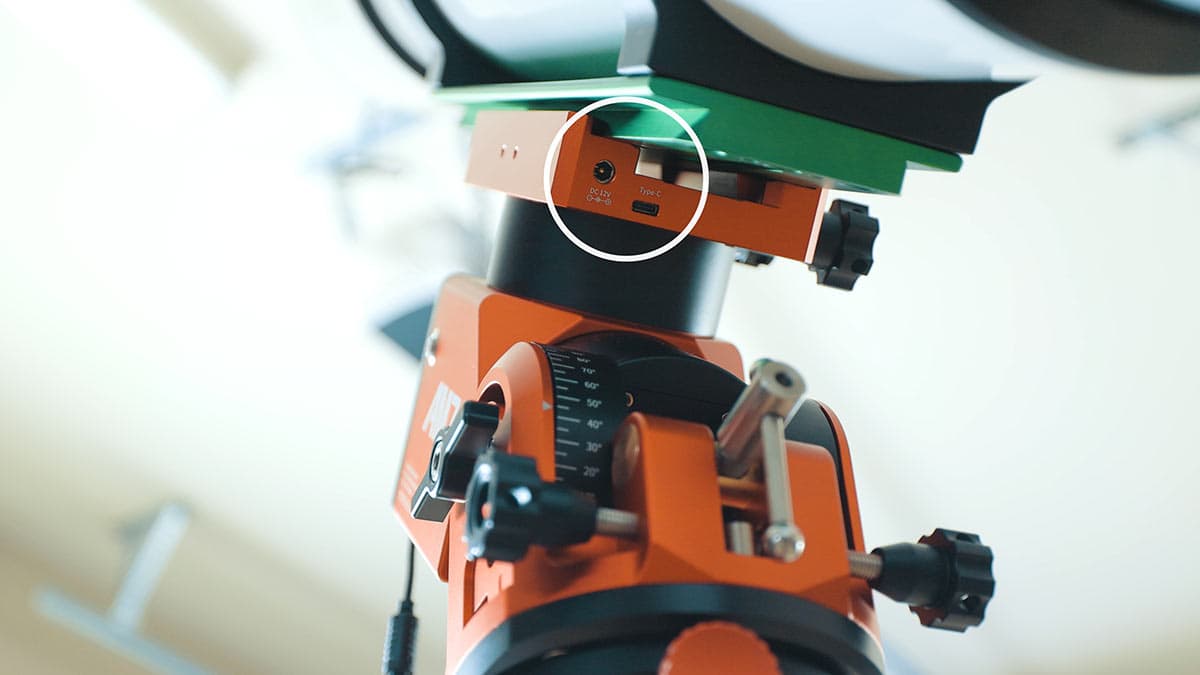
There are power ports on the rear of the saddle for better cable management.
The Joystick
The ZWO AM7’s Smart Hand Controller features a responsive joystick for precise manual slewing and intuitive local control without a mobile device.
It also acts as a built-in Wi-Fi hub for wireless operation and enables direct firmware updates, keeping the mount current without requiring a separate computer connection.
While it is a neat option, I must admit, I’ve never used the joystick to control the ZWO AM7, not even once!
Mechanical Features & Safety
As you move into heavier payload territory, mechanical design starts to matter a lot more. The AM7 includes several features that become especially important at higher loads.
Mechanical Zero Position
The mount includes a mechanical zero (home) position, which allows it to reliably return to a known starting orientation.
This might sound minor, but when you’re running automated sessions, especially unattended ones, consistent homing adds confidence. If you power down, reset, or restart a session, the mount knows exactly where it is supposed to be.
That consistency becomes more important as your system gets heavier and more complex.
RA-Axis Brake
One of the most meaningful upgrades over the AM5 is the inclusion of an RA-axis brake.
If power is lost unexpectedly, the RA brake prevents the telescope from suddenly swinging under its own weight. With heavier optical systems, that protection matters.
Is it something you plan on using? Hopefully not. But when you’re dealing with expensive cameras, filter wheels, and large refractors, it’s reassuring to know there’s a mechanical safeguard in place.
No DEC Brake, Balance Still Matters
There is no brake on the declination axis, which means proper balance is still essential, especially with heavier scopes.
Harmonic drive mounts can “hold” position surprisingly well, even unpowered. But that doesn’t replace good balance.
As your payload increases:
- Small imbalances create more leverage
- Strain on the system increases
- Safety margins shrink
Take the time to balance carefully. With heavier systems, this isn’t optional – it’s part of protecting your equipment and ensuring smooth tracking.
Important Reminder
After completing polar alignment, always lock down the Alt/Az bolts.
It’s an easy step to overlook, especially when you’re excited to start imaging, but those bolts secure your alignment. If they’re left loose, even slight movement can throw things off during slews or meridian flips.
With heavier systems, everything benefits from being snug, secure, and intentional. When you start pushing into larger payloads, mechanical details stop being “nice features” and start becoming part of a responsible setup.
Tripod & Pier Options
When you’re mounting a heavier refractor or SCT, you’re dealing with thousands of dollars in optics, cameras, and accessories. A solid foundation isn’t optional; it’s part of protecting that investment.
Tripods
Both the ZWO TC-40 and the Apertura Heavy Duty Carbon Fiber Tripod are rated around 110 pounds.
On paper, that rating may look similar, but heavier-duty carbon fiber tripods typically feature wider, thicker legs, a broader stance, mid-level spreader trays, and increased overall rigidity.
That extra stability becomes more noticeable as your system gets heavier. The mount feels more planted, vibrations dampen faster, and you’re less likely to question whether the tripod is contributing to small guiding inconsistencies.
If you’re running the AM7 anywhere near its upper payload range, this is not the place to cut corners. Even if the mount can technically handle the weight, your tripod should never feel like the weak link in the system.
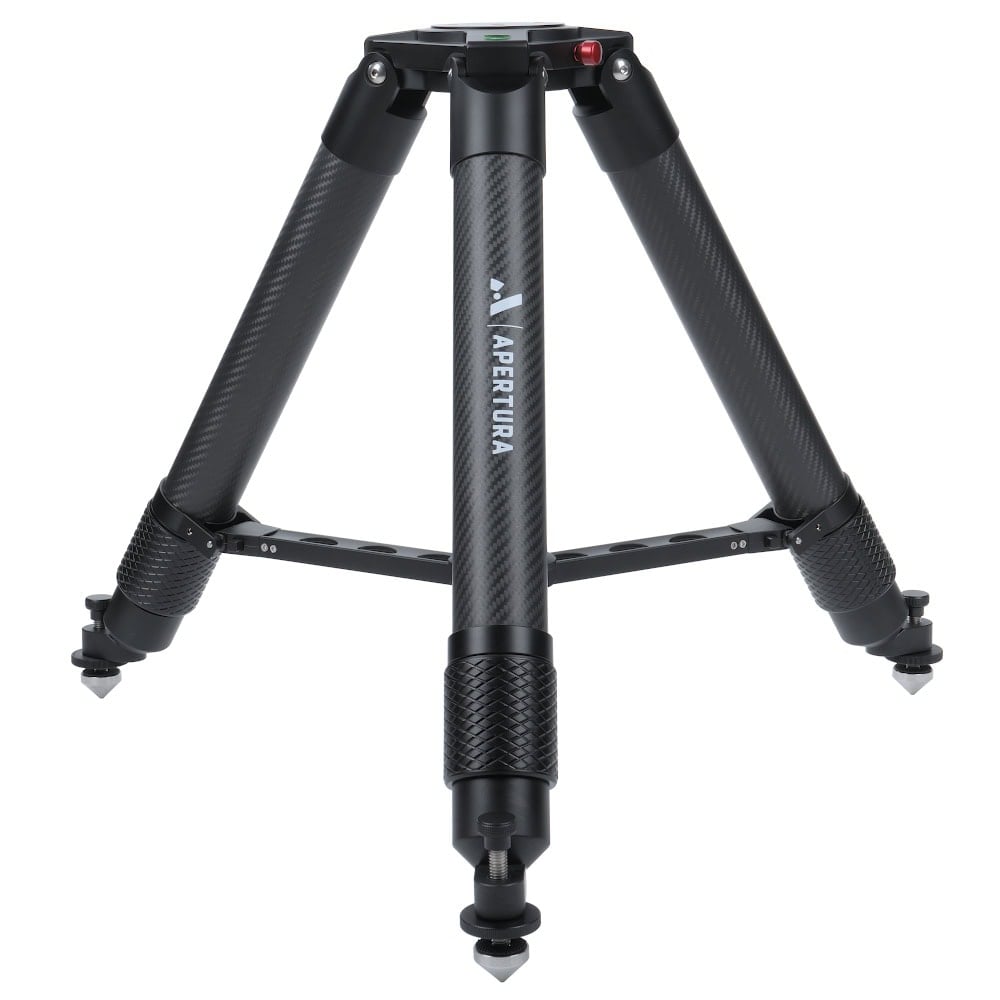
I used the Apertura Heavy-Duty Carbon Fiber Tripod for my imaging tests on the ZWO AM7. It is rated for 110 pounds.
This tripod includes a base plate that can be unlocked and rotated (so handy for polar alignment). Just remember to lock it back in once you have positioned it to your liking.
Pier & Tri-Pier Configurations
For even greater stability, a tri-pier or semi-permanent pier setup is an excellent match for the AM7.
You do give up some portability compared to a lightweight carbon fiber tripod, but in return you gain a more comfortable working height, better clearance for longer telescopes, and maximum overall rigidity.
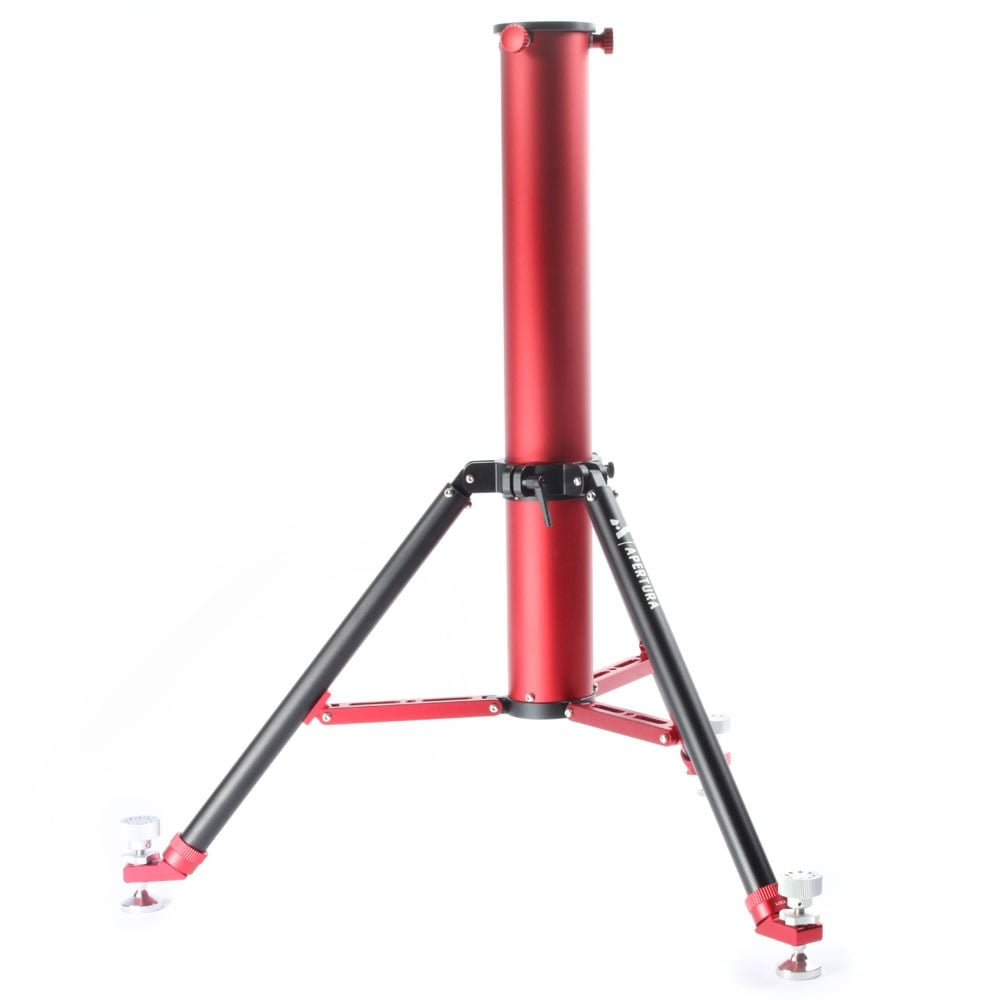
The Apertura ‘Anchor Pier‘ is what I used for longer telescope systems for better clearance. It’s a good match with the AM7.
More importantly, you gain confidence. Heavier optical systems create more leverage on the mount, especially when slewing or when pointed closer to the horizon. A rigid pier-style base minimizes flex and reduces the chance of unwanted movement, which becomes increasingly important as payload increases.
If you regularly run medium-to-heavy scopes and don’t tear down your setup every night, a pier configuration simply makes sense. It adds stability, improves safety, and helps ensure your mount is operating comfortably within its limits rather than right at the edge.
The Larger Counterweight Shaft
The counterweight shaft on the ZWO AM7 is larger in diameter than the ones for the AM3 and AM5. It requires counterweights with a 25mm bore instead of 20mm.
Unfortunatly I didn’t have a single counterweight in the astro-garage that fits this new shaft size (if you can believe that). At the time of writing, I know of only 2 counterweights that will fit the AM7.
The Sky-Watcher 11 lb counterweight for the AZ-EQ6, and the Apertura 22 lb counterweight designed specifically for the AM7 (shown below).
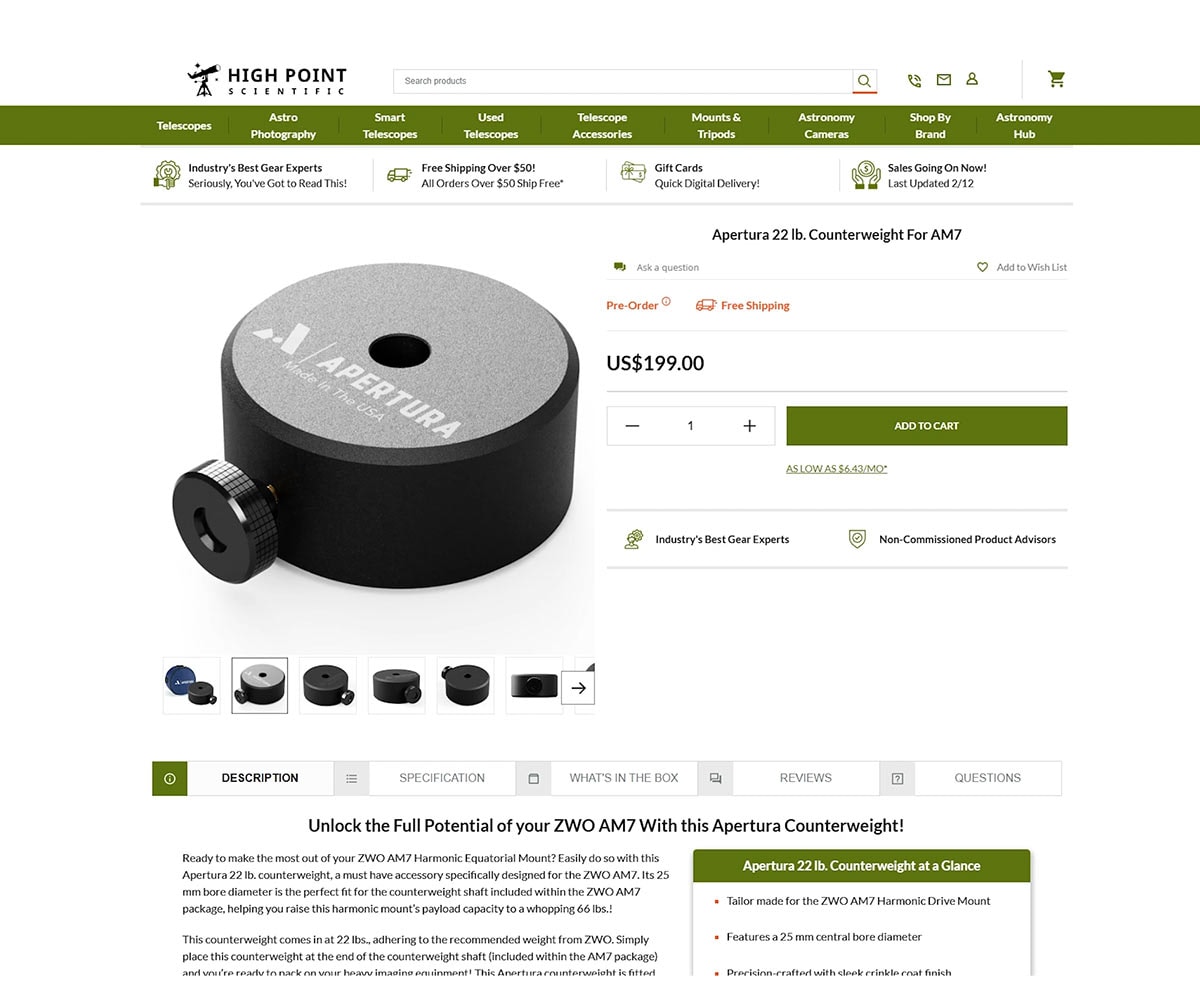
The Apertura 22 lb. Counterweight for the AM7.
Please note that the AM7 includes the counterweight shaft but not the counterweight itself. If you plan to mount a heavy system (over 44 pounds), you will need to purchase one.
How It Compares to Other Mounts
The AM7 sits directly above the AM5N in the ZWO lineup, increasing the counterweight-free payload from 33 pounds to 44 pounds. That extra 11 pounds may not sound dramatic at first, but in real-world astrophotography, it makes a meaningful difference.
That jump can be the difference between a mount that feels close to the edge and one that feels completely comfortable. It opens the door to larger 5”–6” refractors, heavier triplet designs, fully loaded SCT imaging trains, and future upgrades that might otherwise feel risky on the AM5.
Astrophotography gear tends to grow over time. A slightly larger mount often means less stress on the system, smoother guiding, and greater flexibility over time, all without significantly increasing bulk or complexity.
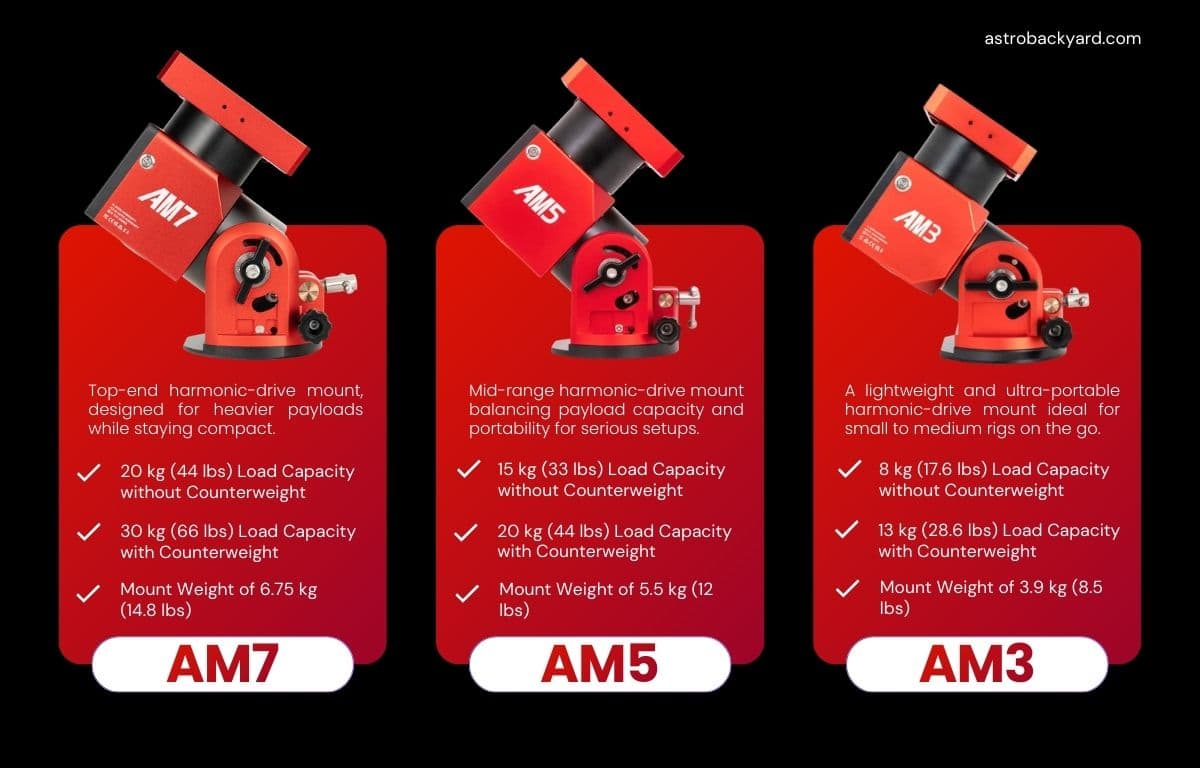
ZWO AM5 VS AM7
If your fully loaded telescope weighs over 30 pounds, or you’re planning to move into longer focal lengths where stability becomes more critical, the AM7 starts to make a lot of sense. It also becomes appealing if you simply want more headroom for future upgrades.
Imaging setups tend to grow over time, and having extra capacity means your mount won’t be the limiting factor as your system evolves.
On the other hand, if you’re running a refractor under 30 pounds and you’re nowhere near pushing payload limits, the AM5N remains an excellent choice. It’s lighter, more portable, and still highly capable for most backyard imaging setups. If maximum portability is your top priority, the AM5N (or the AM3) may actually be the better fit.
The key thing to understand is that the AM7 doesn’t fundamentally change the experience, it expands the capacity. You’re getting the same harmonic drive convenience, just with more room to grow.
| Feature | AM7 | AM5N |
|---|---|---|
| Mode | Equatorial / Alt-Azimuth | Equatorial / Alt-Azimuth |
| Drive System | Harmonic + Timing Belt (300:1 Reduction Ratio) | Harmonic + Timing Belt (300:1 Reduction Ratio) |
| Load Capacity without Counterweight | 20 kg (44 lbs) | 15 kg (33 lbs) |
| Load Capacity with Counterweight | 30 kg (66 lbs) | 20 kg (44 lbs) |
| Mount Weight | 6.75 kg (14.8 lbs) | 5.5 kg (12 lbs) |
| Avg. Cost | $2,999 USD | $2,499 USD |
ZWO AM7 Compared to Traditional Mounts
When you look outside the harmonic drive category, the comparison gets interesting.
The Sky-Watcher EQ6-R, for example, also carries a 44 lb payload rating, but the mount head itself weighs significantly more. Traditional worm gear equatorial mounts in this class are bulkier, heavier, and generally less portable.
The AM7 delivers a similar rated capacity in a much lighter, more compact form. With a counterweight installed, the AM7 can handle up to 66 lbs, which pushes it into territory that would normally require a serious equatorial mount.
That said, there’s still something to be said for traditional heavy-duty mounts when you’re dealing with truly large systems. For monster scopes – big Newtonians, long focal length imaging rigs, or observatory-class setups – mounts like the EQ8-R or CQ-350 still inspire a certain level of confidence.
Harmonic drive mounts are often at their best when used within their comfortable range, especially in counterweight-free configurations. One of the biggest advantages of the AM7 is not having to mess with counterweights at all. Once you start stacking weight and counterweights aggressively, you’re drifting closer to traditional mount territory anyway.
For most backyard astrophotographers running medium-to-heavy setups, the AM7 hits a really compelling middle ground: More capacity than the AM5 without stepping into full observatory-class bulk.
Periodic Error Report
One detail worth highlighting is that ZWO ships the AM7 with its own factory-measured periodic error (PE) report specific to your exact unit. Periodic error refers to the small, repeating tracking deviations caused by imperfections in the mount’s drive system as it rotates through a full cycle.
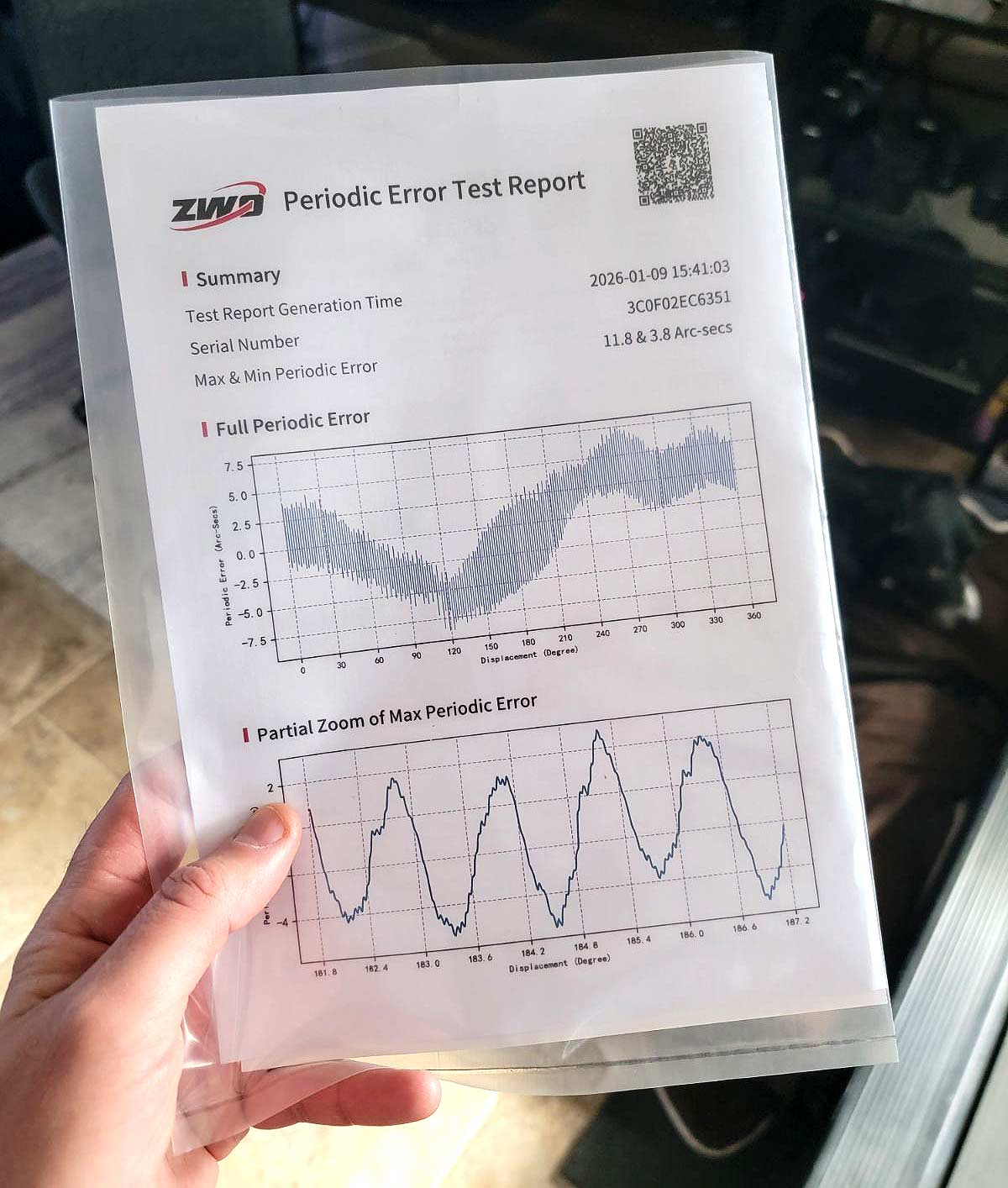
The periodic error test report included with my ZWO AM7 (Max & Min Periodic Error: 11.8 & 3.8 Arc-secs).
Even though harmonic drive mounts like the AM7 are designed for smooth, low-error tracking, no two mechanical systems are perfectly identical. By including a printed PE test graph from the factory, ZWO gives you a transparent look at how your mount performed during quality control testing.
This report typically shows the amplitude and pattern of the tracking error over one full worm cycle, giving you realistic expectations for guiding performance. It’s a reassurance that your mount meets its advertised tracking specifications and a useful baseline reference for comparing real-world guiding logs later.
Mount Control Using Sky Atlas
The ZWO AM7 supports control through ZWO’s Sky Atlas app on iOS and Android, allowing you to wirelessly slew the mount, select targets from a built-in sky database, and initiate GoTo commands directly from your phone or tablet.
My favorite feature on the ASIAIR app is the Sky Atlas, which uses plate solving to automatically find and center my deep-sky target.
This makes setup and operation especially convenient for backyard astrophotographers like me, eliminating the need for a tethered laptop. Once you get used to wirelessly controlling your telescope with your phone (which is always on hand), it’s hard to go back to anything else.
The AM7 also features an indicator LED system that clearly displays its current operating mode, so you can quickly confirm connection status, tracking state, or wireless activity at a glance. You can enable or disable Bluetooth as needed, which is helpful in observatory environments where minimizing wireless interference or restricting connections is important.
Who Is the AM7 For? (And Is It Worth It?)
So, who is the ZWO AM7 really for? This mount is designed for astrophotographers who are starting to push beyond lightweight refractors and want more stability without stepping into observatory-class equipment.
The AM7 is ideal for:
- Astrophotographers running heavier setups
- Longer focal length imaging setups
- Anyone tired of lifting traditional equatorial mounts
- Backyard imagers who want more payload capacity without sacrificing portability
- Users invested in the ASIAIR ecosystem
If you’re starting to look at 5”–6” refractors, EdgeHD-class SCTs, or heavier imaging trains loaded with filter wheels, rotators, and off-axis guiders, the AM7 starts to make a lot of sense.
- Run a small refractor (70–100mm class)
- Keep your imaging system under ~25–30 lbs
- You’re not pushing payload limits
- Value maximum portability over future headroom
The AM7 doesn’t fundamentally change the experience; it expands the capacity. You still get the simplicity and convenience of a harmonic drive mount. You just gain more room to grow.
And the truth is, there are excellent medium-load mounts available that handle lighter rigs beautifully. If your current setup is stable and well within limits, you may not need to upgrade at all, and that’s perfectly fine.
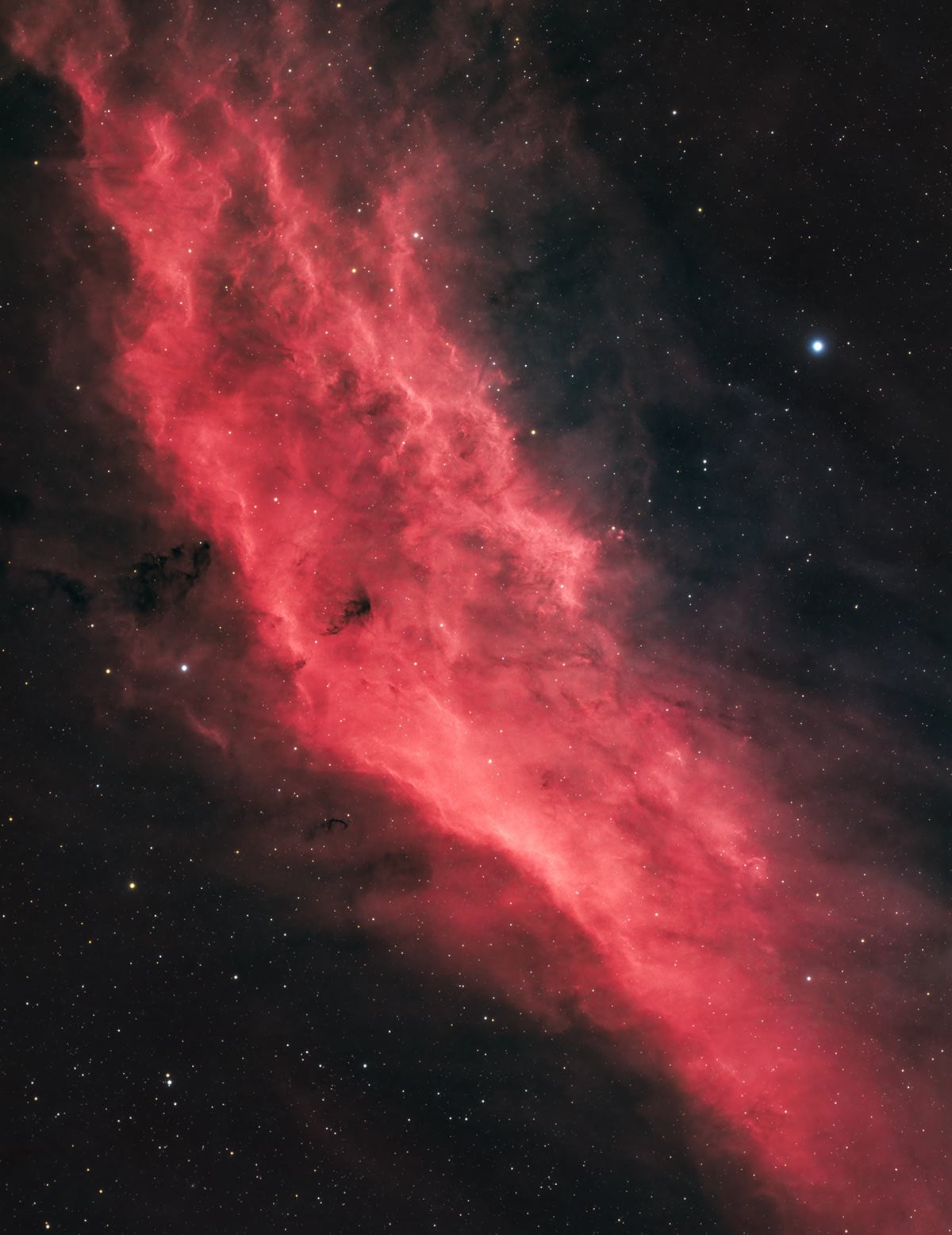
The California Nebula (6 Hours Total Exposure). ZWO AM7 + William Optics UltraCat 108)
Community Notes on the ZWO AM7:
Across the web, on forums like Cloudy Nights, there’s been significant anticipation about how the AM7 will handle heavier payloads, with many hoping for stable guiding at longer focal lengths.
Some users have expressed concerns about release delays, tripod support under heavier setups, and whether the AM7 will be a significant leap from the AM5N.
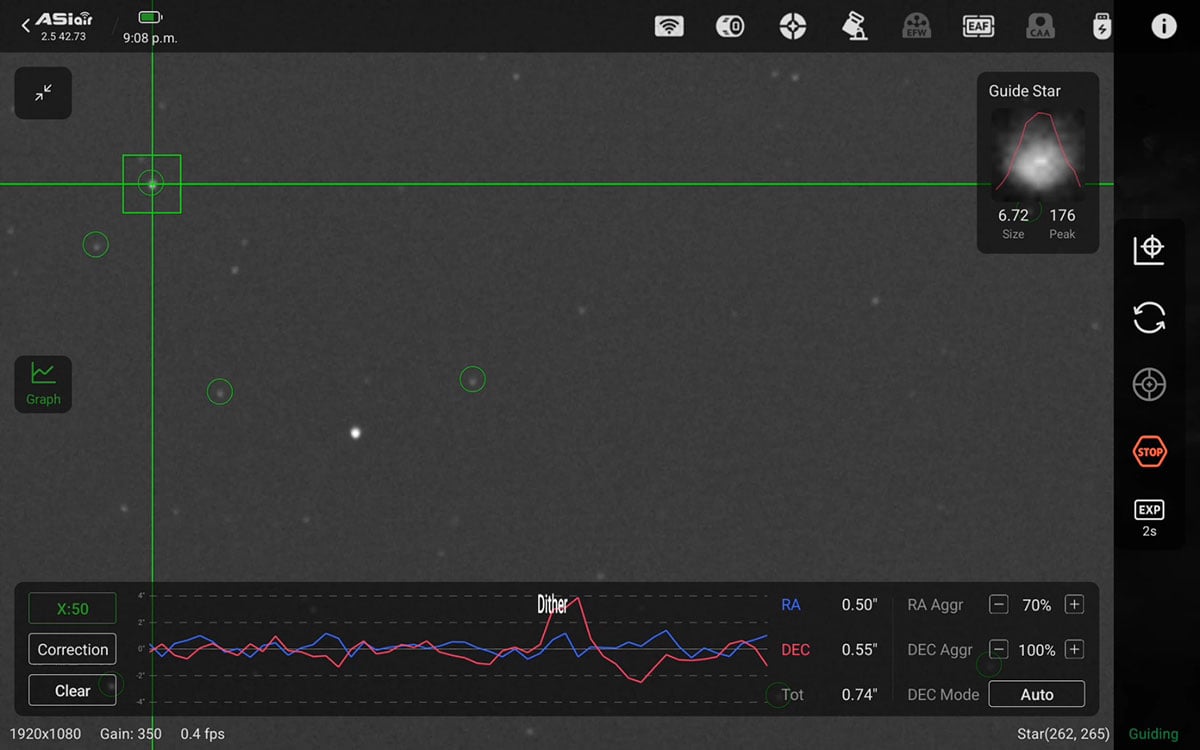
My guiding graph using the ZWO AM7 with the William Optics UltraCat 108 + Camera (20 pounds) without the counterweight.
While some are waiting for hands-on reviews to finalize their opinions, others are curious about the maturity of the strain-wave technology.
In my own testing, however, the AM7 performed excellently, handling a heavy payload without any signs of struggle. When the weather improves, I will test the astrophotography performance of the AM7 using a heavier, longer-focal-length telescope, such as the William Optics FLT 132.
The Comments on My YouTube Video
While my review is based on hands-on testing of the ZWO AM7, I also wanted to include community feedback from the comments section of my YouTube video and from ongoing discussions on popular astronomy forums. This helps highlight the most common questions, concerns, and real-world expectations people have about the AM7 beyond my own experience.
- Anticipation & excitement over the release: Many in the community have been eagerly awaiting hands-on reviews and pre-order availability, and users have expressed relief that ZWO finally launched the AM7 after a long wait.
- Payload capacity expectations: Comments frequently discuss the AM7’s increased capacity (20 kg without counterweight and up to 30 kg with counterweight) compared to the AM5, and how that may suit heavier imaging trains.
- Comparison to older models: Some users noted that for lighter telescopes, the AM5 (or even AM3) remains perfectly capable, and that the AM7 might not offer a dramatic enough jump to justify switching for every user.
- Innovation vs incremental upgrade: A recurring theme is that the AM7 feels like a scaled-up version of the AM5, with few groundbreaking new features (e.g., people mentioned a desire for encoders or more advanced alignment aids).
- Tripod and stability concerns: With the AM7’s higher payload potential, some viewers and commenters advise pairing it with a much more robust tripod or pier setup, since the stock carbon tripod may be a limiting factor under heavier loads.
- Diverse real-world use cases: Beyond specs, enthusiasts and early reviewers in comments and related videos are sharing their own setups (from modest refractors to heavy SCTs) and debating where the AM7 fits best in real imaging scenarios.
Frequently Asked Questions (FAQ)
What is the payload capacity of the ZWO AM7?
The AM7 supports 44 lbs without a counterweight and up to 66 lbs with a counterweight installed.
Can the ZWO AM7 run without a counterweight?
Yes. One of the main benefits of the AM7 is its ability to run up to 44 lbs without a counterweight.
Is the ZWO AM7 good for long focal length astrophotography?
Yes, especially when guided. The mount performs very well with an autoguiding system.
Does the AM7 work with ASIAIR?
Yes. The AM7 integrates seamlessly into the ZWO ecosystem and works very well with ASIAIR.
Is the AM7 better than the AM5?
It depends on your payload. The AM7 offers more capacity and an RA brake, but the AM5 is lighter and more affordable.
The Bottom Line
With the AM7, you’re essentially paying for an extra 11 pounds of counterweight-free payload compared to the AM5N.
On paper, that may not sound like much. In practice, it’s often the difference between a mount that feels maxed out and one that feels relaxed and stable. That extra headroom means less second-guessing, more flexibility for future upgrades, and the confidence that your mount isn’t the limiting factor in your system.
If you already own an AM3 or AM5, you know how reliable and convenient these harmonic drive mounts are. The AM7 doesn’t reinvent that experience; it simply scales it up. You get the same streamlined workflow, just with the ability to comfortably carry heavier telescopes without stepping back into the world of bulky 40-pound equatorial mount heads.
For many backyard astrophotographers, the AM7 lands right in that sweet spot between portability and capacity.
If you’re already using a traditional mount that works perfectly, that’s great too. Proven gear still produces incredible results. This isn’t about chasing the newest thing; it’s about choosing the mount that makes you want to set up more often.
At the end of the day, the mount is just the foundation. What matters most is that you’re outside under the stars, capturing the night sky, with whatever gear helps you do that consistently. Clear skies.
The ZWO AM7 is available for pre-order at High Point Scientific.
 Trevor Jones is an astrophotographer and a valued member of the RASC. His passion is inspiring others to start their astrophotography journey on YouTube so they can appreciate the night sky as much as he does. His images have been featured in astronomy books & online publications, including the NASA Astronomy Picture of the Day (APOD).

I’m curious what the tracking performance was when using the C11. My experience with harmonic drives has been that they don’t perform well with larger SCTs since their center of mass is a good 8inches from the dovetail. Thoughts?
You are not alone on this. The next clear-sky chance I get, I will run the Celestron Edge HD 11 on the AM7 (without a counterweight) and report back on the guiding performance.