
How to Photograph Planetary Conjunctions: A Practical Guide

If you have ever looked up at a dusk or dawn sky and noticed two noticeably bright ‘stars’ sitting side by side, there is a good chance they are actually planets in our solar system.
These celestial meetings are called planetary conjunctions, and they’re some of the most photogenic events you can capture with just a camera and a tripod.
Unlike faint nebulae or galaxies, planetary conjunctions are bright, easy to find, and don’t require hours of long exposures. I’ve captured many planetary conjunctions with my camera over the last decade, and I have some tips for you.
I’ll share everything from the gear I recommend to the camera settings that work best.
I captured the conjunction of Jupiter and Venus with my telescope in the backyard.
Where to Find Upcoming Planetary Conjunctions
If you want to stay ahead of the curve and know exactly when the next close planetary pairings will light up the sky, a great resource is the
Star Walk website’s planetary conjunctions page.
They maintain an updated list of upcoming planetary conjunctions, complete with easy-to-read guides, sky maps, and tips for spotting the event.
It’s an excellent tool to bookmark if you’re planning your astrophotography sessions or just want to enjoy these celestial alignments with your own eyes.
What Is a Planetary Conjunction?
A planetary conjunction happens when two or more planets appear very close together in the night sky. From our perspective on Earth, their paths line up, creating a beautiful “close approach” that can be observed with the naked eye.
Some of the most striking conjunctions happen when Venus and Jupiter pass within a degree of one another, often outshining everything else in the sky except the Moon.
Conjunctions can also include the Moon itself, creating wonderful photo opportunities where a crescent Moon hangs just above or beside a bright planet.
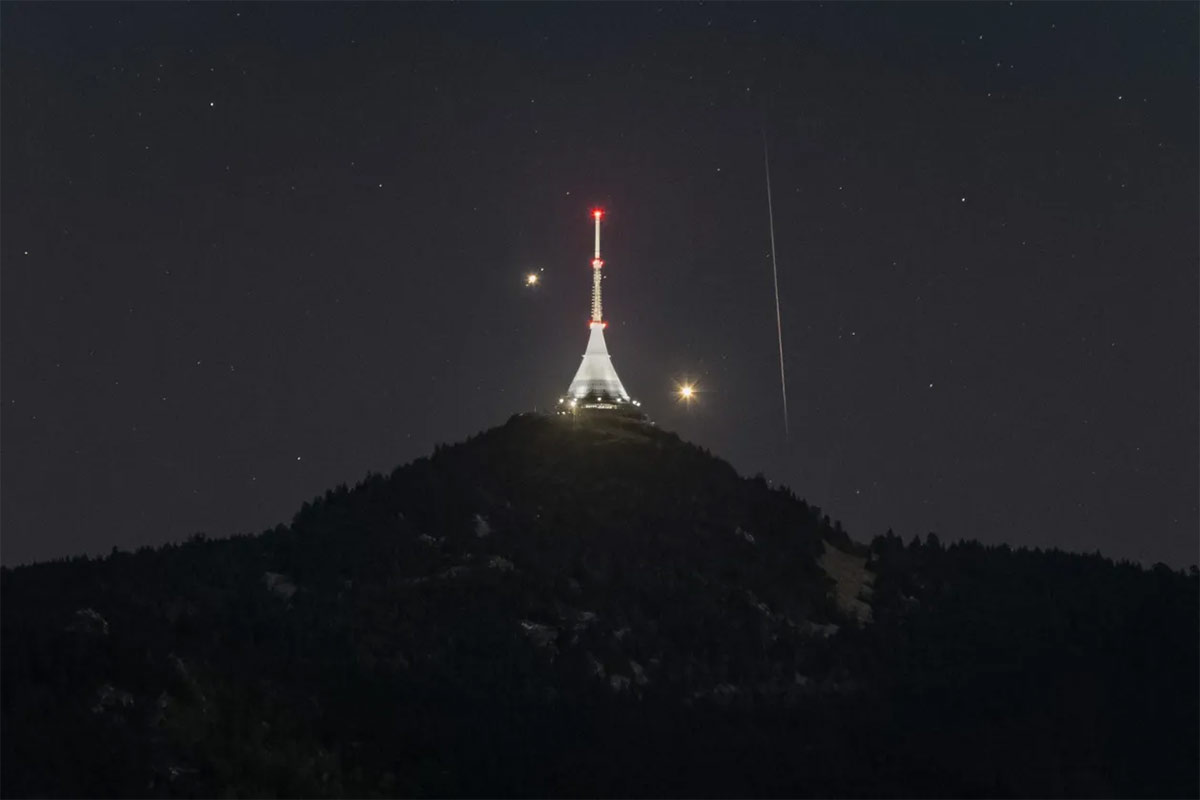
A conjunction of Venus and Jupiter behind Ještěd by Jakub K. Canon R6 Mark II & Canon 70–200 f/2.8 @ f/4, 200 mm (+ 1.6× in-camera crop). 1.6 second exposure.
When people talk about planetary conjunctions in practical, backyard terms, they’re usually referring to when two planets appear very close together to the eye.
- Less than 1° apart: Often called a “close conjunction.” This is about the width of two full moons side by side and looks very striking.
- 1°–5° apart: Still commonly reported as a conjunction, and usually still obvious to casual observers.
- Greater than 5°: Technically still a conjunction (if coordinates align), but less exciting visually.
Why Planetary Alignments Are Worth Photographing
Unlike deep-sky astrophotography, which often requires a telescope, tracking mount, and specialized filters, planetary alignments and conjunctions can be photographed with very modest gear.
Here are a few reasons these events are so rewarding to capture:
- Bright and easy to find — Planets stand out against the night sky, making them beginner-friendly.
- Short exposures work — You don’t need hours of imaging; a single frame can look amazing.
- Wider context — Conjunctions look fantastic framed with a landscape, skyline, or natural foreground.
- Rare events — Close planetary groupings don’t happen every day; capturing them creates a record of a special cosmic moment.
For many beginners, photographing a planetary conjunction is the first step into astrophotography.
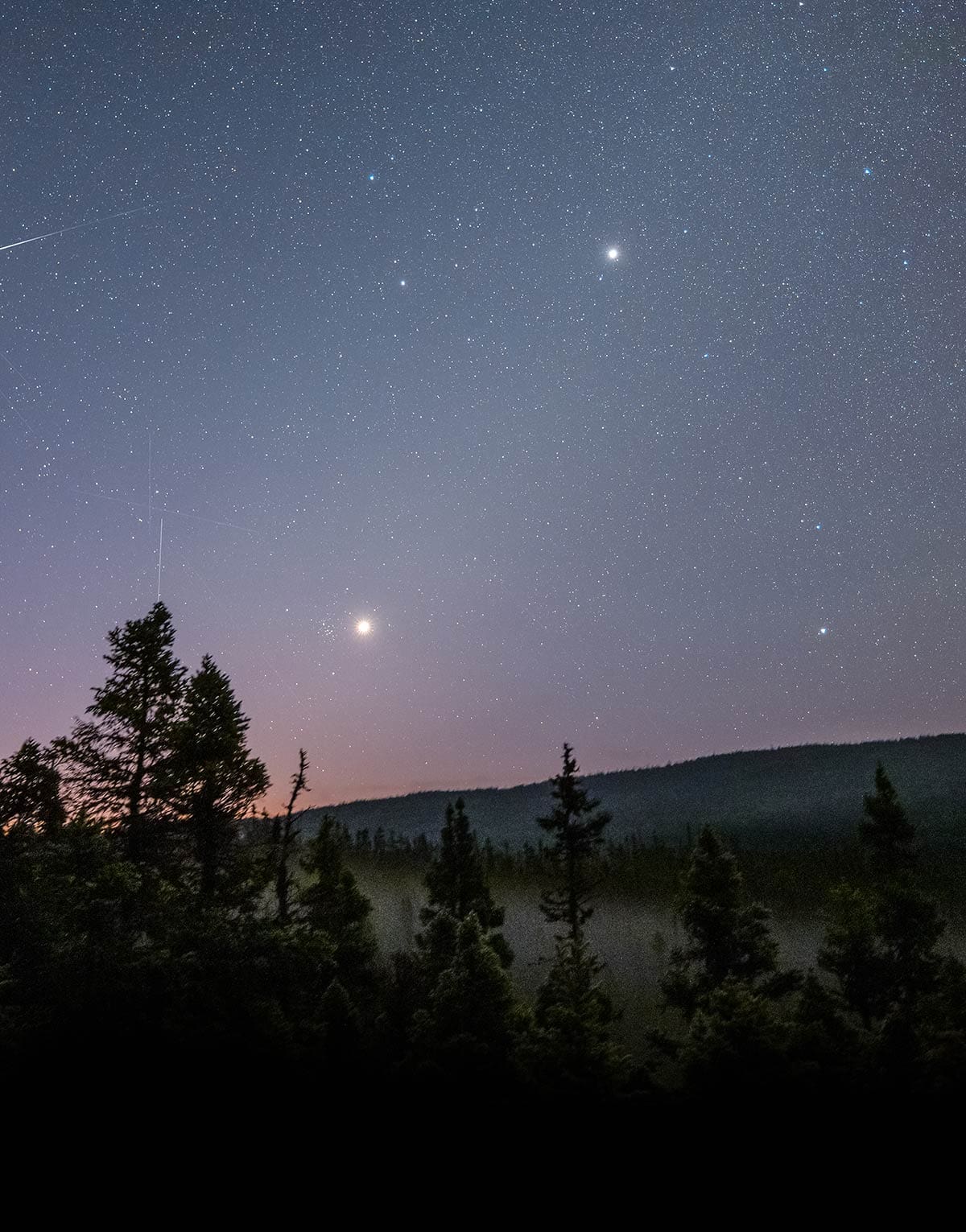
I captured this pairing of the planet Venus with the Beehive Cluster (and Jupiter nearby) using my DSLR camera and lens.
Best Gear for Photographing Planetary Conjunctions
One of the best things about conjunctions is that you don’t need expensive or complex equipment. A basic camera setup is enough to capture stunning results.
- Camera: Any DSLR or mirrorless camera with manual settings will work. Even modern smartphones can capture bright planets, but for higher quality, a dedicated camera is better.
- Lens: A wide-angle lens (14–35mm) is excellent for including the landscape. A telephoto lens (85–200mm) works well if you want to zoom in on the planets themselves.
- Tripod: Essential for stability during long exposures.
- Optional: A star tracker can help if you want to take slightly longer exposures without star trailing, but it’s not required for conjunctions.
Personally, I like using my Sigma 24mm F/1.4 lens on wide field shots that include a landscape, and a Rokinon 135mm F/2 lens (on a star tracker) for closer pairings in the sky.
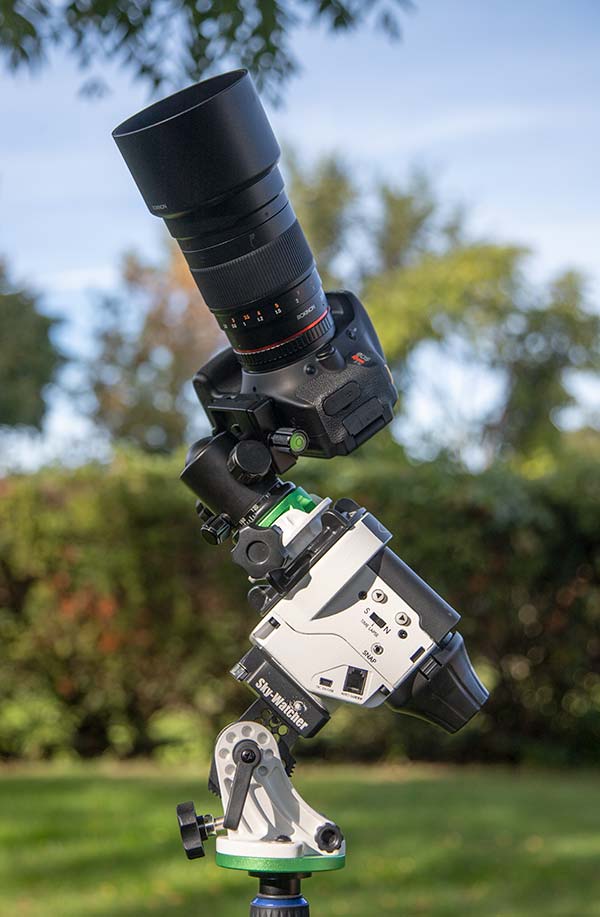
For longer focal length lenses, a star tracker is needed for a sharp image using longer exposures. (Sky Watcher Star Adventurer 2i)
Best Settings for Planetary Photography (Wide-Field)
Your exact settings will vary depending on your camera and lens, but here’s a reliable starting point:
- Mode: Manual
- Focus: Manual, set on a bright star or planet (use live-view at 10x zoom)
- Aperture: f/2.8 (or the widest your lens allows)
- ISO: 800–1600
- Shutter speed: 2–10 seconds (shorter for telephoto, longer for wide-angle)
- File format: Always shoot in RAW
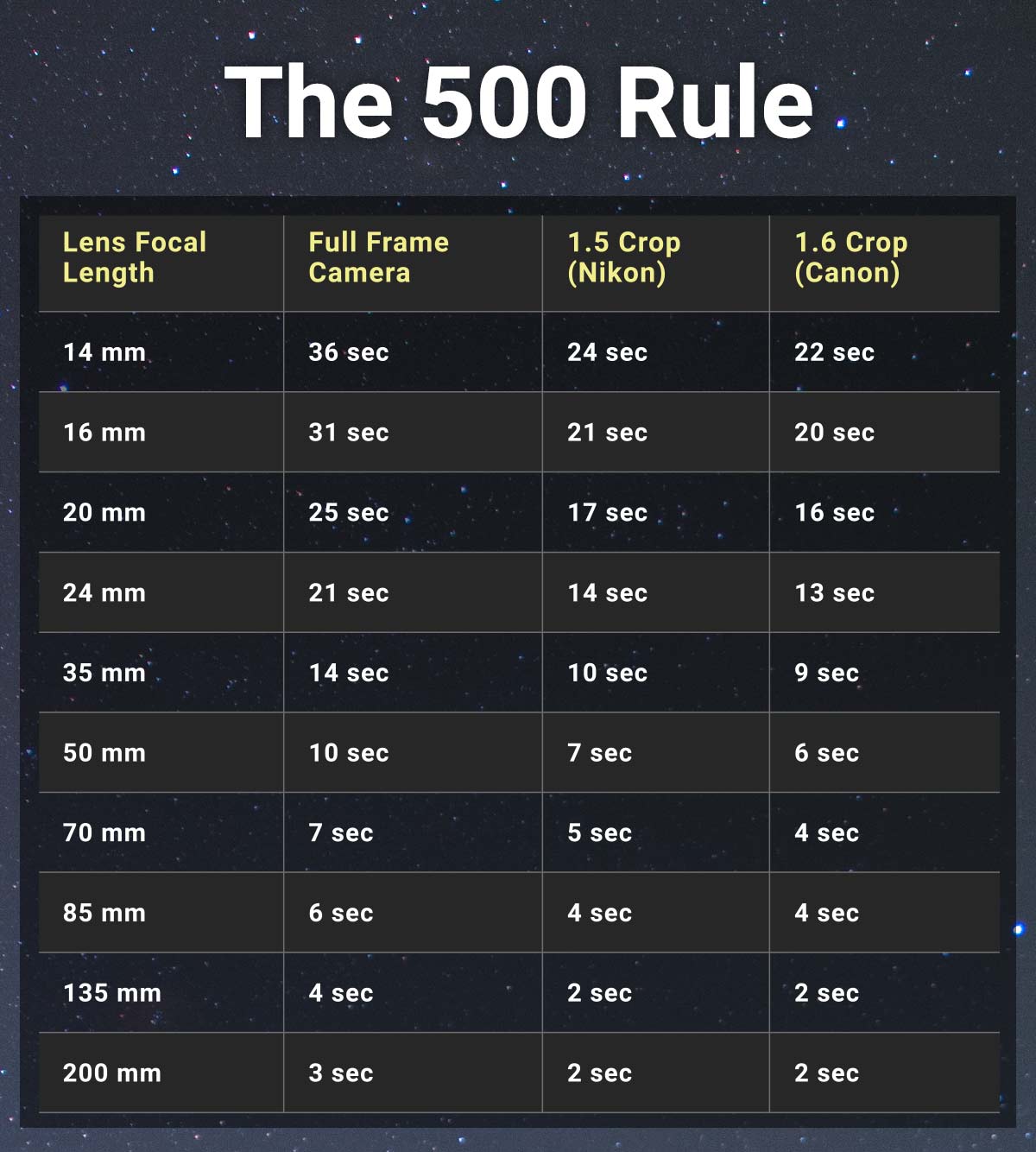
If you’re taking pictures using a stationary tripod, remember the “500 Rule”.
Just divide 500 by your focal length (full-frame equivalent) to estimate the longest exposure before stars start to trail. For example, with a 50mm lens, keep exposures under 10 seconds.
How to Compose a Stunning Conjunction Image
Composition is everything when photographing planetary conjunctions. Since planets are small bright points of light, adding an interesting foreground gives your photo context and scale.
Here are some strategies and tips for capturing a memorable planetary conjunction with an interesting scene surrounding it:
- Frame the conjunction above a skyline, mountain, or tree line.
- Use reflections in water to double the impact.
- Capture the conjunction just after sunset or before sunrise when the sky still has color.
- Include the Moon if it’s nearby—it creates a dramatic visual anchor.
Scout your location ahead of time using a smartphone app like Stellarium, SkySafari, or PhotoPills to line up the planets with your chosen foreground.
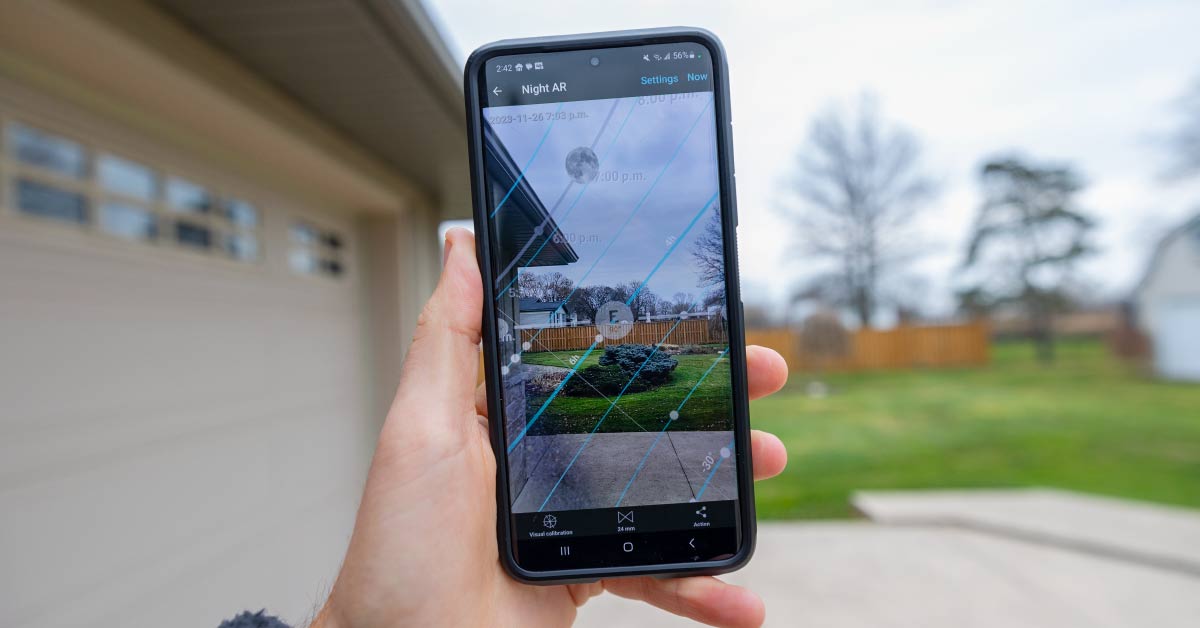
Photopills is a useful mobile app that lets you plan an incredible planet pairing anywhere in the world.
Advanced Techniques for Capturing Conjunctions
If you want to push your images further, try these techniques:
- Stack multiple exposures — Combine several short exposures in software like DeepSkyStacker or Sequator to reduce noise.
- Blend exposures — Take a short exposure for the planets (so they don’t overexpose) and a longer one for the foreground, then blend in Photoshop.
- HDR approach — Useful when the Moon is part of the conjunction, as its brightness can overwhelm the planets.
These techniques aren’t required, but they can give your images a polished, professional look.

A tracked and stacked image of a planetary conjunction can yield a smooth, detailed image with plenty of background stars. However, you will need to capture a separate untracked landscape and blend the two photos together for a complete image.
Post-Processing Planetary Conjunction Images
Even a single RAW frame of a conjunction can benefit from a bit of editing. The same techniques used for a great nightscape image apply to planetary conjunction photography.
Here is a simple workflow you can use as a template for your next wide-field planetary conjunction photo:
- Adjust white balance — A cooler tone (around 4000–5000K) brings out the natural night sky colors.
- Boost contrast — Helps the planets stand out against the background.
- Reduce noise — Light noise reduction makes a big difference, especially at higher ISOs.
- Sharpen foreground — If you included landscape elements, selective sharpening can make them pop.
You don’t need advanced astrophotography software for this; basic tools in Lightroom or Photoshop are often enough.
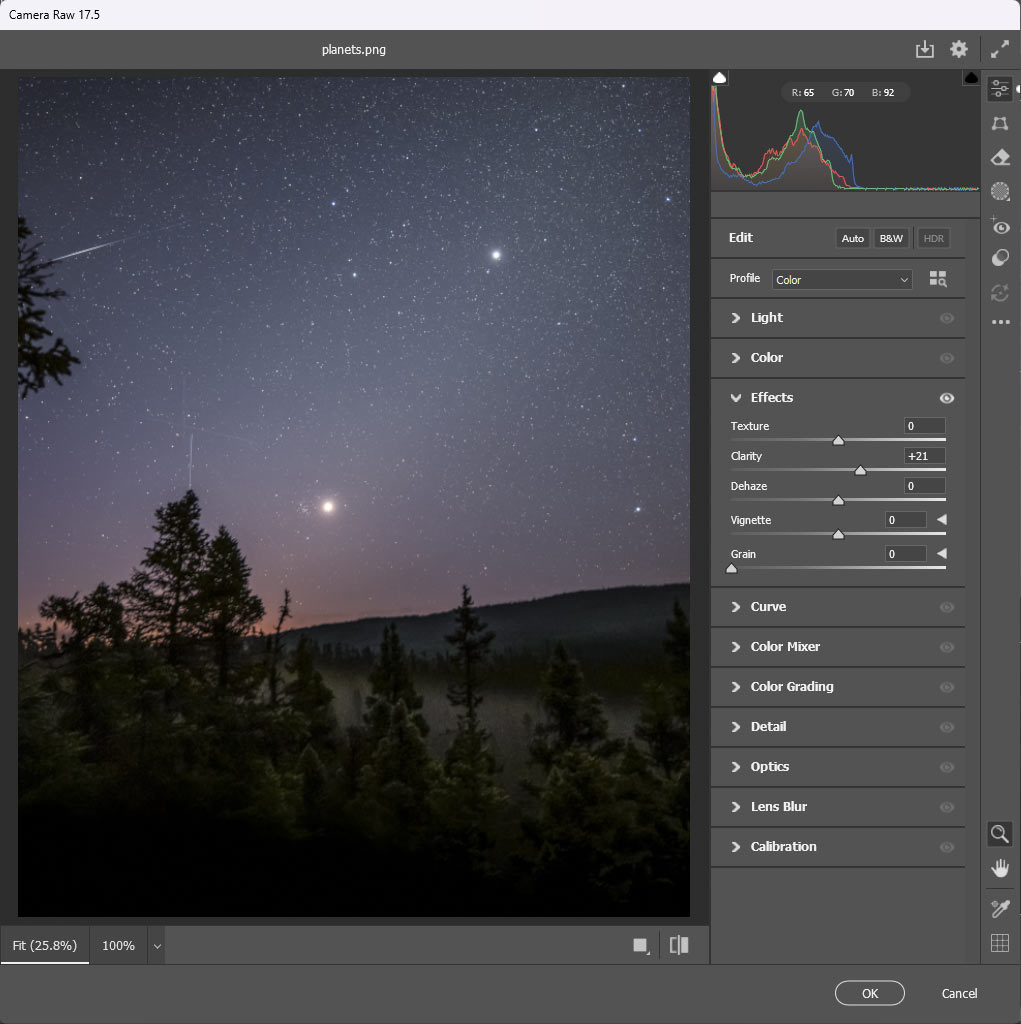
I like to use the clarity slider in the Adobe Camera Raw filter in Photoshop to bring up subtle shadows. In this case, it revealed the faint fog behind the treeline.
Related Article: The Best Image Processing Software for Astrophotography
Tips for Beginners Photographing Planetary Conjunctions
If this is your first time, keep it simple:
- Set up early to avoid the planets getting too low on the horizon.
- Take test shots and adjust exposure until you’re happy.
- Use a remote shutter release (or a 2-second timer) to avoid camera shake.
- Don’t stress about perfection. Sometimes the most memorable shots are the spontaneous ones.
The key is to enjoy the process of being outside, under the night sky, watching the planets align. Unlike a long, drawn-out night of deep-sky imaging, a conjunction is all about timing, and they don’t last long.
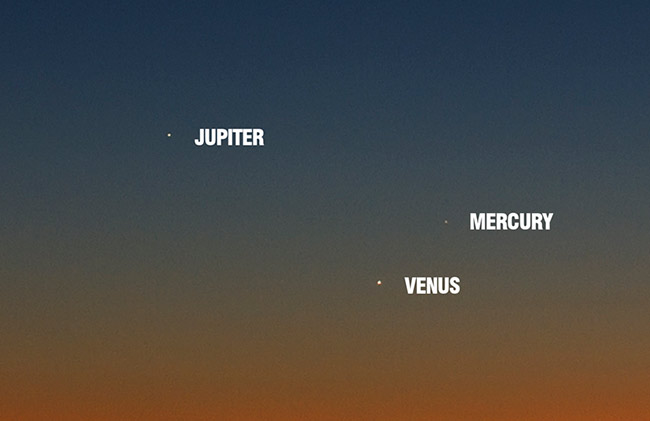
One of my first planetary conjunction images. Jupiter, Venus, and Mercury appeared very close to each other in the evening sky.
Triple Conjunctions
A triple conjunction happens when two planets (or a planet and a star) appear to meet in the sky three times within just a few weeks or months.
This occurs because one or both of the objects briefly shift into retrograde motion, making them cross paths multiple times before resuming their normal direction.
Unlike planetary alignments, which involve several planets, a triple conjunction only features two celestial objects. These events are rare and fall into three categories:
- Inferior planets (Mercury or Venus): Frequent, but often hidden by the Sun’s glare.
- Inferior and superior planet (e.g., Venus and Jupiter): About once a decade; sometimes all three passes are visible.
- Two superior planets (e.g., Jupiter and Saturn): Also, about once per decade, though bright, visible pairings may only occur once a century.
Great Conjunctions
A great conjunction refers specifically to the meeting of Jupiter and Saturn, the two largest planets in the solar system.
Because of their slow orbits, Jupiter takes 12 years to circle the Sun, while Saturn takes nearly 30. The pair aligns only about once every 20 years.
Great conjunctions are especially significant because Jupiter and Saturn are both bright and easily visible, making their close pairing a striking sight.
Depending on their positions, they can appear extremely close together, sometimes less than 0.1° apart, as seen in the spectacular ‘Christmas Star’ conjunction of 2020.
These events are rare opportunities to witness the giant planets side by side, and they have been recorded and celebrated by skywatchers for centuries.
Final Thoughts
Planetary conjunctions and alignments are among the most accessible and widely enjoyed astronomical events to photograph.
With a bit of planning and a willingness to get outside at the right time, you’ll have a fantastic photo of a rare celestial event that captivates the general public.
If you want to dig deeper into the rewarding hobby of astrophotography, be sure to check out the Getting Started Page, where I share everything I know.

The Crescent moon and planet Venus. Canon EOS Ra + Canon EF 300mm F/4 Lens (tracked).

Trevor Jones is an astrophotographer and a valued member of the RASC. His passion is inspiring others to start their astrophotography journey on YouTube so they can enjoy the night sky as much as he does. His images can be seen in astronomy books & online publications, including the NASA Astronomy Picture of the Day.
Related Content
- The Best Smart Telescopes for Astrophotography in 2026 (Compared)
- How To Photograph Planets (Using any Camera)
- Image Processing Software for Astrophotography (Top Choices in 2026)