
Apertura CarbonStar 200 Review: Built for Astrophotography

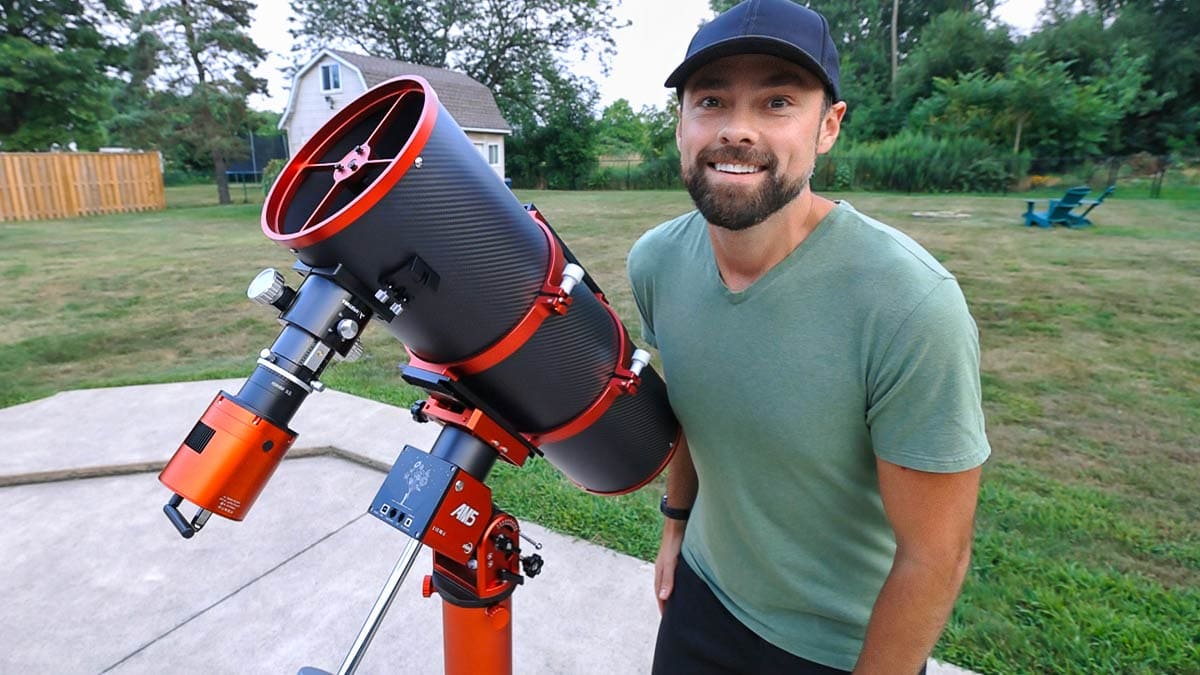
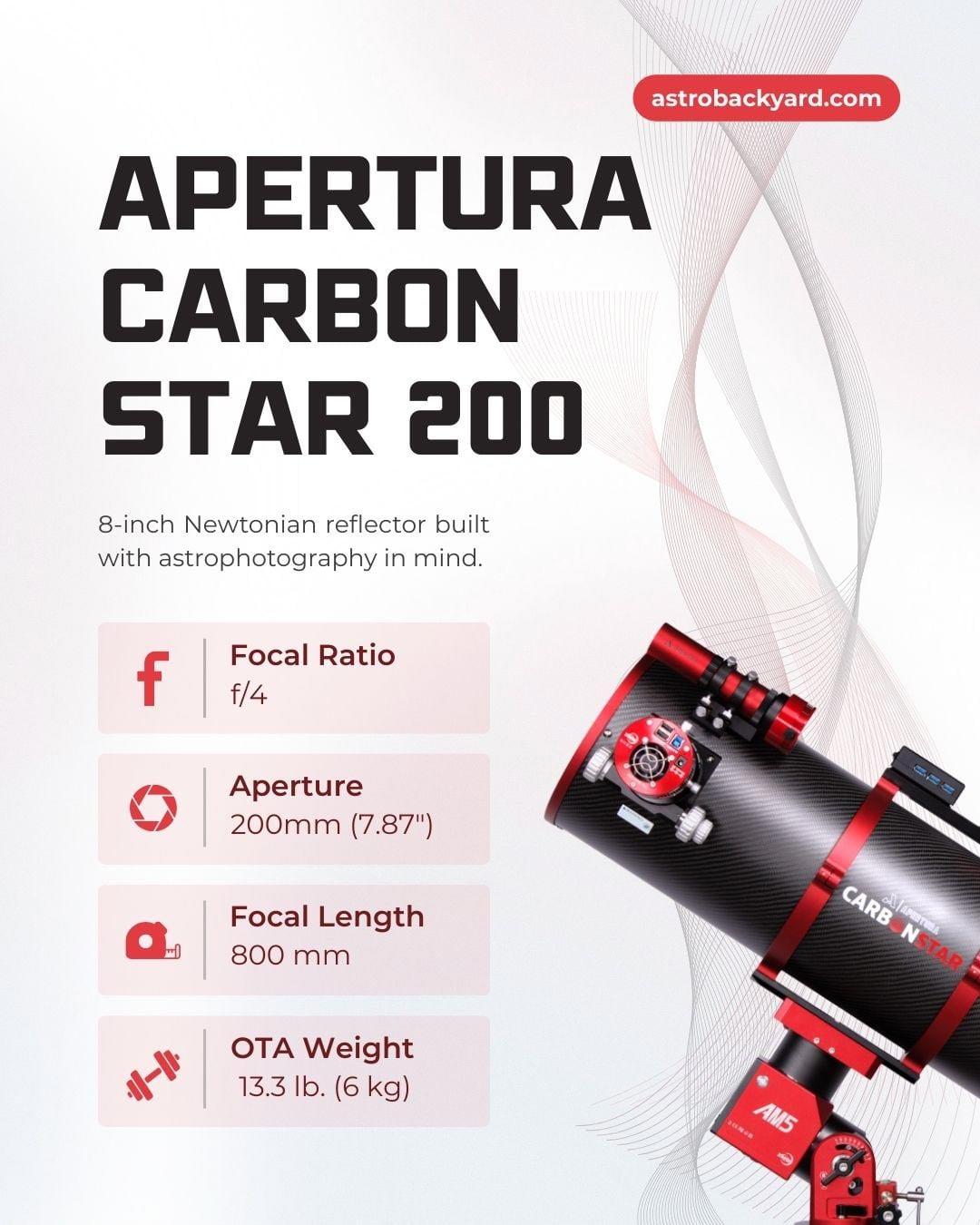
The Apertura CarbonStar 200 is an 8-inch f/4 Newtonian reflector built with astrophotography in mind. While there are many reflectors available in this size, the CarbonStar 200 stands out with some clever upgrades.
I’ve always been a refractor-first kind of imager, but testing this scope over several nights made me appreciate the strengths of a fast reflector design, especially when your clear nights are limited.
This is my honest take from using the CarbonStar 200 in my Bortle 6 backyard, with all the usual constraints: changing temperatures, stray light from the neighbors, and the constant race against clouds.
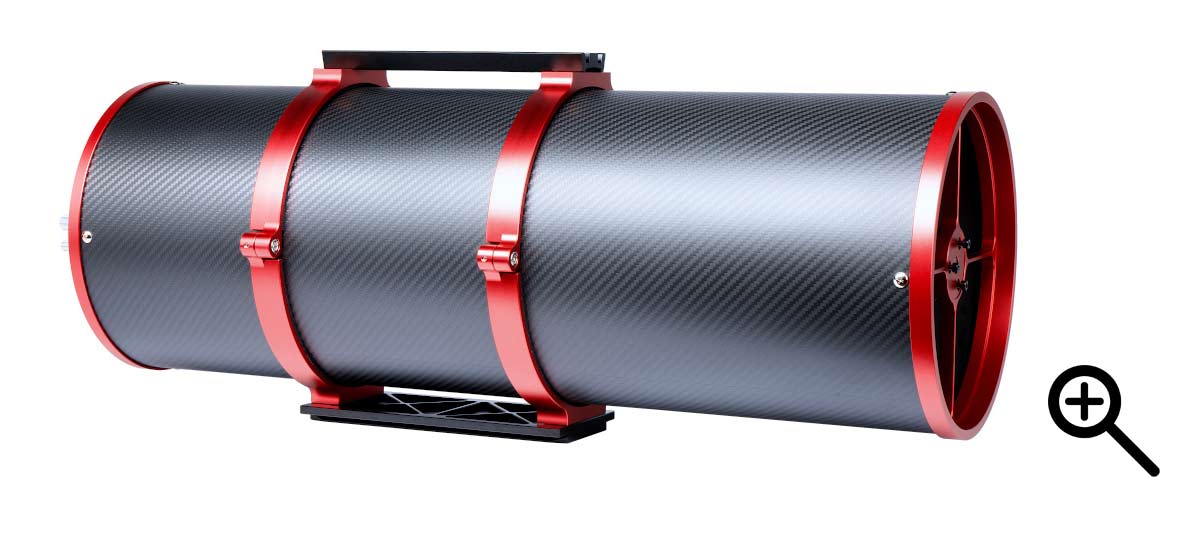
The CarbonStar 200 is sold exclusively at High Point Scientific, the company behind its development.
In this review, I’ll share who the CarbonStar 200 was designed for and how I’ve been enjoying it in the backyard. This is a serious astrophotography telescope at a competitive price. Let’s dig in!
Apertura CarbonStar 200 Complete Specs:
- Focal Ratio: f/4
- Optical Design: Newtonian Reflector
- Telescope Aperture: 200mm
- Focal Length: 800 mm
- Primary Mirror Type: Parabolic
- Primary Mirror Material: Borosilicate
- Focuser Style: Rack & Pinion
- Focuser Size: 2″
- Focuser Speed: Dual Speed
- Optical Tube Assembly Material: Carbon Fiber
- Telescope OTA Weight: 15.8 lb. (Assembled)
- Telescope OTA Length: 26.5″
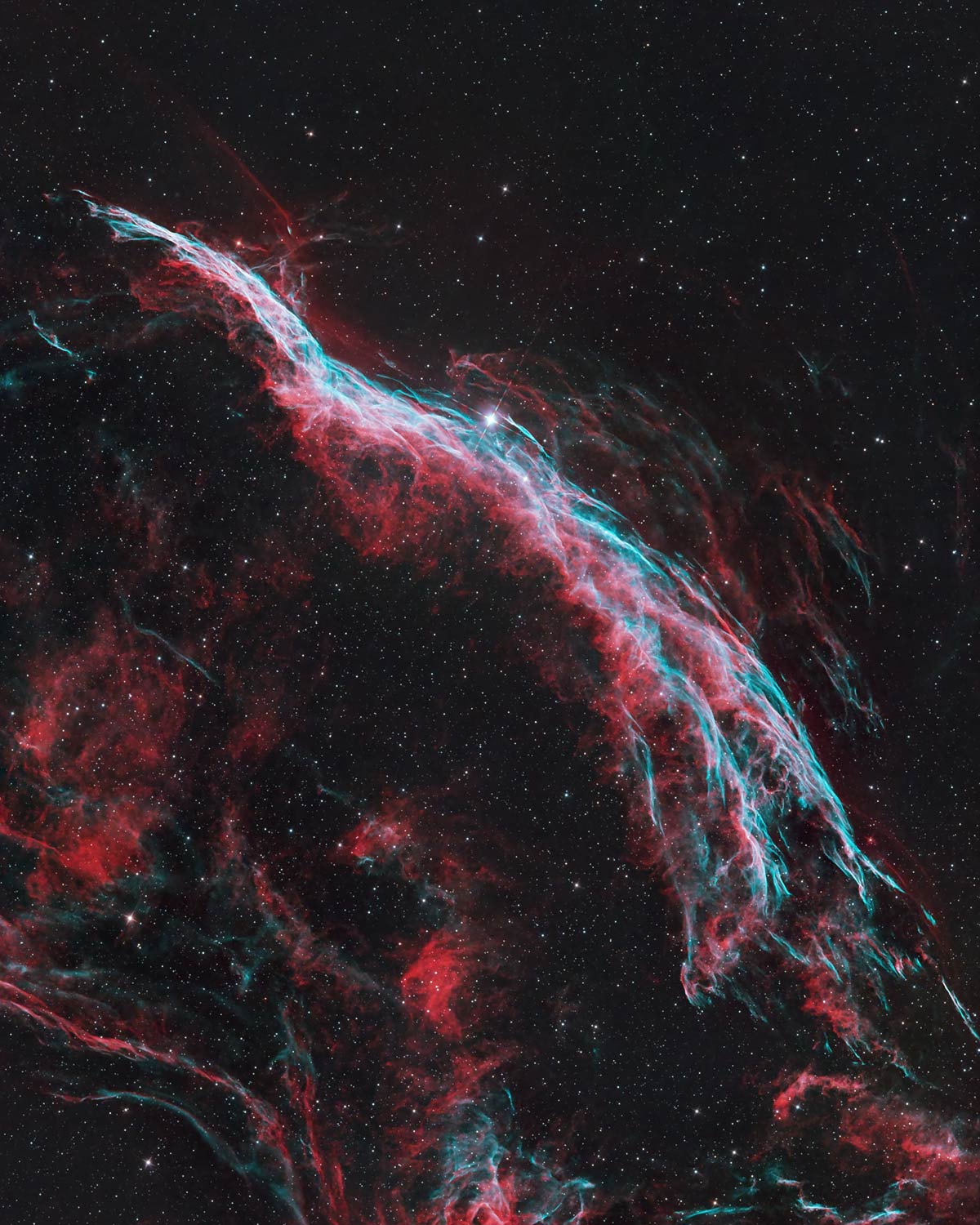
My test image of the Veil Nebula using the CarbonStar 200 and the ZWO ASI2600MC Air. (6 Hours Total)
Equipment Profile
- Telescope: Apertura CarbonStar 200 (with Coma Corrector)
- Camera: ZWO ASI2600MC Air
- Filter: Optolong L-eXtreme Filter
- Mount: ZWO AM5
Optical Design and Speed: Why F/4 Matters
With a focal length of 800mm and an F/4 focal ratio, the CarbonStar 200 gathers a lot of light very quickly. Compared to this telescope’s younger sibling (the Apertura CarbonStar 150), the 8-inch version can collect 78% more light with the additional aperture.
In practice, that means:
-
You can capture the same level of detail in half the exposure time compared to a slower scope (like f/7 or f/8).
-
More usable subs before clouds roll in or dew sets on the optics.
-
Better chances of completing a project in a single night.
For me, imaging the Western Veil Nebula at 800 mm felt like stepping up in magnification without losing too much field of view. The diffraction spikes on bright stars are a natural byproduct of the Newtonian design, which some people love for their “classic” look.
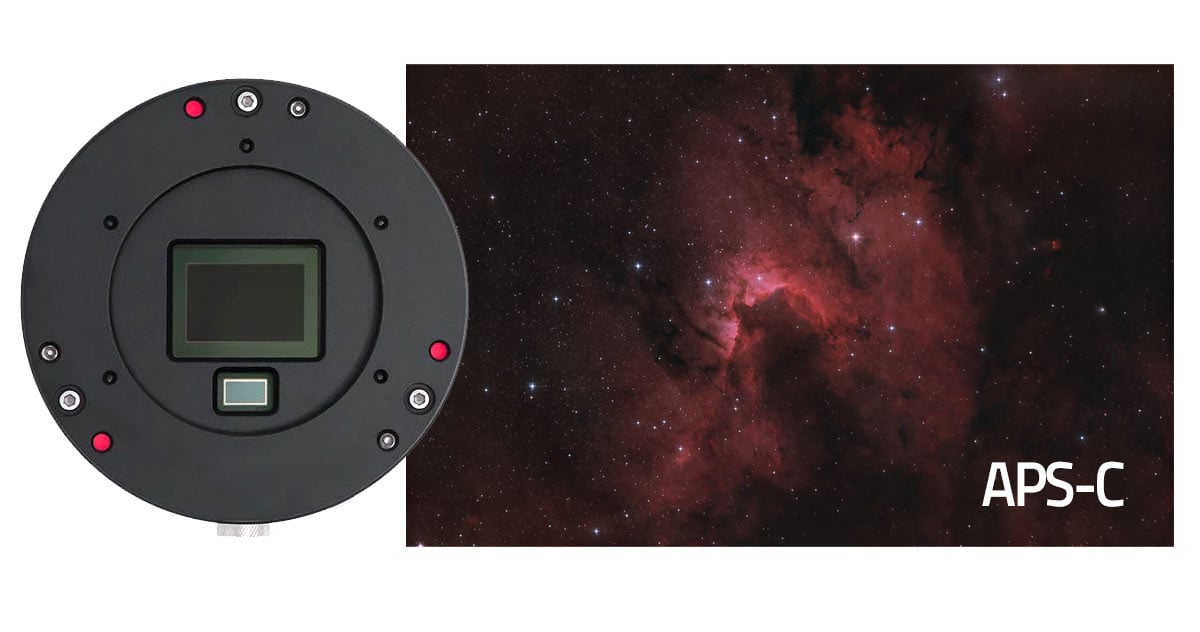
In terms of field illumination, the CarbonStar 200 was optimized for APS-C-sized camera sensors. This is great news for owners of the popular 2600-series SONY IMX571 sensor.
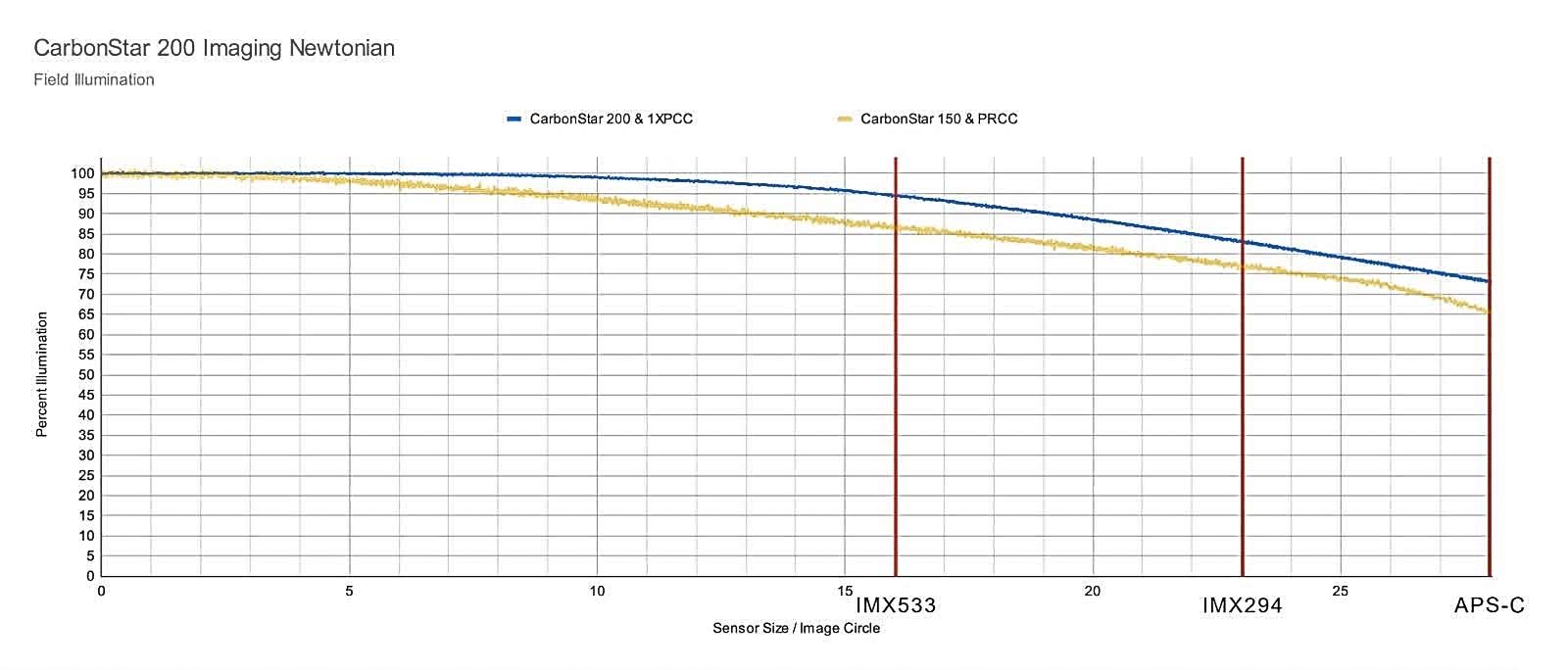
The blue line shows the improved field illumination on the CarbonStar 200 over the 150 version (yellow).
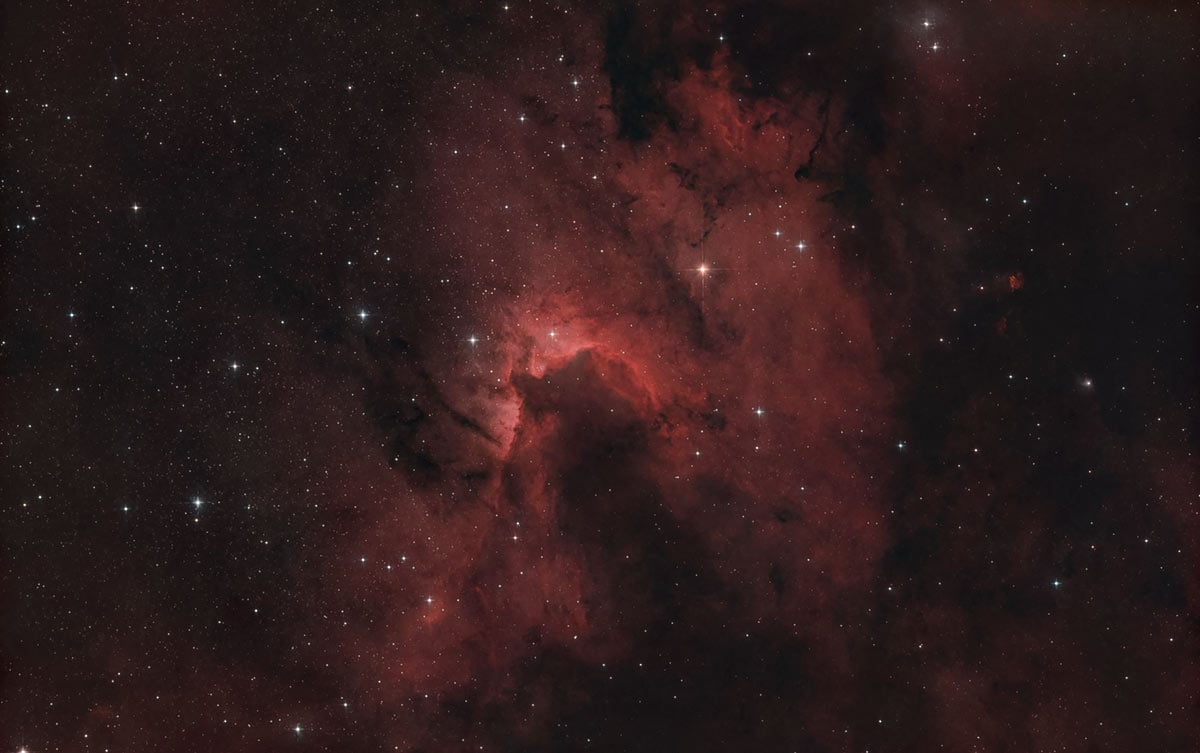
My second ‘test image’ was the Cave Nebula in Cepheus. I used a ZWO ASI2600MC Air camera with an Optolong L-eXtreme filter.
Sensor Pairing and Image Quality
The CarbonStar 200 pairs extremely well with popular astro cameras like the ASI533MC Pro or ASI2600MC Pro. These sensors give you:
-
Perfect image scale for sharp, detailed targets.
-
Minimal star distortion when paired with the dedicated 1x coma corrector.
For smaller sensors like the ZWO ASI533MC Pro, you can get away without the corrector—but with APS-C sensors, you’ll appreciate those round stars from corner to corner.
This means that you will not need to crop away the bad corners of the image frame during processing. In my image tests, the stars looked great to the edges of the frame, and vignetting was minimal.
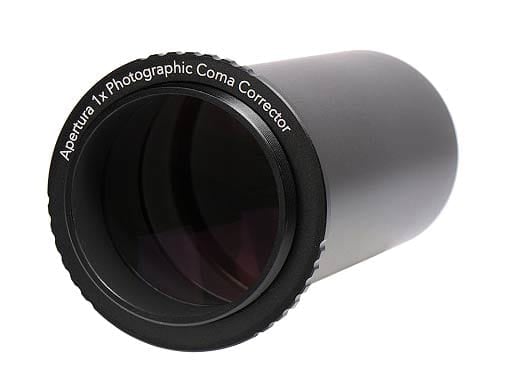
Make sure to invest in the dedicated 1x coma corrector if you’re using a crop-sensor camera.

I completed an 18-hour-long project on the Wizard Nebula with the CarbonStar 200. ZWO ASI2600MM Pro, SHO Filters.
Carbon Fiber Tube: Stability Over the Night
The carbon fiber tube looks pretty slick. But this material wasn’t chosen for its looks (although I do really dig it), carbon fiber is lighter than steel and resists thermal expansion.
On a typical night in my backyard, temperatures can drop several degrees over a session. With metal-tube reflectors, that shift can throw off focus, forcing you to refocus multiple times.
With the CarbonStar 200, focus barely changed through the night. That means fewer interruptions and more total imaging time.
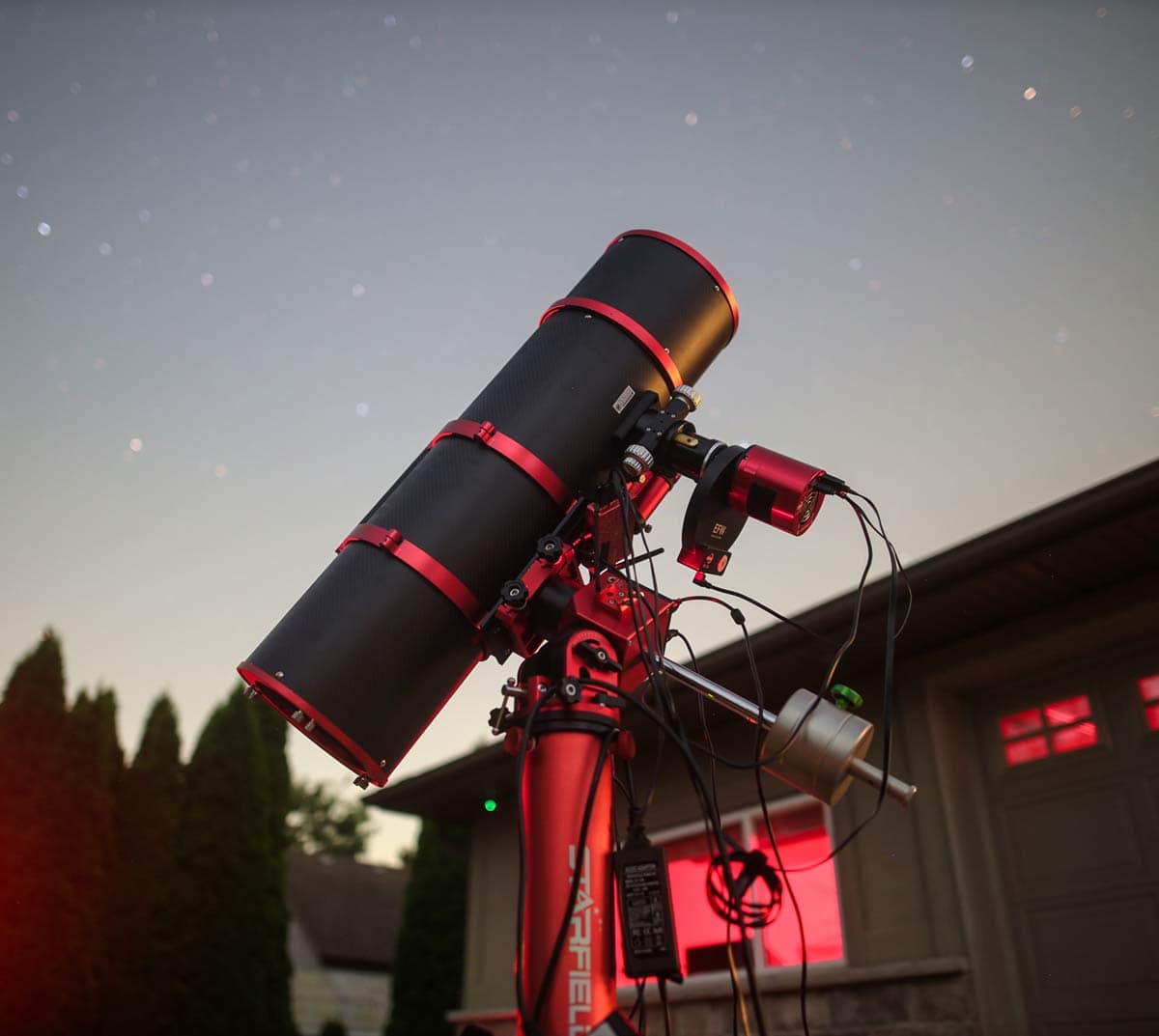
I was surprised at how little the focus changed on this F/4 telescope throughout a night of imaging.
Light Management and Contrast
Inside the tube, 13 knife-edge baffles help cut down on stray light. While these are common in refractor telescopes, you don’t typically see them in a Newtonian reflector.
Why it matters:
-
In suburban backyards, even small light leaks can wash out faint nebula detail.
-
Better contrast makes it easier to stretch the image in post-processing without blowing out the background.
The included rear cap helps too, but you’ll still want a simple dew shield—especially if you’re pointing near light sources. I learned this when a red light from my garage crept into the first few subs one night.
In my mind, a dew shield is an absolute must with the CarbonStar 200. You can either make your own (black foam material works well) or get the matching carbon fiber model from High Point Scientific.
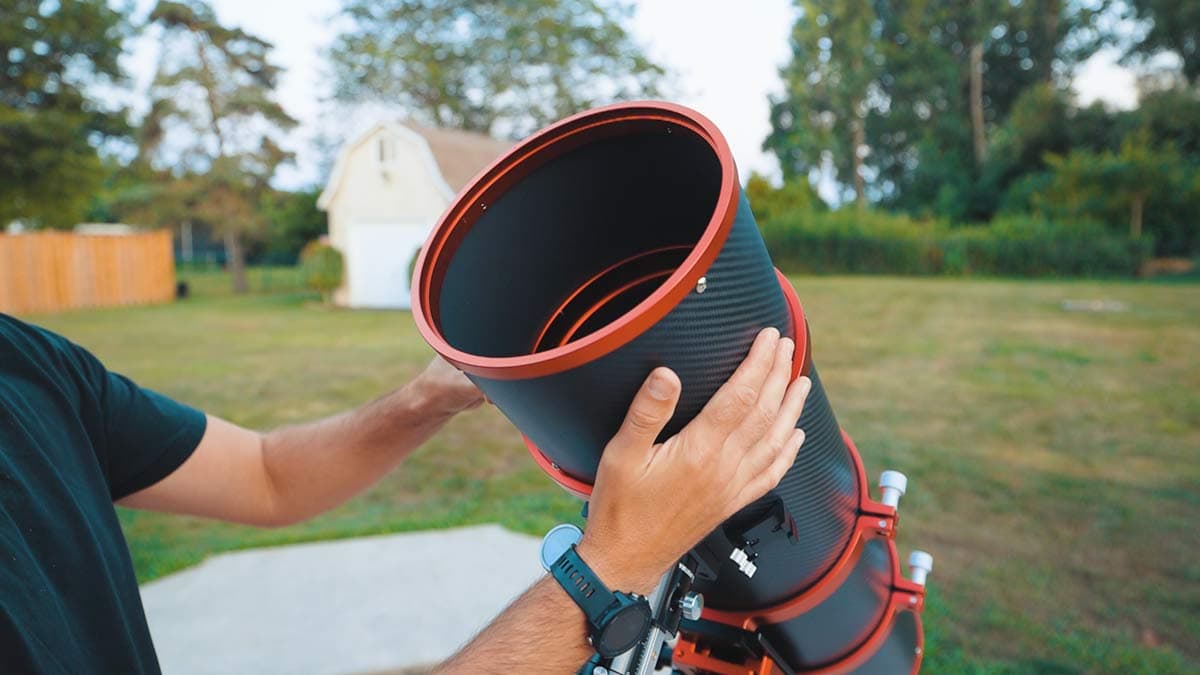
The matching carbon fiber dew shield looks beautiful, although it is shorter than a traditional, soft wrap-around dew shield.
A solid dew shield will make taking flat frames on the CarbonStar 200 a lot easier. I still use a white t-shirt to filter down the light intensity (even when using a light panel).
Collimation: A Necessary Step
Newtonians require regular collimation—aligning the mirrors so light travels straight to the camera sensor.
I use a simple SVBONY laser collimation tool I purchased on Amazon to accomplish this task, and it only takes about 2-3 minutes.
The process involves adjusting the screws on the secondary mirror with an Allan key to center the red dot on the center of the primary.
Next, I adjust the screws on the back of the primary until the red dot is centered within the bullseye on the collimator.
I do it before every imaging session, and after a meridian flip (just to be sure). Skipping collimation results in softer stars and smeared details, making it a worthwhile addition to your routine.

I use a simple laser collimator tool (this one on Amazon) to align the mirrors on the CarbonStar 200.
Mounting and Weight
At 15 pounds, the CarbonStar 200 is light enough to carry assembled from the garage to the backyard. It rides well on mid-range equatorial mounts like the ZWO AM5, AM3, or Sky-Watcher EQ6-R Pro.
You may have noticed that I am using a counterweight on this system. While it is not necessary with this payload, it provides peace of mind and a better balance to the rig overall.
I’ve kept the CarbonStar 200 mounted to the ZWO AM5 mount and Starfield Tri-Pier 1000 for about a month now. The tri-pier provides a more practical overall height and better clearance.
For guiding, the built-in shoe accepts a mini guide scope. I used my ASI2600MC Air in dual-sensor mode to image and guide through the same optical tube, controlled by ASIAIR for a simple, automated workflow.
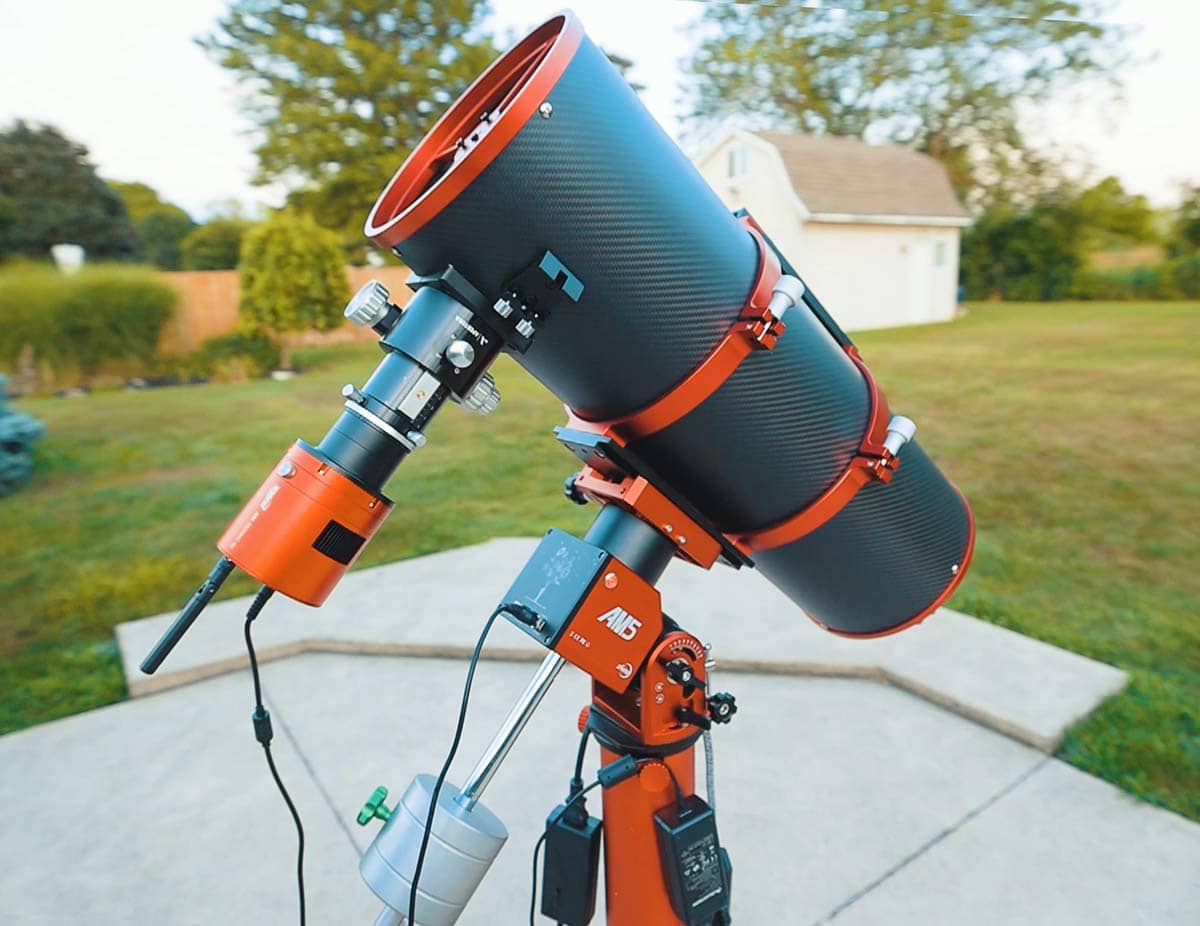
An all-in-one smart camera like the ASI2600MC Air provides a streamlined imaging experience without the need for an additional guide camera and telescope.
When Clear Nights Are Rare
Where I live, a “clear” night might only last a few hours before clouds, fog, or smoke move in. That’s where the CarbonStar 200 shines.
The large 8-inch aperture and fast focal ratio enable me to gather more total signal in a short window, thereby improving the final stacked image.
It also opens the door to targets I wouldn’t attempt with a smaller, slower scope—fainter galaxies, planetary nebulae, and dust lanes in emission nebulae become more achievable.
This telescope would be an excellent choice for Galaxy Season next year, and I hope to be able to test it in that scenario. The 800mm focal length should be enough reach to capture a nice image of the Sunflower Galaxy, a project I desperately need to revisit.
The Trade-Offs
-
Diffraction spikes are unavoidable with Newtonians. I personally like the big, dramatic ones on bright stars, but the smaller spikes across the field can be distracting. I reduced the star size in post to draw more attention to the nebula.
-
Collimation is a step refractor owners don’t have to deal with. If you’re unwilling to spend a few minutes aligning mirrors, this scope may frustrate you.
- The larger, lightweight profile of this system may make it more susceptible to wind, so if windy nights are common where you set up, a stocky compact refractor might be a better fit.
Adding an Electronic Autofocuser
I improved CarbonStar’s performance in the fall of 2025 by installing an electronic autofocuser for greater control and automation. This simple upgrade allows me to collect even sharper data, without having to run outside and re-focus after a significant temperature change.
I am happy to report that the standard ZWO EAF autofocuser is up to the task of controlling a rather heavy imaging payload that includes the ASI2600MM Pro camera, a 7-position filter wheel, and the CarbonStar dedicated coma corrector.
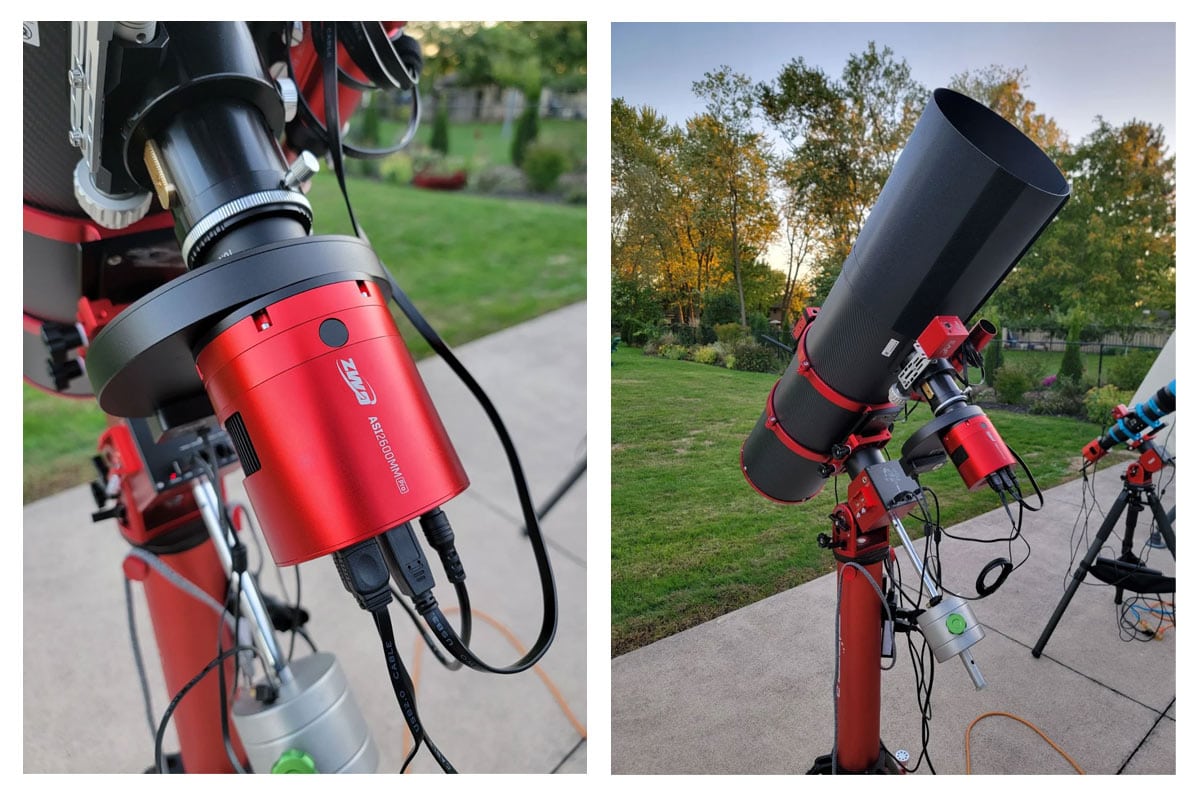
The ZWO EAF was all I needed to maintain razor-sharp images night after night. I highly recommend this simple upgrade to the CarbonStar 200.
Star Flaring from Mirror Clips
Several readers who purchased the CarbonStar 200 (or similar GSO-made Imaging Newtonians, such as the StellaLyra 8″) have noted a few important considerations. One owner pointed out that the mirror clips can introduce noticeable flares on bright stars, and that a dedicated mirror mask (like this one offered through First Light Optics) may help resolve this.
Another observation came from running a flat contour plot in PixInsight, which revealed slight off-center brightness in the field. While this isn’t unusual for fast Newtonians, it’s worth checking in your own data.
The optional Apertura dew shield measures around 8″ in length, though some recommend using one that’s 1.5× the telescope’s aperture for optimal performance. These practical insights from fellow users highlight both the strengths and quirks of the design, and provide some additional steps you can take to fine-tune performance.
A Smaller Alternative: Askar N160
If the CarbonStar 200 feels a little large for your setup, the Askar N160 is another imaging Newtonian worth considering. It combines a 160mm aperture with a compact carbon-fiber tube and an included coma corrector, delivering a 544mm focal length at f/3.4.
I’ve been using it with the ZWO ASI585MC Air and ZWO AM3 mount for a portable backyard imaging setup. Live stacking galaxies and star clusters on my tablet has been particularly enjoyable.
You give up some aperture and focal length compared to the CarbonStar 200, but gain wider framing and a smaller telescope to handle. Read my Askar N160 review for sample images and practical notes on focusing, collimation, and camera spacing before choosing between these two imaging Newtonians.
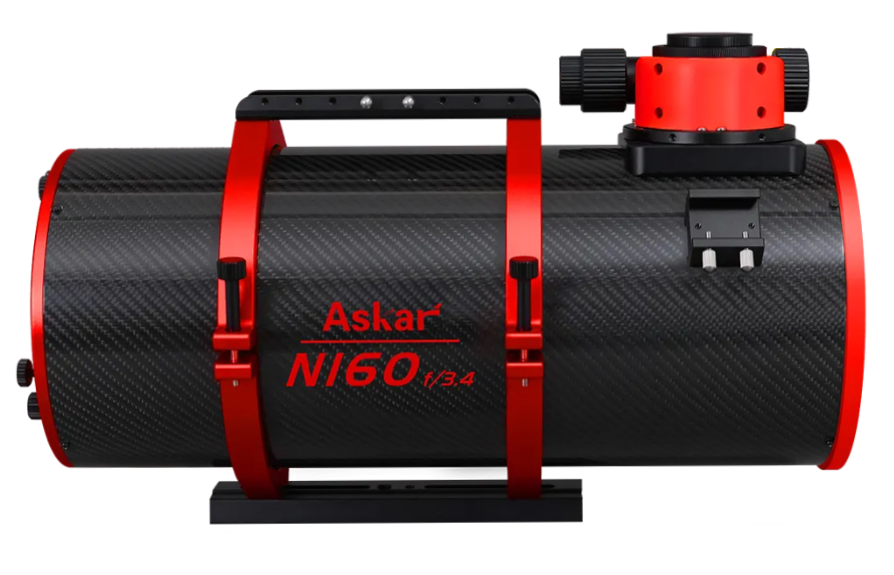
The Askar N160 feels a lot like a smaller version of the CarbonStar – closely matched to the CarbonStar 150.
Final Thoughts
If you’re a backyard astrophotographer trying to make the most of limited clear skies, the Apertura CarbonStar 200 is worth considering. If you take the time to read the full report about this telescope’s development process, you’ll realize that this is not a simple rebrand of an 8-inch Newtonian.
The CarbonStar 200 offers a combination of fast optics, generous aperture, and stable carbon fiber construction. The rack-and-pinion focuser is robust enough to handle a heavy APS-C camera and filter wheel, and upgrading to an automatic focuser is an option.
It won’t replace my refractors for every target, but for deep, light-hungry projects, this reflector has earned a place in my imaging lineup. As I take new images with the CarbonStar from the backyard (including narrowband images with my monochrome camera), I’ll update the post with the fresh data.
Key Takeaways for Everyday Use:
-
Shorter exposure times mean more frames before weather changes.
-
Stable focus saves you from constant refocusing on temperature drops.
-
Works with popular astro cameras without heavy cropping.
-
Lightweight enough for most mid-range mounts.
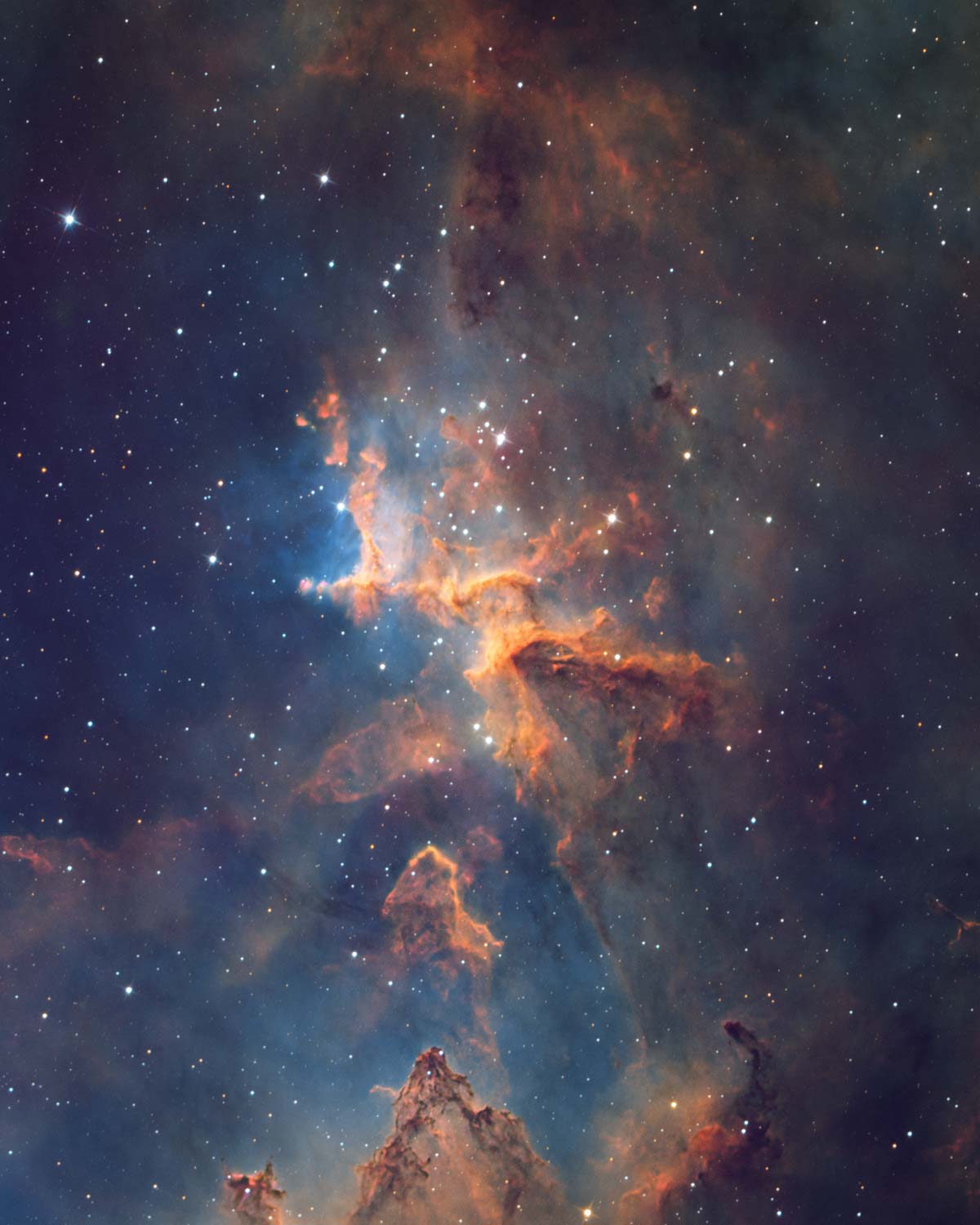
I captured 30 hours of total exposure time on Melotte 15 using the CarbonStar 200 and my ZWO ASI2600MM Pro camera. (Hubble Palette)

Trevor Jones is an astrophotographer and a valued member of the RASC. His passion is inspiring others to start their astrophotography journey on YouTube so they can enjoy the night sky as much as he does. His images can be seen in astronomy books & online publications, including the NASA Astronomy Picture of the Day.

Which filter(s) did you use to capture the veil nebula?
I used the Optolong L-eXtreme filter!
Hi Trevor, I purchased the CarbonStar also and am really enjoying it. Your unboxing and review is very good. One thing you didn’t mention and I don’t like are the flares on stars caused by the mirror clips. I’m waiting on them to offer a mirror mask to resolve this issue. Also, I ran the flat contour plot in Pixinsight and it shows the brightness level of the image off center on my telescope. Did you run this check, and if so could you post the result? Thank you. The dew shield provided by HP looked like it was around 8″ long, is that the case? I read that dew shields should be 1 1/2 times the aperature of the telescope. Do you have an opinion on that? I enjoy your videos very much for the technical descriptions, as well as the personal touch of including Rudy and Ashley in them. Keep up the terrific work!
Thank you for the kind words, David! I didn’t notice the mirror clip flare issue, but I will investigate with further testing (hopefully tonight, actually). I haven’t heard that ratio for dew shields before, but it sounds about right to me! Unfortunately I had to send the CarbonStar 200 dew shield back already – but I can dig deeper into the flat contour plot and star flaring. Super helpful points, thank you!
Hey David,
I bought a StellaLyra 8 inch Imaging Newtonian (Virtually the same GSO Made OTA as the CarbonStar 200) from First Light Optics in the UK right before they announced the CarbonStar 200. First Light Optics sells this Mirror Mask you might want to consider. Should work fine.
https://www.firstlightoptics.com/misc/backyard-universe-primary-mirror-mask-for-gsostellalyrats-200mm-newtonian.html
Hi Ed, I’m very interested in buying this scope – can I ask what coma corrector you use?
Trevor, first many thanks for the wealth of information you provide, great advice, and genuine love of this amazing “hobby” – whatever the right word is. It’s contagious!
It isn’t obvious to me if this telescope works for visual astronomy. I read the user manual but didn’t see a single reference. I think it is but want to make sure before I “buy it for the kids”. Ha ha. They really enjoy the visual experience but I think they prefer the pictures (Esprit 100 is the current scope).
Many thanks!
Thank you, Abe! The CarbonStar 200 CAN be used for visual astronomy as well. I’d recommend picking up a nice wide-field eyepiece (25mm would be perfect) if you don’t already own one. I’m not much of a visual guy but I’ve heard this one is great: https://bit.ly/4oGyV4A
This is great. Thanks heaps!
Hi Trevor, what counterweight is on your AM5 and how do you decide how far up the bar to place it?
Hi Phil. It’s the counterweight from the Sky-Watcher Wave 150i. I just guessed where to place the weight on the shaft as you can’t release the clutches on the AM5!
I’m curious how guiding went with the 2600mc Air and this scope, enough guide stars and star quality was ok? Thinking about a 2600mm Duo with 2″ filters and whether or not it would guide well with the light falloff towards the guide sensor.
Hi Eric. In my experience, the guiding was great with the 2600MC duo/air through this scope, even with a strong dual-narrowband filter in front of it.
where did you get the dew sheild? i cant find the Apertura one for sale. Highpoint just has the 150 one for sale.
Hello, what “seeing conditions” would this set up work with? Right now the seeing conditions are constantly “average” and “below average”.
I regularly use a 300-400 lens, I’d like to upgrade but am not sure if the environment where I am would work with an 800 mm lens.
https://www.cleardarksky.com/csk/faq/seeing_catagories.html