How to Photograph the Wolf’s Cave Nebula (VdB 152)

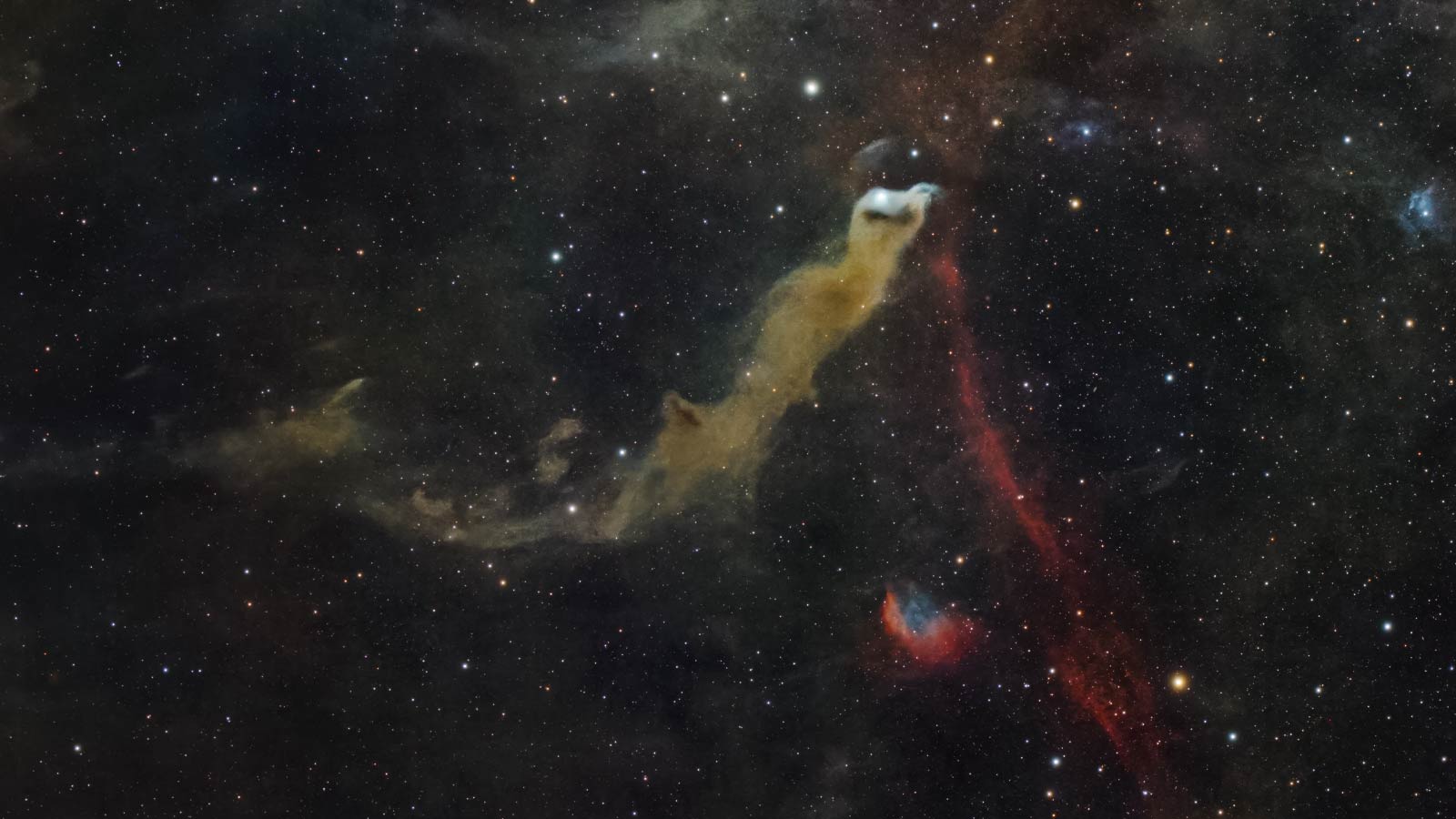
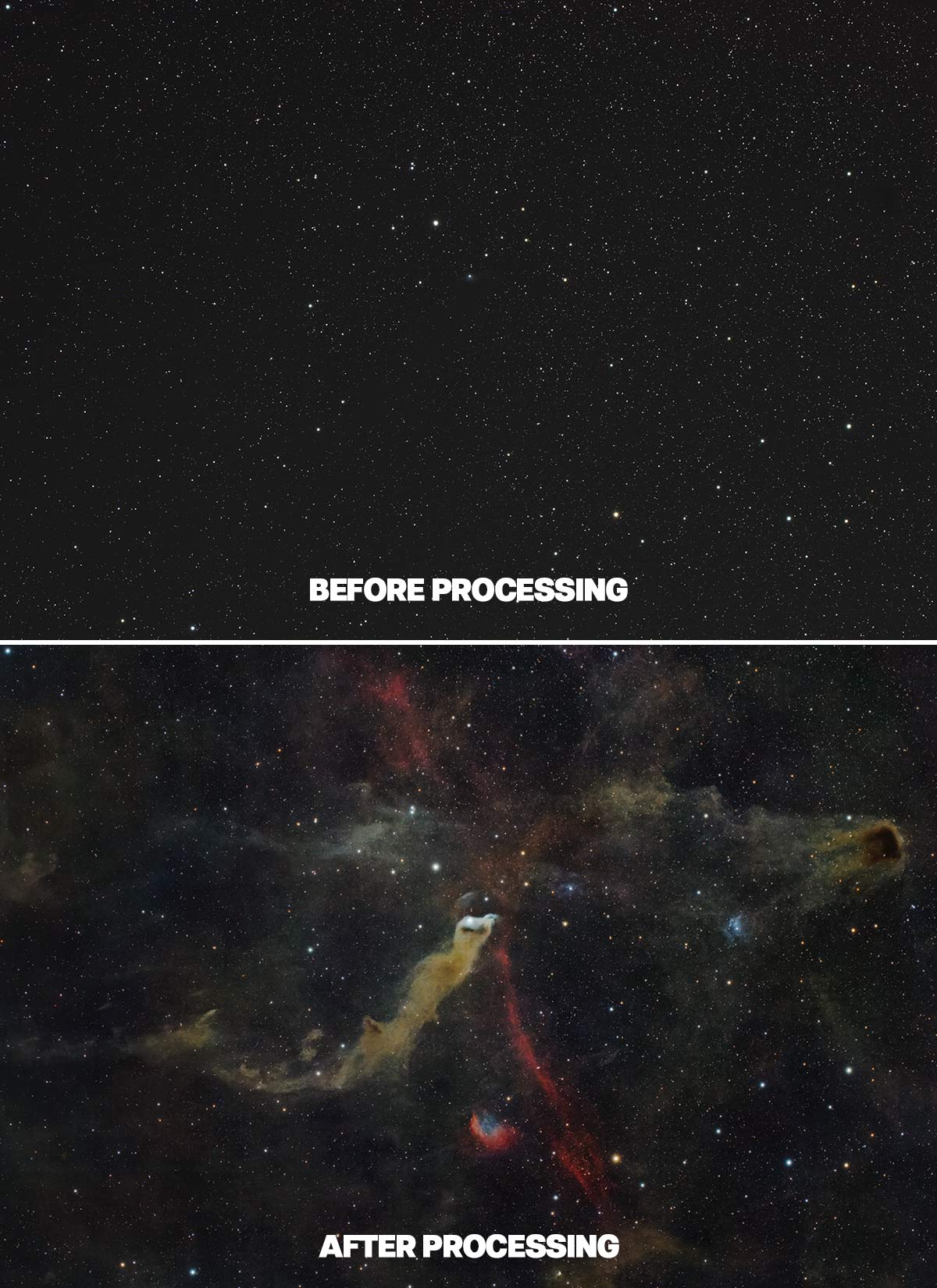
At first glance, this looks like an empty patch of sky. There is no bright red nebula jumping off the screen and no familiar galaxy waiting in the middle of the frame.
But hidden among the stars is the Wolf’s Cave Nebula, an extremely faint complex of blue reflection nebulosity and dark interstellar dust in the constellation Cepheus.
I have wanted to photograph the Wolf’s Cave Nebula for years, but I knew it would be a difficult target from my light-polluted backyard.
When Ashley and I booked a campsite in southern Ontario during the new moon, I finally had the darker sky and clear northern view I needed to try it.
The Wolf’s Cave Nebula is a dusty deep-sky complex approximately 1,400 light-years away in Cepheus. Its small blue reflection nebula, vdB 152, sits at the tip of the long dark nebula Barnard 175.
Wolf’s Cave Nebula Facts
| Common name | Wolf’s Cave Nebula |
|---|---|
| Catalog designations | vdB 152 and Ced 201 |
| Dark nebula | Barnard 175 |
| Object type | Reflection and dark nebula complex |
| Constellation | Cepheus |
| Distance | Approximately 1,400 light-years |
| Best imaging method | Broadband imaging under dark, moonless skies |
Photographing an Empty Patch of Sky
When I pointed the telescope toward this region, the first exposure was not very encouraging. The camera showed a crowded star field surrounded by a whole lot of darkness.
The blue reflection nebula barely registered, and the dusty shape of Barnard 175 was almost impossible to separate from the background.
Some deep-sky objects provide immediate gratification. Even a single exposure of the Orion Nebula or North America Nebula can reveal an obvious shape.
The Wolf’s Cave is different. Its signal is subtle, spread across the background, and very easy to bury beneath light pollution, moonlight, noise, or aggressive processing.
This was why the campsite mattered. Our location was under Bortle 4 skies, far enough from the strongest city glow to give the camera a much cleaner starting point.
We also planned the trip around the new moon so bright moonlight would not wash over the same faint dust I was trying to record.
If you are unfamiliar with these sky-quality classes, my guide to the Bortle scale explains what the numbers look like in the real world.
What Is the Wolf’s Cave Nebula?
The Wolf’s Cave Nebula lies along the northern Milky Way in Cepheus, a constellation filled with molecular clouds and dusty deep-sky objects. The blue feature is cataloged as vdB 152 in Sidney van den Bergh’s catalog of reflection nebulae. It is also known as Ced 201.
Extending away from the blue nebula is a long, comet-like lane of obscuring dust called Barnard 175. Together, the reflection nebula and dark cloud form the complex commonly called the Wolf’s Cave.
Dark nebulae do not glow brightly on their own. Their dense dust blocks the light of stars behind them, creating what looks like a gap in the Milky Way. The “empty” area in my image is therefore not empty at all. It contains enough interstellar material to hide a portion of the crowded background star field.
Why Is vdB 152 Blue?
vdB 152 is a reflection nebula. Instead of producing visible light through ionized gas, it becomes visible when dust scatters light from a nearby blue-white star. Shorter blue wavelengths scatter more efficiently than longer red wavelengths, giving the nebula its characteristic blue color.
The illuminating star is thought to be something of a visitor. Measurements show that its motion through space differs from the motion of the cloud, suggesting that it wandered into the dusty region rather than forming there. Ultraviolet light from the star may also produce a very dim reddish luminescence in the surrounding dust.
You can see a much deeper reference image and scientific description on NASA’s Astronomy Picture of the Day page for the Wolf’s Cave Nebula.
The Wolf’s Cave is not the same object as the Cave Nebula. Wolf’s Cave refers to vdB 152, Ced 201, and Barnard 175. The brighter Cave Nebula is Sh2-155, also known as Caldwell 9. Both are in Cepheus, which makes the similar names especially confusing.
Taking Astrophotography to the Campsite
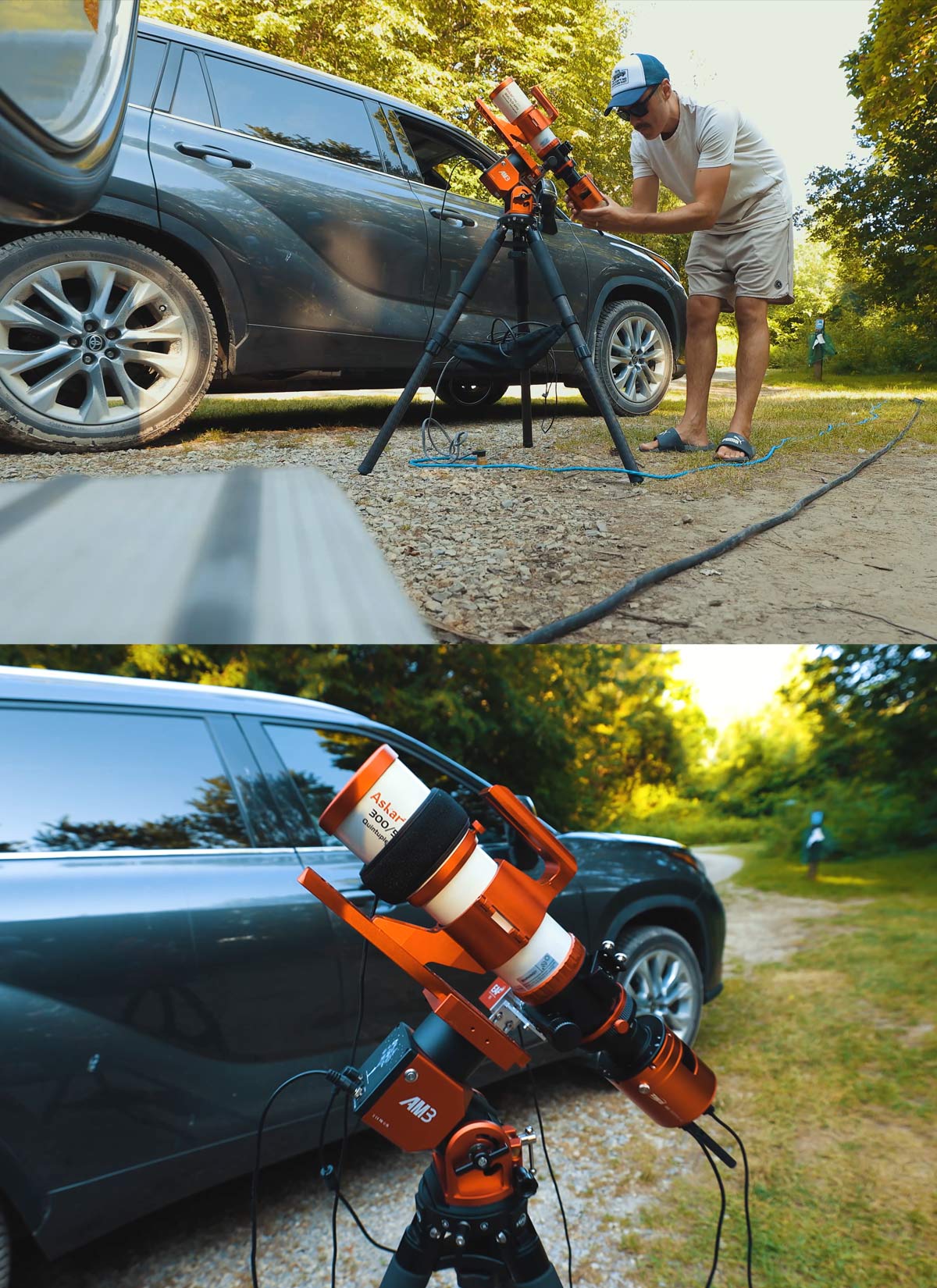
Packing for a remote astrophotography trip is its own puzzle. The telescope, mount, camera, power equipment, and a ridiculous number of cables all need to arrive safely. I try to pack each system together and load everything in reverse order, so the first item I need is not trapped at the bottom.
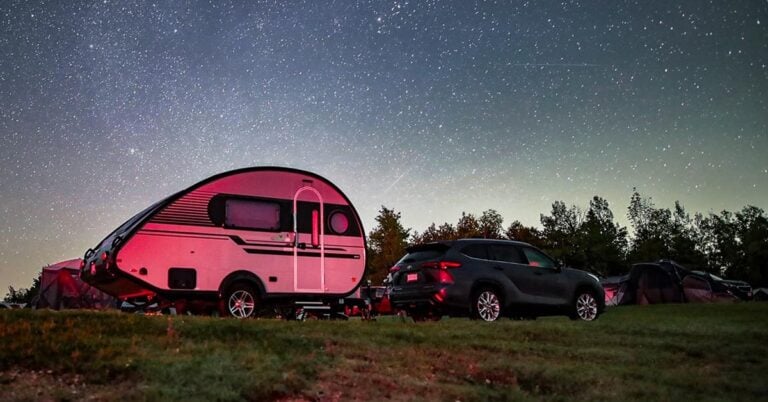
Our TAB 400 teardrop trailer makes these trips far more comfortable than my early dark-sky adventures. We can travel with the telescope while still having a warm bed, a kitchen, and coffee in the morning. That changes the experience from something to endure into something Ashley and I can slow down and enjoy.
Rudy may enjoy the camping trips more than either of us. Every campsite brings new trails and smells to investigate. As he gets older, these trips feel more important, and we try to let him experience as much as possible while he can still enjoy every step.
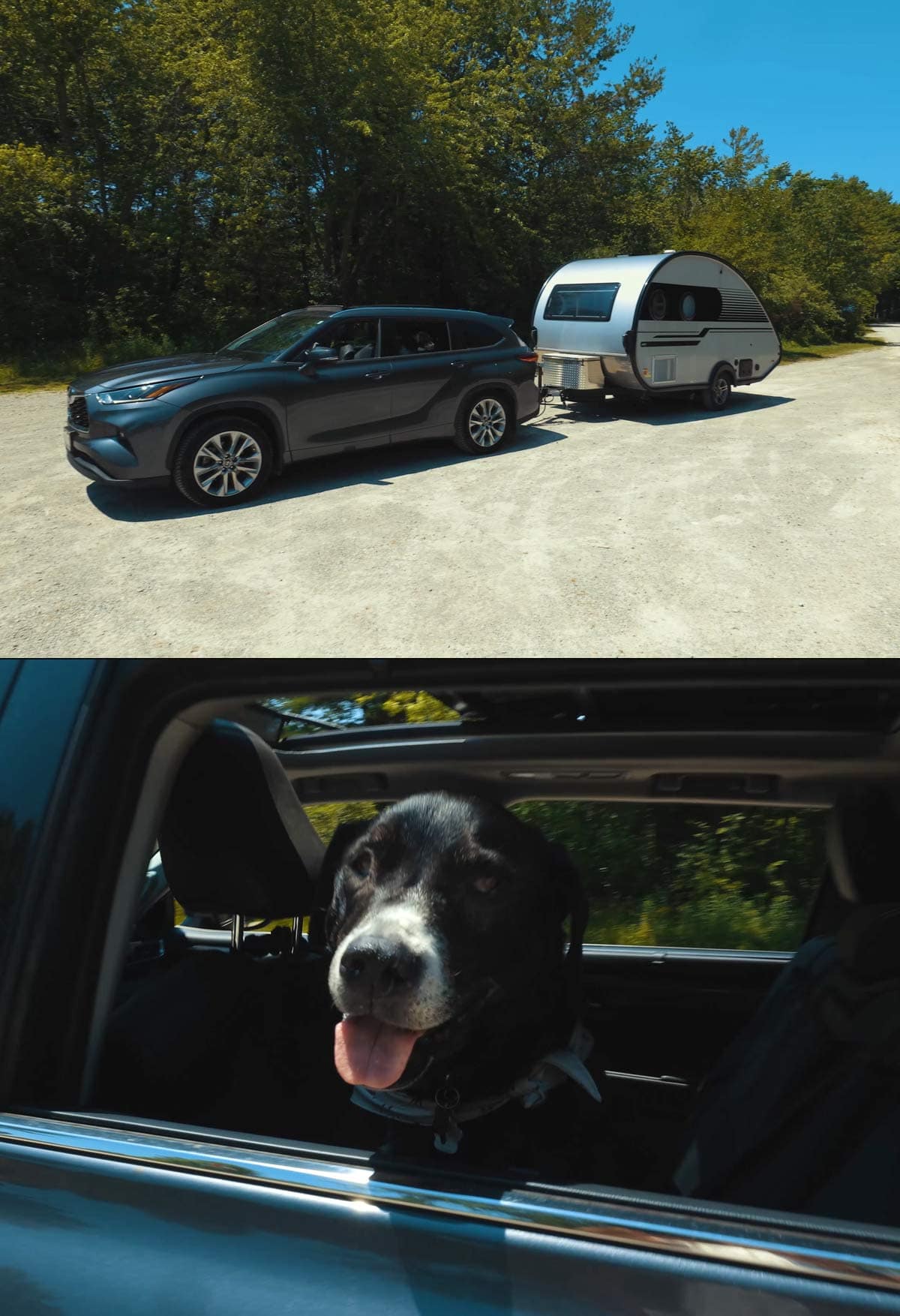
Rudy enjoying his trip to dark skies (and ready to get out of the car after a long drive).
My Portable Wolf’s Cave Astrophotography Setup
At a campsite, every piece of equipment has to earn its space. I used a compact setup that was easy to transport but still capable of recording a serious deep-sky image:
- Telescope: Askar FRA300 Pro
- Camera: ZWO ASI2600MC Air
- Mount: ZWO AM3
- Sky conditions: Bortle 4
- Moon phase: New moon
- Filter: No light-pollution or narrowband filter
The Askar FRA300 Pro is a 60mm astrograph with a 300mm focal length and a fast f/5 focal ratio. Its wide field of view framed the long shape of Barnard 175 and the surrounding Cepheus dust rather than isolating only the small blue reflection nebula.
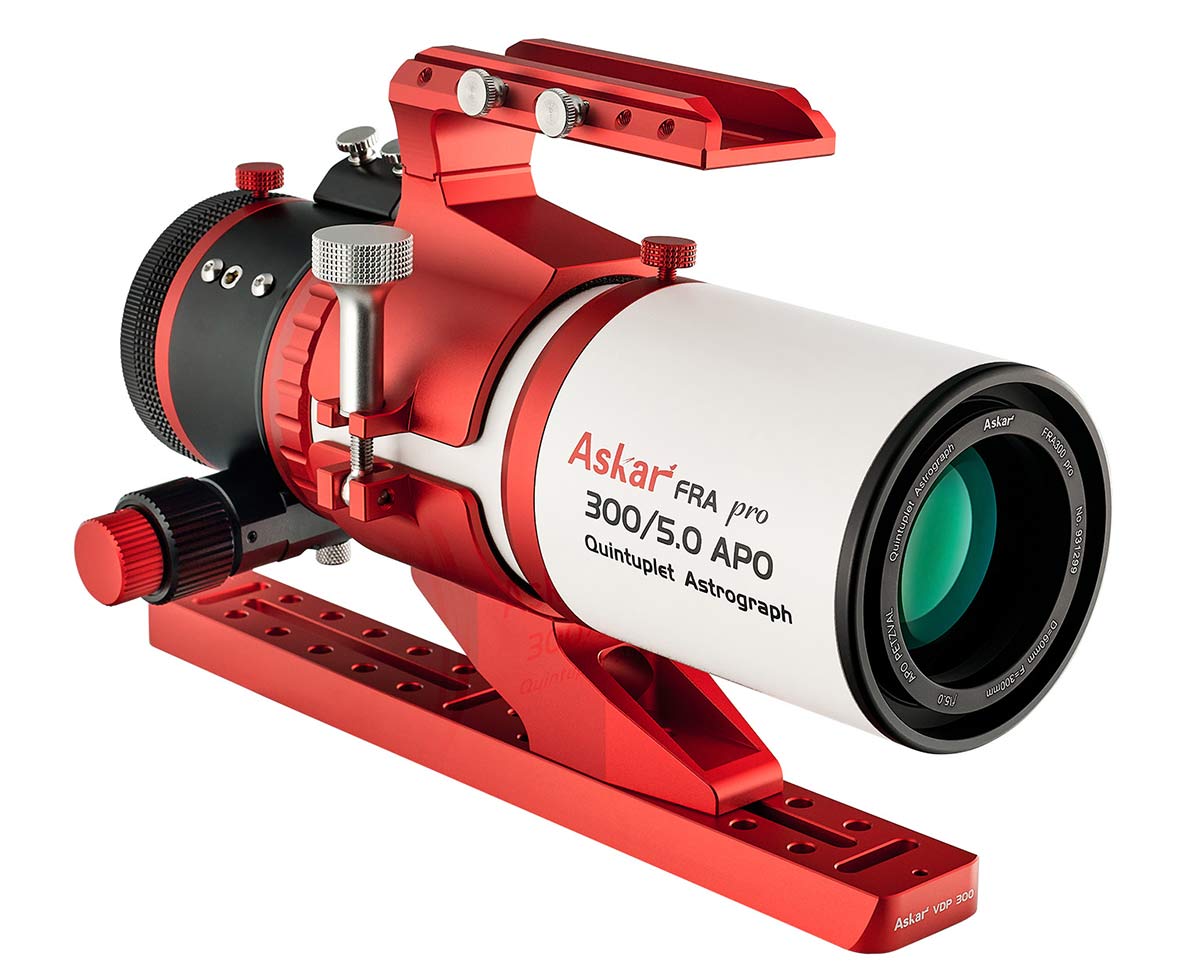
I used the Askar FRA300 Pro Quintuplet APO Refractor to capture the Wolf’s Cave Nebula.
I paired it with the ZWO ASI2600MC Air, a cooled 26-megapixel APS-C color camera with built-in guiding and smart control. Combining imaging, guiding, and control in the camera body helped reduce the number of separate components I needed to bring into the field.
The lightweight ZWO AM3 mount completed the portable system. Once everything was polar aligned, focused, and running, the telescope could quietly collect exposures while we spent time around the campsite.
Why I Did Not Use a Narrowband Filter
I captured the Wolf’s Cave Nebula without a light-pollution or dual-narrowband filter. This target depends heavily on broadband light: the blue starlight scattered by vdB 152, the natural colors of the dense star field, and the subtle brown dust surrounding Barnard 175.
A dual-narrowband filter is extremely effective when a nebula emits strongly in hydrogen-alpha and oxygen III. However, it rejects much of the continuous spectrum needed to record a reflection nebula. That is why filters designed for bright emission nebulae are generally a poor match for vdB 152.
A mild broadband filter can sometimes help under suburban skies, but for this project I wanted the cleanest natural color possible. Driving to a darker location was more valuable than trying to filter the light pollution out afterward. My dual-narrowband filter guide explains why reflection nebulae belong in the broadband category.
My First Finished Image of Wolf’s Cave
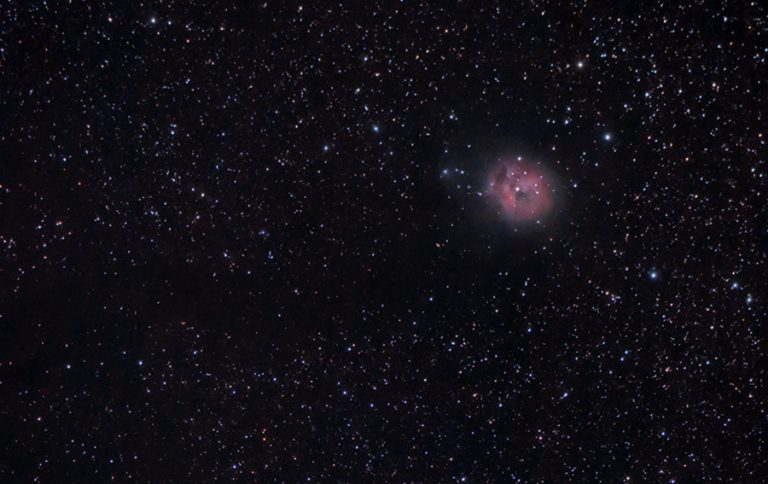
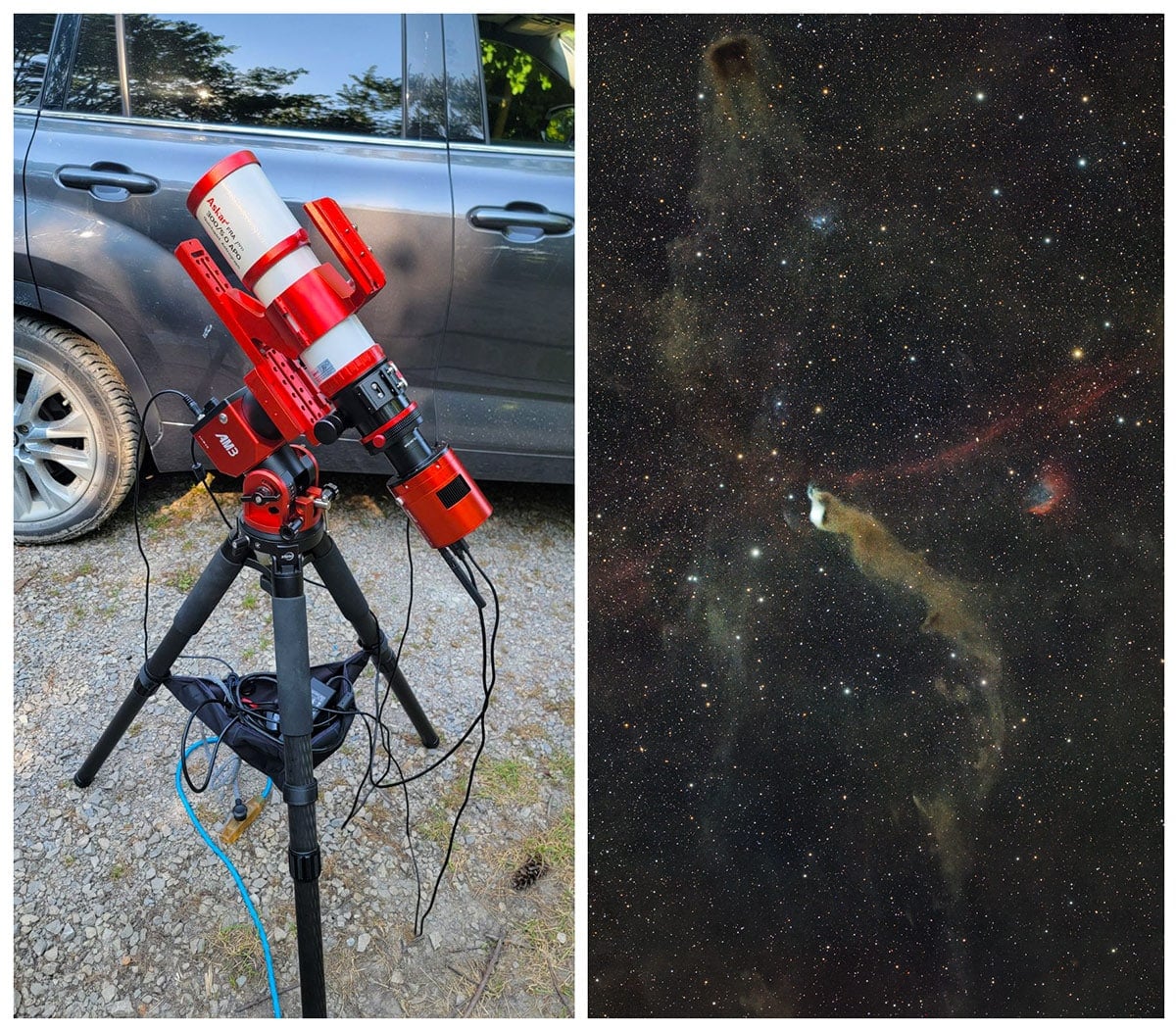
After stacking and processing the data, the hidden structure finally emerged. The small blue reflection nebula sits at one end of Barnard 175, while the dusty cloud extends across a packed field of stars. It looks as if something had been hiding inside an empty patch of sky, which is precisely what was happening.
I am proud of what this small telescope captured from our campsite, but I also know the image can go much deeper. Exceptional versions of this target may contain dozens of hours of broadband exposure, sometimes supplemented with hydrogen-alpha data to reveal extremely faint red structures in the area.
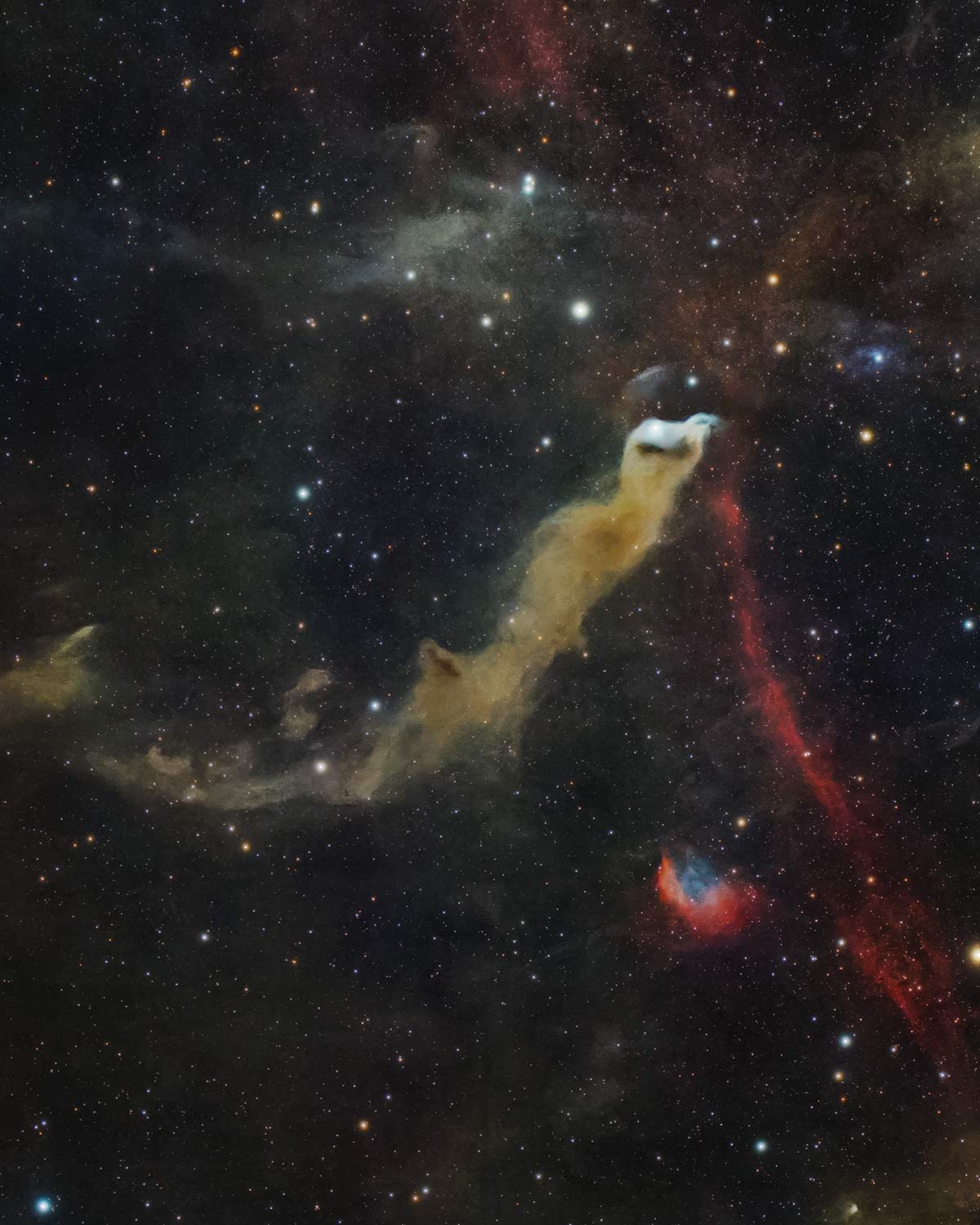
My final image of the Wolf’s Cave Nebula. 160 x 3 minutes using Gain 100 (8 hours total exposure).
I did not collect that much data during one camping trip. This image represents the opportunity I had, not the end of the project.
Some astrophotography targets take several clear nights spread across an entire season. You collect a few hours, wait for another moonless night, and carefully add the new exposures to everything captured before.
For now, this is my version of the Wolf’s Cave Nebula: an affordable portable telescope, a compact mount, and a one-shot-color camera under dark southern Ontario skies.
No permanent observatory, no narrowband filter, and no instant result. Just natural starlight and enough patience to reveal what was hiding in the darkness.

Trevor Jones is an astrophotographer and a valued member of the RASC. His passion is inspiring others to start their astrophotography journey on YouTube so they can appreciate the night sky as much as he does. His images have been featured in astronomy books and online publications, including the NASA Astronomy Picture of the Day (APOD).