Black Hole Star: JWST Discovers a Strange New Cosmic Object

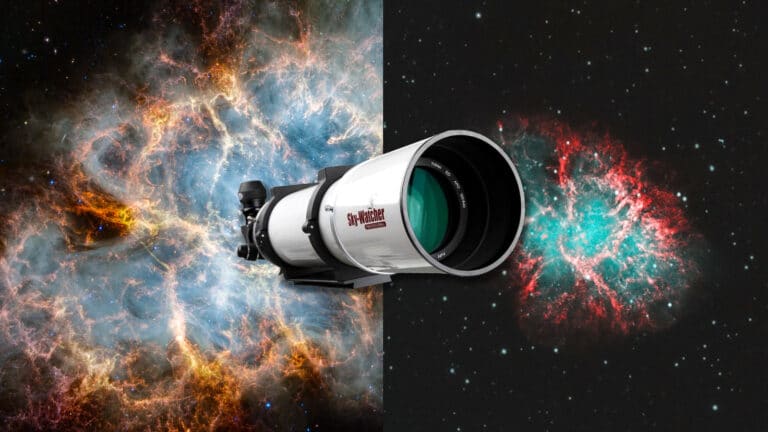
When I photograph a tiny red object in the night sky, it is usually an emission nebula glowing in hydrogen-alpha light. When the James Webb Space Telescope finds a tiny red object, it can turn out to be something far stranger.
Astronomers using JWST have studied an object called MoM-BH*-1 that existed just 660 million years after the Big Bang. It looks like a red point of light, but its spectrum does not behave like an ordinary star or galaxy. The leading explanation is a previously unobserved configuration that researchers are calling a black hole star.
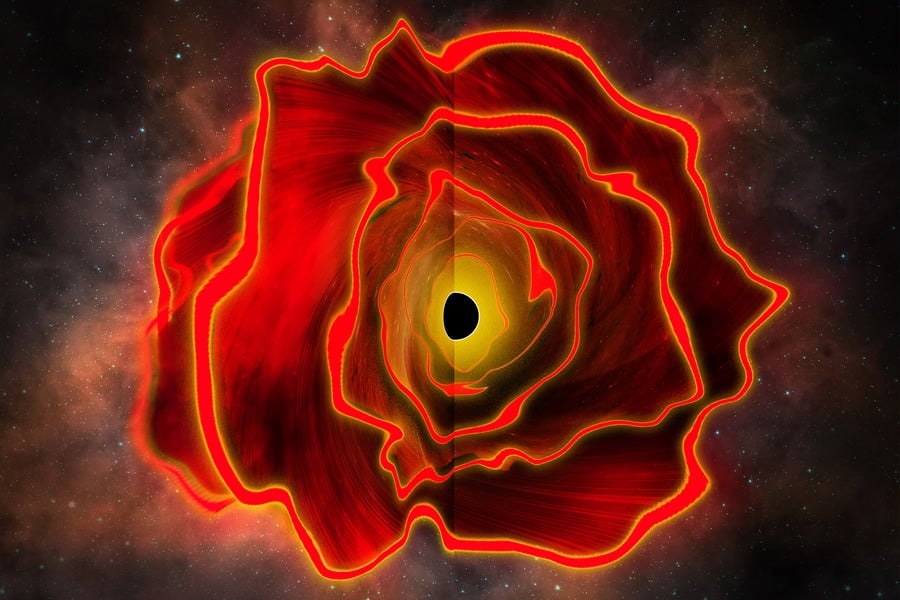
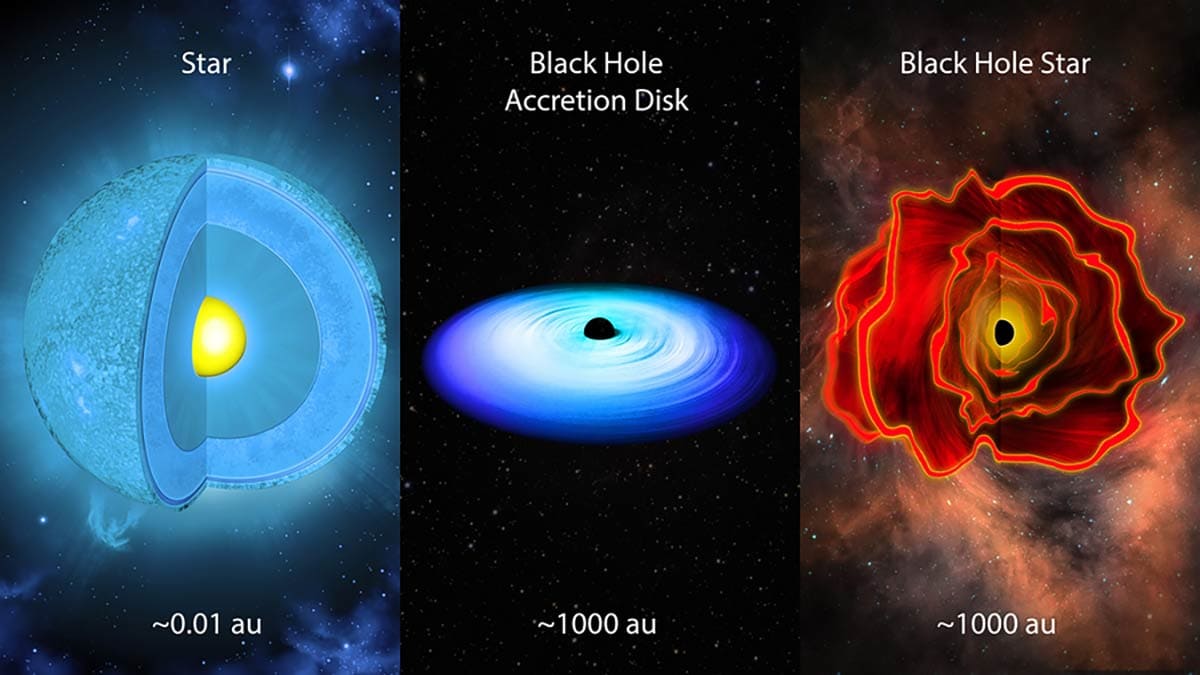
A black hole star is not a normal star with a black hole sitting inside it. It is a proposed system in which an actively feeding black hole is surrounded by an enormous, extremely dense envelope of gas. The black hole supplies the energy, while the gas reprocesses that energy and produces something resembling a stellar atmosphere.
Black Hole Star Discovery at a Glance
| Object | MoM-BH*-1 |
|---|---|
| Observed with | James Webb Space Telescope |
| Cosmic age | Approximately 660 million years after the Big Bang |
| Redshift | 7.7569 |
| Power output | Roughly 100 billion times the Sun’s luminosity |
| Leading interpretation | An accreting massive black hole inside a dense hydrogen envelope |
What Did JWST Actually See?
MoM-BH*-1 was discovered during a survey called Mirage or Miracle, or MoM, which was searching for extremely early galaxies. In JWST images, the object appeared as a very bright red dot. The real breakthrough came from spectroscopy, where astronomers separated its light into individual wavelengths.
The spectrum contained an enormous Balmer break, where the amount of detected light dropped sharply below a particular wavelength associated with hydrogen. Stellar populations can produce this feature, but the break in MoM-BH*-1 was stronger than ordinary stars could explain.
The spectrum also contained broad, complex hydrogen-beta emission and absorption in multiple hydrogen lines.
According to the peer-reviewed study published in Nature, the observations are best reproduced by an energetic black hole buried inside extraordinarily dense, turbulent gas. The preferred model is almost dust-free: hydrogen itself absorbs and reprocesses the radiation, making the object appear red.
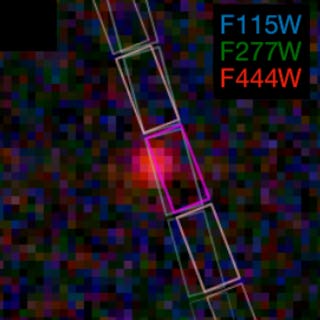
Image of MoM-BH*-1 taken by the James Webb Space Telescope. Rohan P. Naidu et al (Wikipedia)
How Can a Black Hole Look Like a Star?
A normal star is powered by nuclear fusion in its core. A black hole star would be powered by accretion instead. Gas falling toward the central black hole releases tremendous energy, which then passes through a thick surrounding cocoon.
The gas envelope acts like a gigantic pseudo-photosphere. It absorbs radiation from the hidden central engine and releases it from a much larger effective surface. Models discussed in the research place this envelope across approximately 10 to 100 astronomical units, comparable to the scale of our solar system.
That size is model-dependent rather than a surface JWST directly resolved. From this distance, MoM-BH*-1 remains a point of light. Its internal structure is being inferred from the spectrum and computer models.
The black hole’s exact mass is also uncertain because familiar methods may not work in such an extreme environment. MIT’s summary quotes a working estimate of approximately 100,000 solar masses, while the Nature paper’s detailed models discuss roughly one million to 10 million solar masses.
The researchers warn that standard calculations could overestimate black hole masses by orders of magnitude, so this measurement is not yet settled.
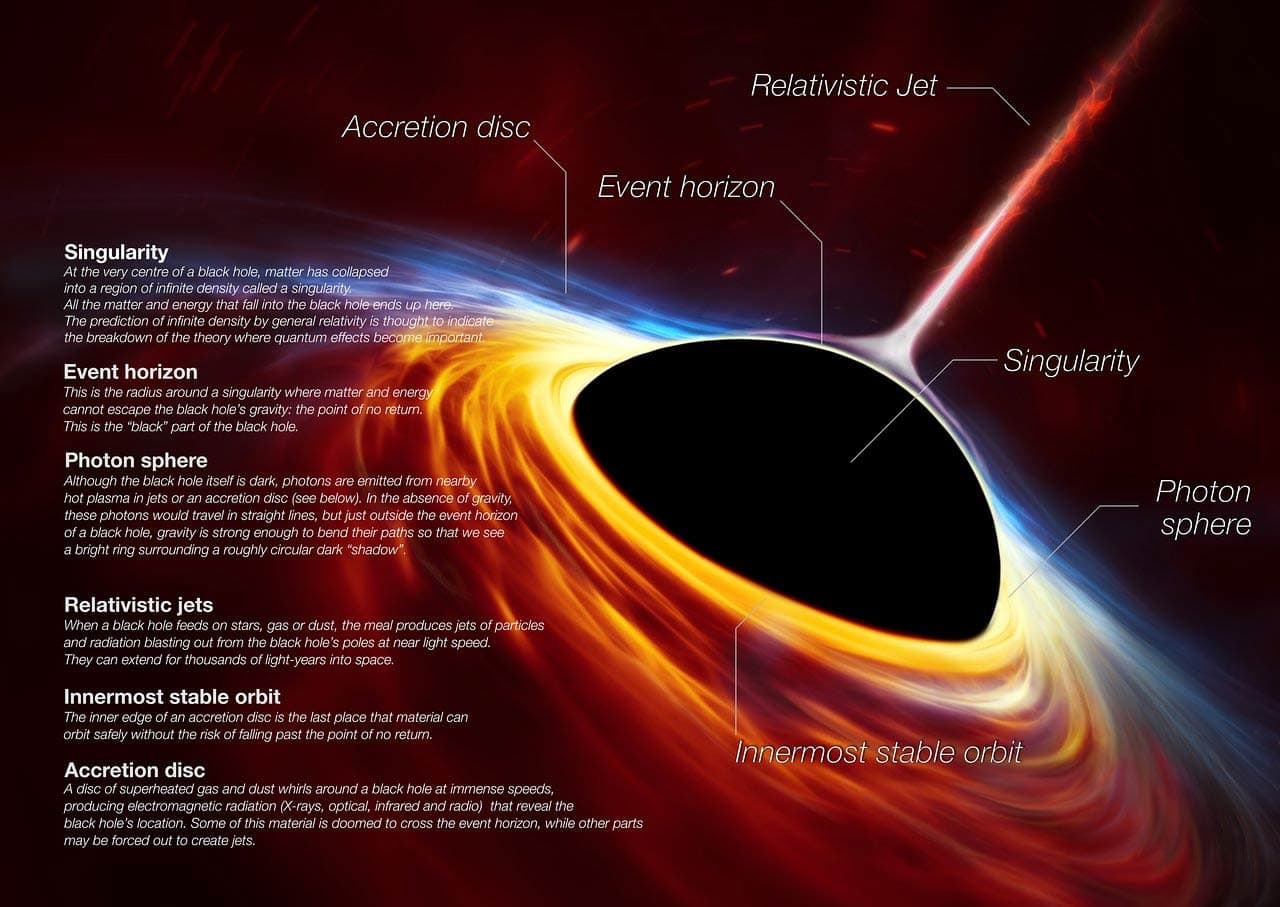
Anatomy of a Black Hole. ESO, ESA/Hubble, M. Kornmesser/N. Bartmann.
Why This Discovery Matters
JWST has uncovered many compact objects in the early universe known as little red dots. They are bright, red, and common in ancient observations, yet they do not fit comfortably into the usual categories of galaxies or active black holes.
MoM-BH*-1 is particularly valuable because the proposed black hole star appears to outshine nearly all of its host galaxy. That gives astronomers a relatively clean look at the source itself. Similar gas-covered black holes embedded in brighter galaxies could explain many of the other little red dots.
The discovery may also help with a much bigger puzzle: how supermassive black holes grew so quickly after the Big Bang. Dense gas could allow an early black hole to feed at an unusually high rate while trapping or redistributing the radiation that would normally push material away.
A black hole star could therefore represent a brief growth phase on the way to becoming a more familiar active galactic nucleus or quasar.
The black hole star interpretation is currently the strongest model for MoM-BH*-1, but it is not a direct photograph of the object’s interior. Deeper spectra, longer-wavelength observations, and monitoring for variability will be needed to test the idea.
Why Does the Black Hole Star Look Red?
The red appearance of MoM-BH*-1 is not the same kind of red light backyard astrophotographers capture from an emission nebula. In a hydrogen-alpha image, the red signal comes from hydrogen emitting light at a particular visible wavelength.
MoM-BH*-1 was detected primarily in JWST’s longer-wavelength infrared bands. Its spectrum contains an exceptionally strong Balmer break, where its brightness drops sharply below a particular wavelength. The leading model suggests that an extremely dense hydrogen envelope is absorbing and reprocessing radiation from an accreting black hole.
In other words, the object is not necessarily intrinsically red in the way a hydrogen-alpha nebula appears red. Its color provides evidence about how radiation is passing through the dense gas surrounding the black hole.
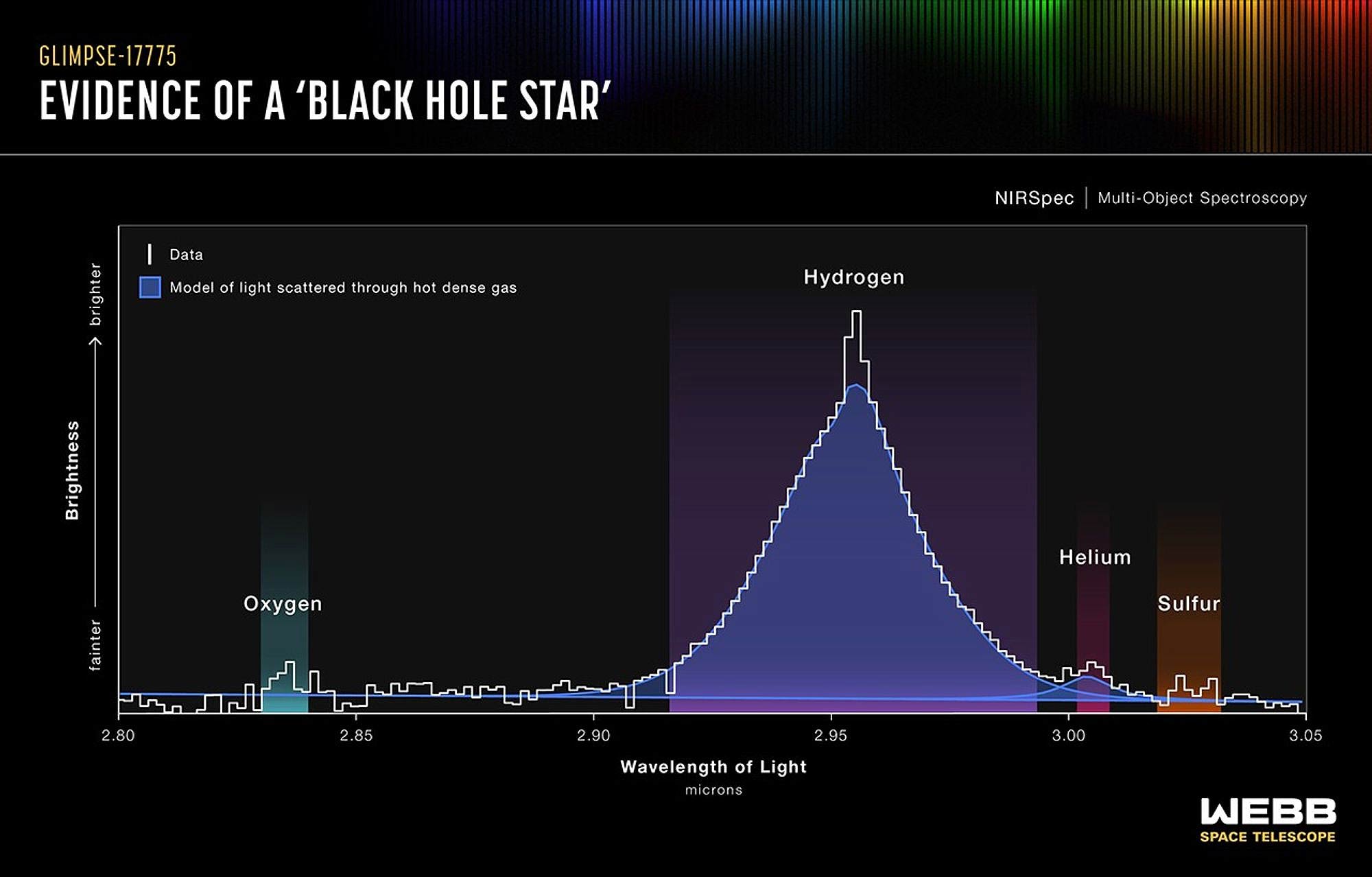
NASA’s James Webb Space Telescope’s spectroscopic data on little red dot GLIMPSE-17775 contains more than 40 spectral lines. The spectrum contains multiple independent indicators that support the theory this little red dot is a black hole star: a rapidly accreting, or growing, black hole enveloped in a hot, dense gas cocoon. This layered, shell-like environment is reprocessing the light emitted from near the black hole and producing the features seen in the spectrum. NASA/JWST.
Black Hole Star Questions
Is a black hole star actually a star?
No. A black hole star is not powered by nuclear fusion like a normal star. It is a proposed system in which an accreting black hole supplies the energy while a vast envelope of dense gas creates a star-like outer atmosphere.
What is MoM-BH*-1?
MoM-BH*-1 is an extremely distant object observed by JWST during the Mirage or Miracle survey. Its unusual spectrum is best explained by a massive black hole surrounded by dense, nearly dust-free hydrogen gas.
When did MoM-BH*-1 exist?
JWST sees MoM-BH*-1 as it appeared approximately 660 million years after the Big Bang. Its measured redshift is 7.7569.
Can an amateur telescope photograph MoM-BH*-1?
No. The object is extraordinarily distant, faint, and unresolved. Detecting its infrared light and analyzing its spectrum required the James Webb Space Telescope.

The Tulip Nebula (Sharpless 2-101) sits right next to Cygnus X-1, one of the first confirmed stellar-mass black holes ever discovered. From our view on Earth, this powerful black hole appears directly within the same cosmic neighborhood as the glowing gas cloud.
An Amateur Astrophotographer’s Perspective
What fascinates me most is how ordinary this object looks in the original image. It is essentially a tiny red dot, exactly the kind of feature that would be easy to overlook in a crowded deep-sky photograph.
As amateur astrophotographers, we spend hours collecting photons to reveal structures hidden inside nebulae and galaxies. JWST is doing the same basic thing on an almost unimaginable scale, collecting ancient light and then using spectroscopy to uncover the physics behind it.
In this case, a red speck may be showing us how some of the universe’s first massive black holes grew. That is a remarkable amount of information hiding inside a single point of light.
Sources
- Nature: A gas-enshrouded and gas-reddened black hole at cosmic dawn
- MIT News: Astronomers discover a brand-new type of astrophysical object
- Phys.org: Black hole star discovery
- SpaceDaily: JWST and MoM-BH*-1
- Wired: Black hole stars are becoming less hypothetical
 Trevor Jones is an astrophotographer and a valued member of the RASC. His passion is inspiring others to start their astrophotography journey on YouTube so they can appreciate the night sky as much as he does. His images have been featured in astronomy books & online publications, including the NASA Astronomy Picture of the Day (APOD).