
What is an Emission Nebula?

An emission nebula is one of the most striking objects in the night sky. A glowing cloud of gas lit up by newly formed stars, often shining in deep reds and vibrant colors. These massive, bright regions mark the places where stars are actively being born.
In this post, you’ll explore what makes an emission nebula glow, break down the different types of emission nebulae, look at how they evolve over time, and highlight well-known examples you’ve probably seen in photos.
Whether you’re just learning the basics or looking for new deep-sky targets to photograph, this guide will help you understand what’s happening inside these huge, energetic clouds and why they’re some of the most exciting objects in the night sky.
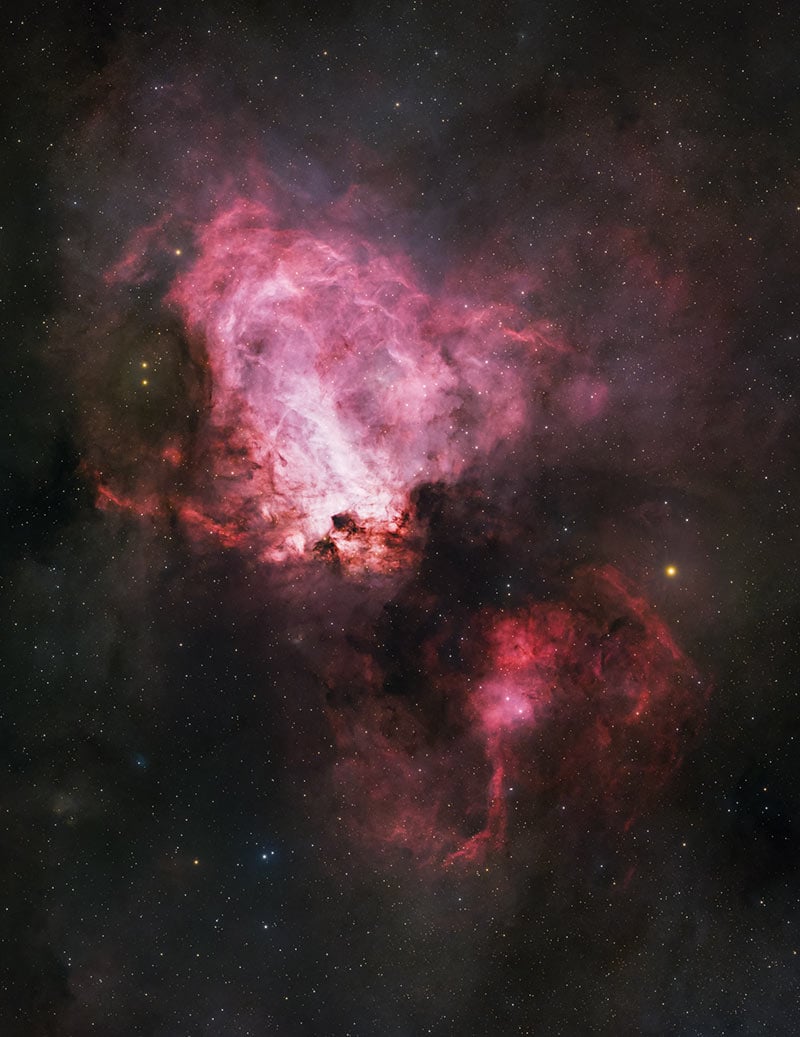
The Swan Nebula (or Omega Nebula) in Sagittarius is a fantastic example of an emission nebula.
Emission Nebulae and Diffuse Nebulae
Emission nebulae are part of a broader group of objects known as diffuse nebulae.
A diffuse nebula is any large cloud of gas and dust that does not have a well-defined outer boundary and appears spread out across the sky. Within this category, emission nebulae represent the regions where the gas has become ionized by nearby hot, young stars and produces its own light.
Other diffuse nebulae, such as reflection nebulae, do not emit light but instead scatter the light of nearby stars. In this sense, emission nebulae are one type of diffuse nebula defined by their ionization and characteristic glow.
Diffuse nebulae include emission nebulae, reflection nebulae, and dark nebulae.
What is an Emission Nebula?
An emission nebula is a large cloud of glowing gas, usually found in an active star-forming region. These nebulae are lit up by nearby hot, young stars that release intense ultraviolet radiation.
When this ultraviolet light reaches the surrounding hydrogen gas, it strips electrons from the hydrogen atoms. This process is called ionization. As the electrons recombine with the hydrogen atoms, the gas releases energy as visible light at specific wavelengths.
One of the most important of these wavelengths is hydrogen-alpha, or H-alpha, at 656.3 nm. This deep-red light is the reason many emission nebulae appear red or pink in long-exposure astrophotography images.
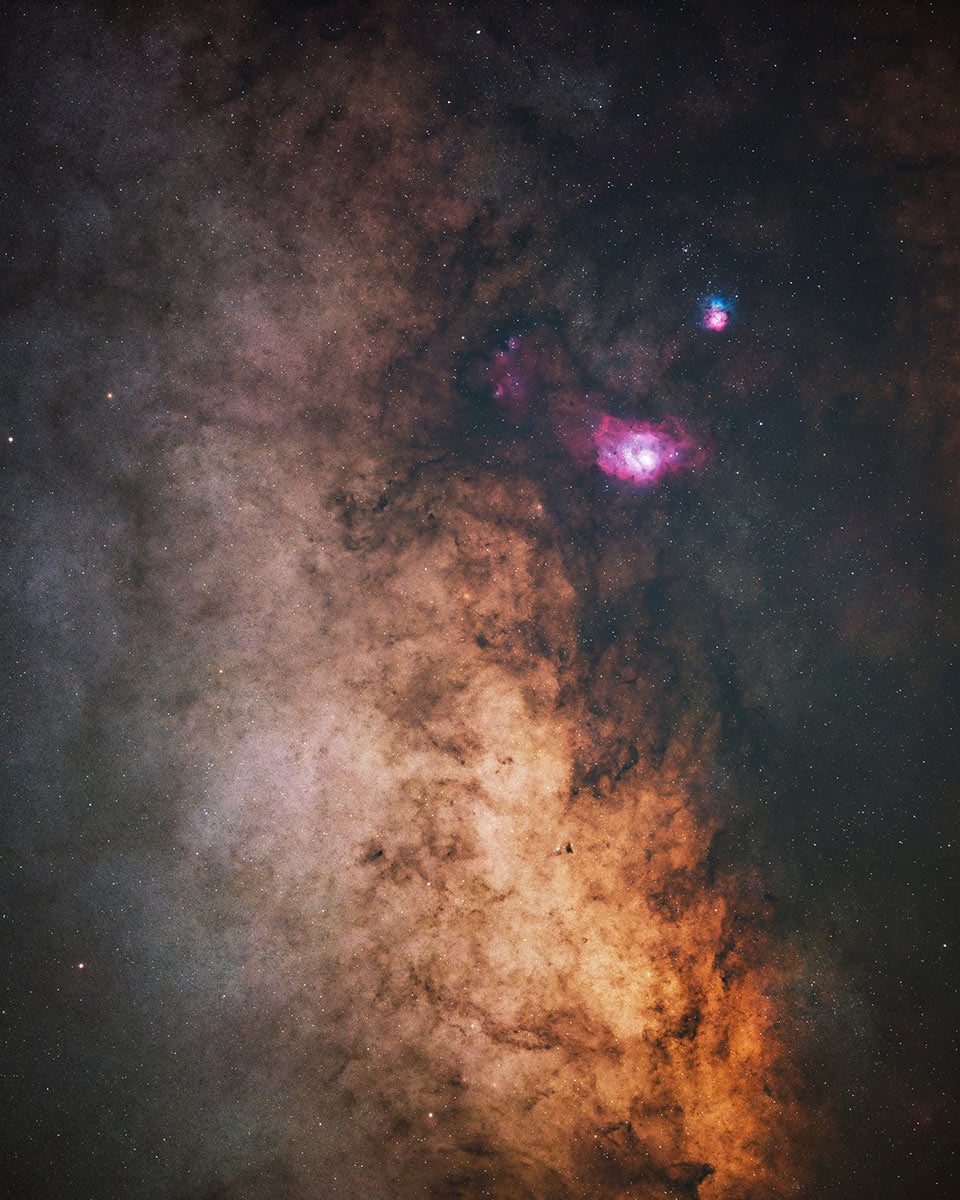
Through astrophotography, we can reveal several emission nebulae in the night sky.
The emission nebulae discussed here are typically known as H II regions. An H II region is a concentration of ionized hydrogen gas surrounding hot, young stars. These regions can span tens or even hundreds of light-years, making them some of the largest and brightest targets in deep-sky astrophotography.
Other objects, such as planetary nebulae and supernova remnants, can also glow because of ionized gas. However, they are usually classified separately because they form in different ways. Emission nebulae, in the classic star-forming sense, are stellar nurseries where new stars are actively shaping the gas around them.
Why Do Emission Nebulae Glow?
Emission nebulae glow because hot, young stars energize nearby gas with ultraviolet radiation. NASA describes emission nebulae such as Sh2-284 as clouds of gas that shine with their own light as stars within or near the nebula flood the gas with intense ultraviolet energy.
Learn more from NASA’s Hubble feature on the emission nebula Sh2-284.
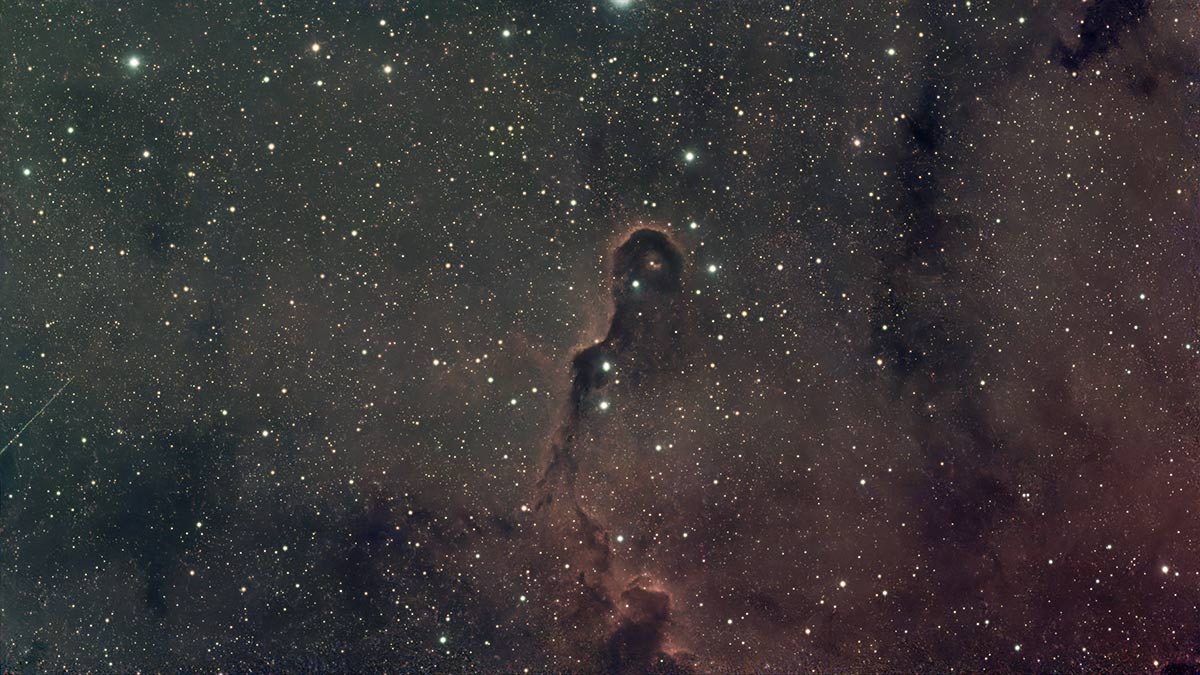
This photo of the Elephant’s Trunk Nebula in Cepheus was captured using a smart telescope in my backyard.
What Are Emission Nebulae Made Of?
Emission nebulae are composed mainly of hydrogen gas, along with smaller amounts of helium, oxygen, sulfur, and other elements.
Hydrogen is the dominant component, and when it becomes ionized by nearby hot stars, it produces the bright hydrogen-alpha emission seen in many astrophotography images.
Other elements such as oxygen (OIII) and sulfur (SII) also emit light at specific wavelengths, contributing to their color and structure in broadband and narrowband images.
That red-pink glow seen in many emission nebulae comes mainly from hydrogen-alpha light, while narrowband astrophotography also captures strong signals from oxygen and sulfur. NASA explains this ionization process in its overview of Hubble’s nebula observations, and ESA/Hubble shows how ionized hydrogen, oxygen, and sulfur are often mapped in images such as the Carina Nebula.

Life Cycle of an Emission Nebula
Emission nebulae begin as enormous, cold clouds of gas and dust drifting through space. Over time, gravity pulls the densest parts of these clouds together, creating pockets where new stars can form.
As young, massive stars ignite inside the cloud, they release intense ultraviolet radiation. This high-energy light strips electrons from nearby hydrogen atoms, turning the gas into ionized hydrogen. Astronomers call this type of star-forming region an H II region.
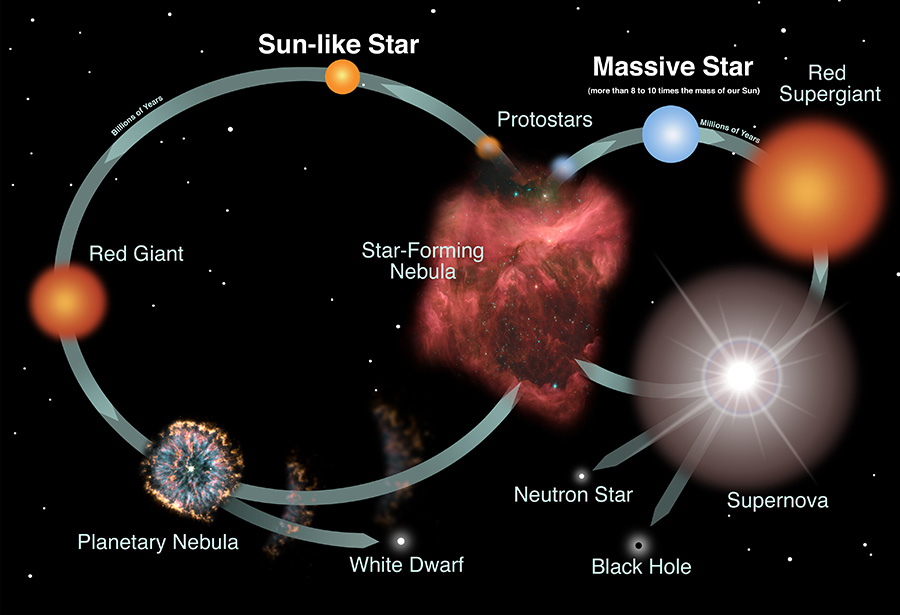
The life cycle of a star (Cambridge University).
Once the gas is ionized, it begins to glow. This is what makes an emission nebula visible. The familiar red-pink color seen in many emission nebulae comes mainly from hydrogen-alpha light, while other gases, such as oxygen and sulfur, can add additional colors, especially in narrowband astrophotography.
The same young stars that light up the nebula also begin to reshape it. Their radiation and stellar winds push outward, carving cavities, compressing some nearby gas, and gradually dispersing the material around them.
Over several million years, the cloud becomes thinner and less dense. As the gas spreads out, there is less material available to ionize and less light for us to see. Eventually, the nebula fades from view, leaving behind young stars, star clusters, and the surrounding interstellar gas they helped shape.
Emission Nebulae Are Temporary Star-Forming Regions
An emission nebula does not glow forever. It shines while young, hot stars are energizing nearby gas with ultraviolet radiation. Over time, that same radiation and the stars’ powerful winds carve into the cloud and disperse the material.
NASA describes this process in the Orion Nebula, where ultraviolet light from massive young stars is actively shaping and hollowing out the surrounding emission nebula.
Learn more from NASA’s overview of Hubble’s nebula observations.
Famous Emission Nebula Examples
There are lots of great emission nebula targets available for astrophotography throughout the year.
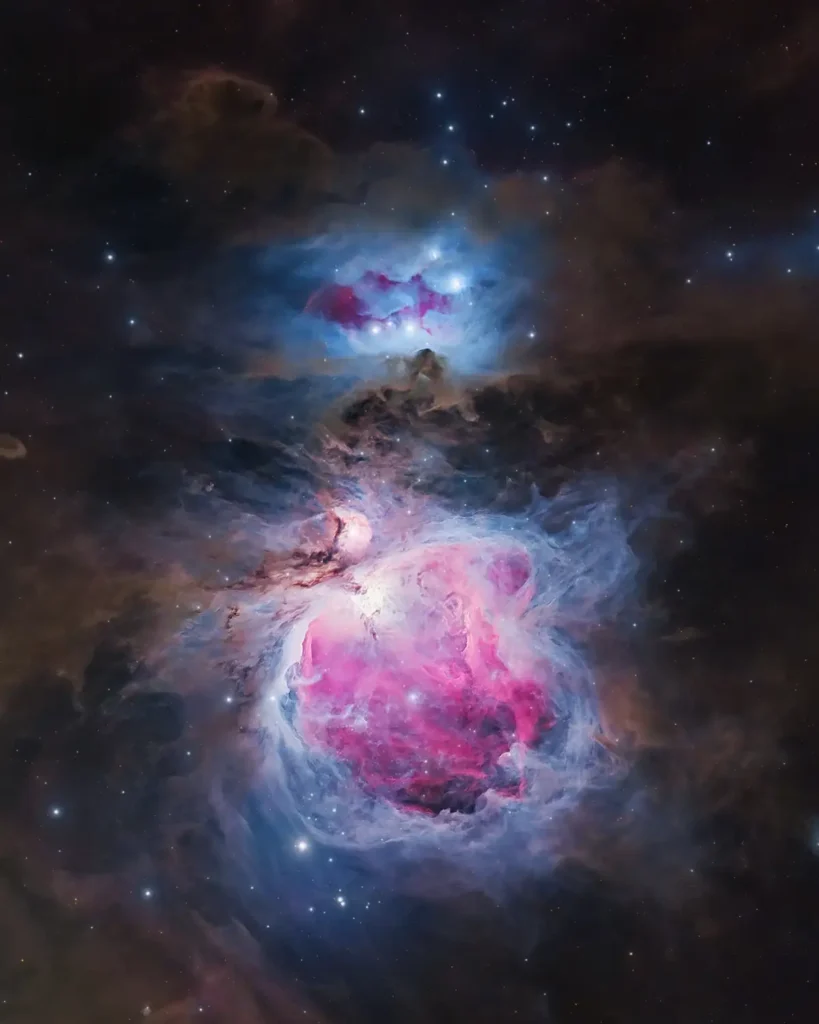
Orion Nebula (M42)
The Orion Nebula is one of the brightest and closest emission nebulae, making it an ideal example of an active H II region.
Its strong emission and large apparent size make it one of the easiest deep-sky objects to photograph.
- Distance: ~1,350 light-years
- Constellation: Orion
- Notable Feature: Visible to the naked eye
- Imaging Difficulty: Beginner
Eagle Nebula (M16)
The Eagle Nebula contains active star-forming regions, including the Pillars of Creation, which are shaped by intense ionization.
Its structure and contrast make it a compelling target.
- Distance: ~7,000 light-years
- Constellation: Serpens
- Notable Feature: Pillars of Creation
- Imaging Difficulty: Intermediate

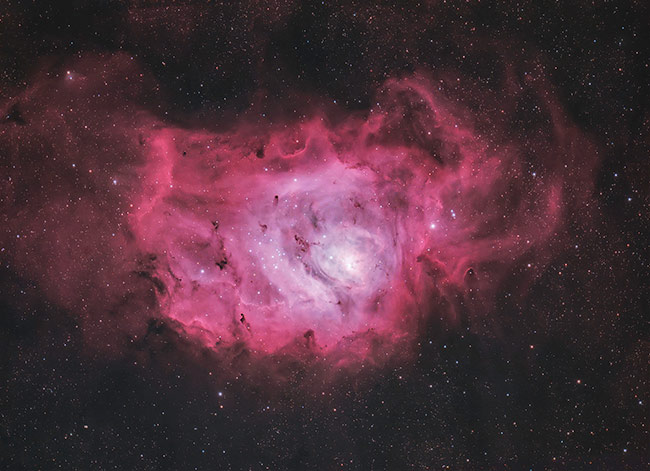
Lagoon Nebula (M8)
The Lagoon Nebula is a large, bright H II region featuring open clusters and defined dust lanes.
Its strong emission makes it easy to photograph in shorter exposures.
- Distance: ~5,200 light-years
- Constellation: Sagittarius
- Notable Feature: Embedded star cluster NGC 6530
- Imaging Difficulty: Beginner
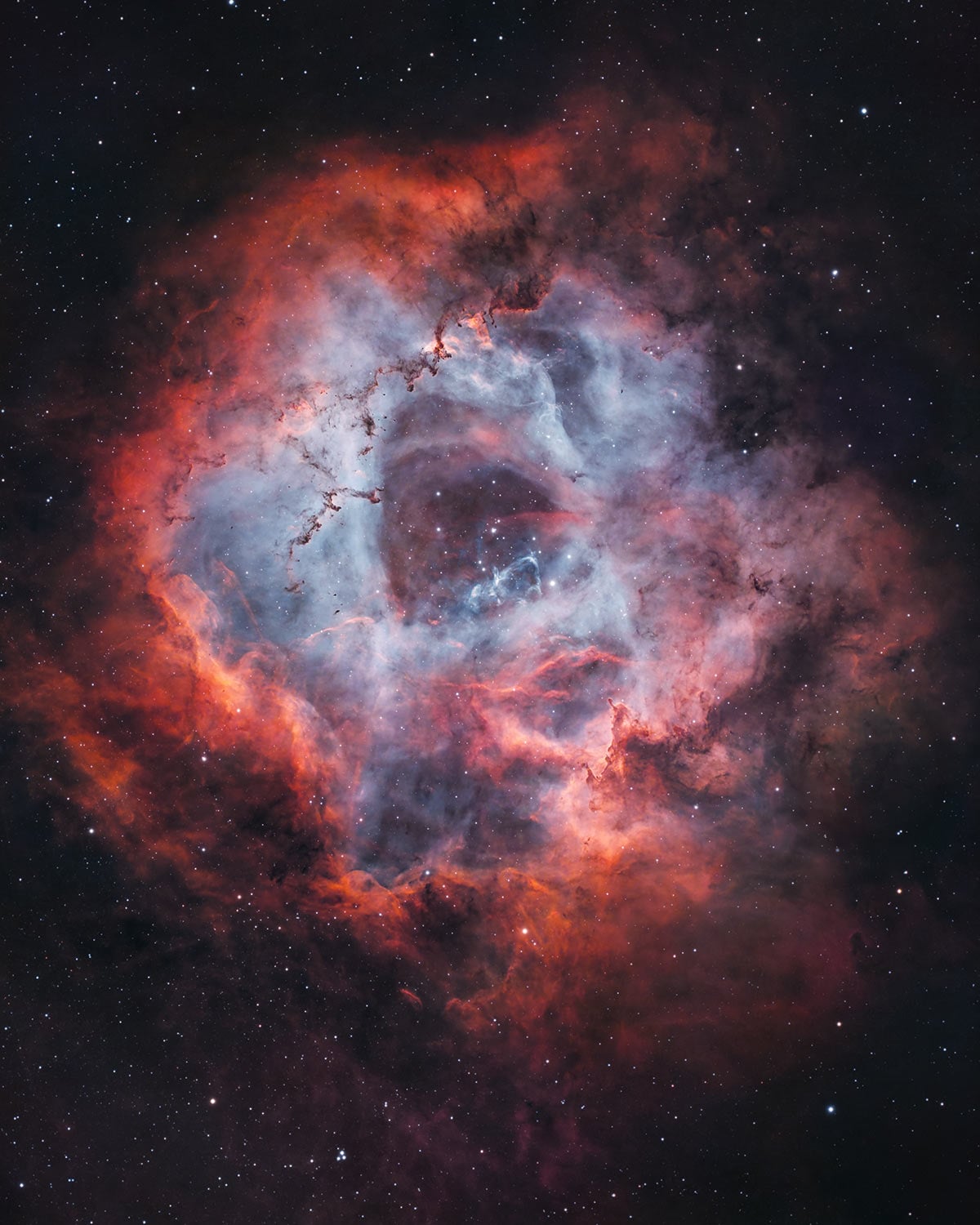
Rosette Nebula (NGC 2237)
The Rosette Nebula is a large circular H II region shaped by stellar winds from its central star cluster.
It responds strongly to hydrogen-alpha imaging.
- Distance: ~5,200 light-years
- Constellation: Monoceros
- Notable Feature: Symmetrical “rose-like” appearance
- Imaging Difficulty: Intermediate
North America Nebula (NGC 7000)
The North America Nebula is part of a large, diffuse H II region shaped by nearby hot stars.
Its distinct outline makes it popular for wide-field imaging.
- Distance: ~2,200 light-years
- Constellation: Cygnus
- Notable Feature: “North America” shape
- Imaging Difficulty: Intermediate

California Nebula (NGC 1499)
The California Nebula is a long, narrow emission nebula strongly energized by the star Xi Persei.
Its hydrogen-alpha signal is its defining characteristic.
- Distance: ~1,000 light-years
- Constellation: Perseus
- Notable Feature: Long red arc shape
- Imaging Difficulty: Intermediate

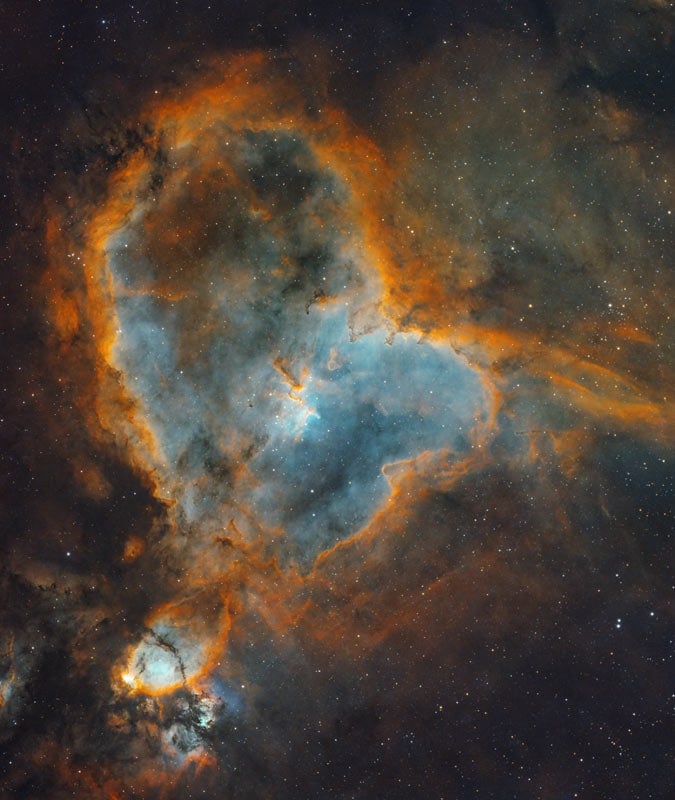
Heart Nebula (IC 1805)
The Heart Nebula contains strong hydrogen-alpha emission shaped by the stellar winds of young stars in Melotte 15.
Its complex structure responds well to narrowband imaging.
- Distance: ~7,500 light-years
- Constellation: Cassiopeia
- Notable Feature: Central sculpted cavity
- Imaging Difficulty: Intermediate
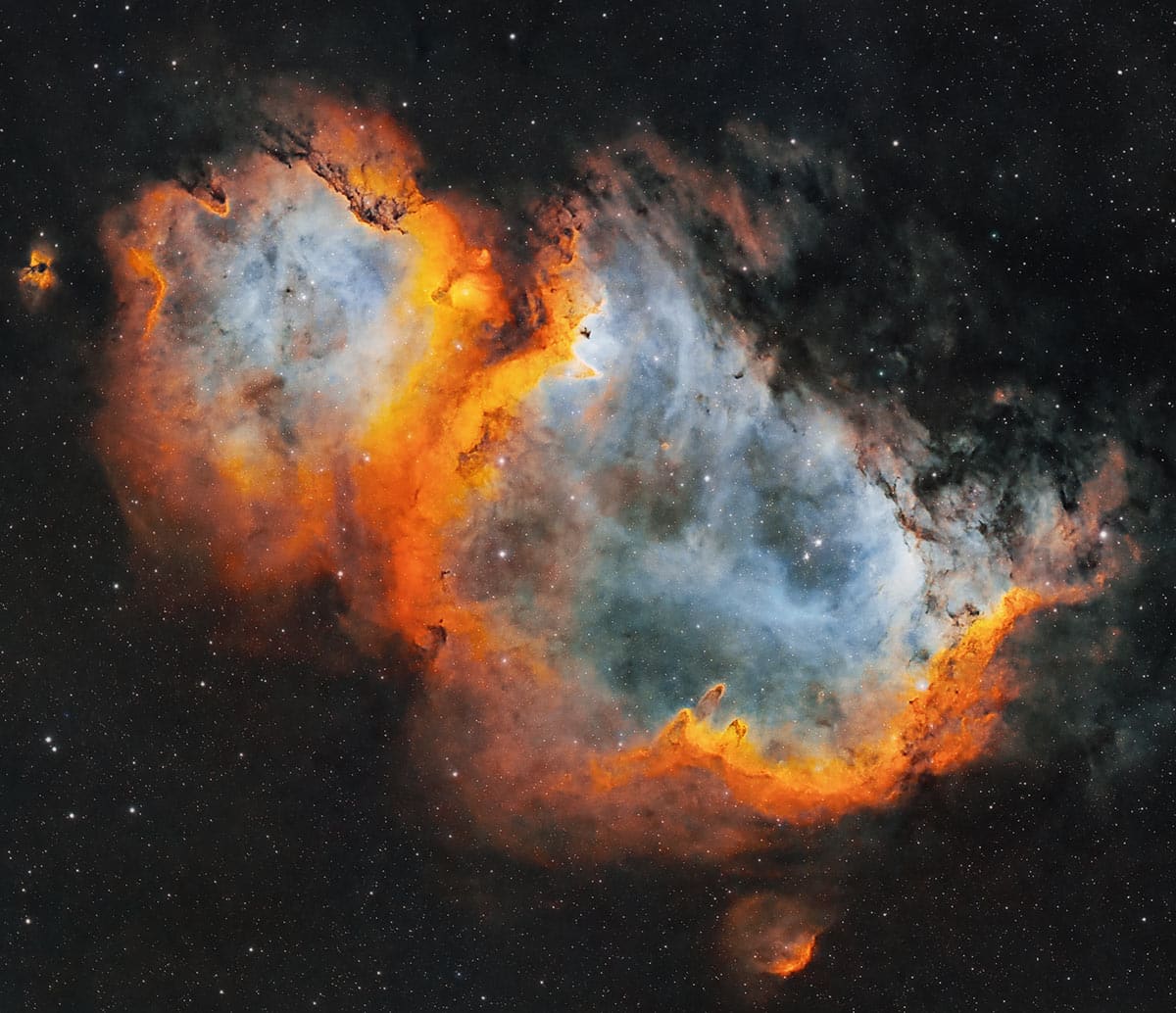
Soul Nebula (IC 1848)
The Soul Nebula sits next to the Heart Nebula and includes several star-forming regions.
It has a smoother structure than the Heart but still responds well to narrowband imaging.
- Distance: ~7,000 light-years
- Constellation: Cassiopeia
- Notable Feature: Multiple embedded clusters
- Imaging Difficulty: Intermediate
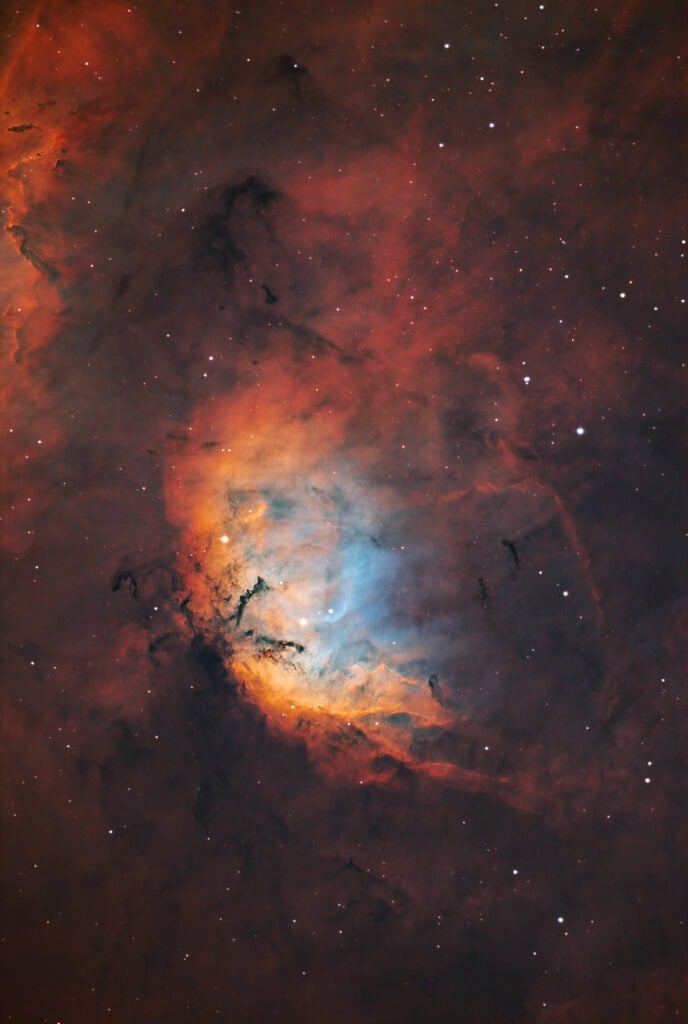
Tulip Nebula (SH2-101)
The Tulip Nebula is a smaller emission nebula in the Cygnus region, shaped by ionization from hot nearby stars.
Its curved “petal” structure is subtle but photogenic.
- Distance: ~5,800 light-years
- Size: ~70 light-years across
- Constellation: Cygnus
- Notable Feature: Close to Cygnus X-1
- Imaging Difficulty: Intermediate to Advanced
Where to Find Emission Nebulae in the Sky
Emission nebulae are most often found along the plane of the Milky Way, where much of our galaxy’s gas, dust, and active star formation is concentrated. This is why so many popular emission nebula targets appear in rich star fields rather than isolated parts of the sky.
Many well-known emission nebulae are located in constellations that sit along or near the Milky Way, including Cygnus, Sagittarius, Cassiopeia, and Orion. These regions contain large clouds of hydrogen gas and young, hot stars capable of lighting them up with ultraviolet radiation.
The best time to observe or photograph an emission nebula depends on the season and your location. In the northern hemisphere, summer brings excellent targets in Cygnus and Sagittarius, including the North America Nebula, the Pelican Nebula, the Lagoon Nebula, and the Eagle Nebula.
In winter, Orion becomes one of the best regions of the sky for emission nebulae. The Orion Nebula is bright, large, and high enough in the sky for many northern observers to capture detailed images through a telescope. It is also one of the easiest emission nebulae to photograph, even for beginners.
Because many emission nebulae are large and faint, they often benefit from wide-field telescopes, camera lenses, and filters that isolate their glowing hydrogen gas. Under dark skies, they can be spectacular, but with the right narrowband filter, many of these targets are also possible from a light-polluted backyard.

You can see many emission nebulae near the core of the Milky Way.
Look Along the Milky Way
Many emission nebulae are found in the star-rich band of the Milky Way because these regions contain the gas, dust, and young stars needed to create glowing H II regions. NASA describes the North America Nebula in Cygnus as an emission nebula whose gas is ionized by a nearby star, causing the cloud to glow and emit light.
Learn more from NASA’s Hubble Caldwell catalog entry for the North America Nebula.
How to Photograph Emission Nebulae
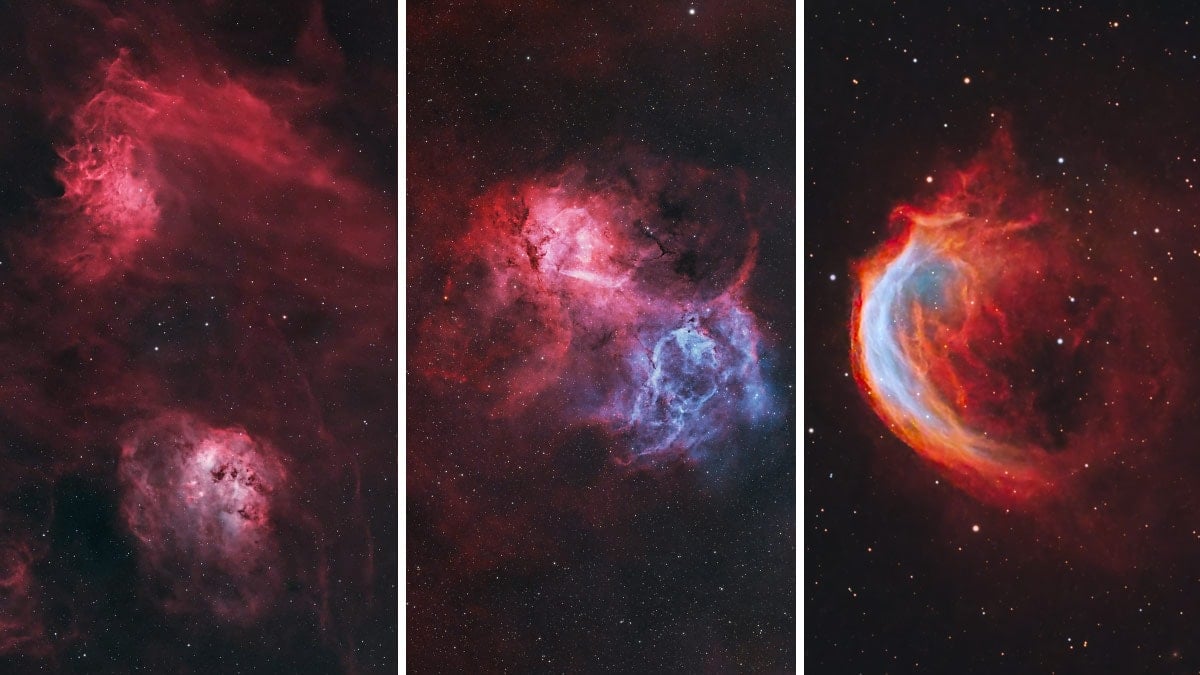
Emission nebulae are some of the most rewarding deep-sky objects to photograph, especially from the backyard. Because these objects glow strongly in specific wavelengths of light, particularly hydrogen-alpha, they respond very well to narrowband imaging techniques.
My favorite approach to photographing emission nebulae is to use a dual-narrowband filter with a one-shot color astronomy camera. This is a simple and effective setup because it allows you to capture the important hydrogen-alpha and oxygen III wavelengths simultaneously while blocking much of the unwanted light pollution and moonlight.
A great example of this type of setup is the ZWO ASI2600MC Pro paired with an Optolong L-eXtreme filter. This combination is especially useful on large, colorful nebulae such as the North America Nebula, Heart Nebula, Rosette Nebula, and the California Nebula. The filter isolates the nebula’s strong emission lines, making the target stand out much more clearly against the background sky.
For emission nebulae, I usually use longer individual sub-exposures than I would for broadband targets like galaxies or reflection nebulae. A typical exposure length for me is about 4 to 5 minutes per sub-frame, depending on the target’s brightness, sky conditions, and the mount’s tracking accuracy.
One thing I have noticed after photographing many emission nebulae is that the hydrogen signal is usually very strong and easy to collect. The oxygen III signal, on the other hand, often takes much more total exposure time to build up. For this reason, it helps to collect several hours of data whenever possible.
With enough integration time, careful tracking, and a good narrowband filter, emission nebulae can reveal incredible structure, contrast, and color, even from a light-polluted backyard.
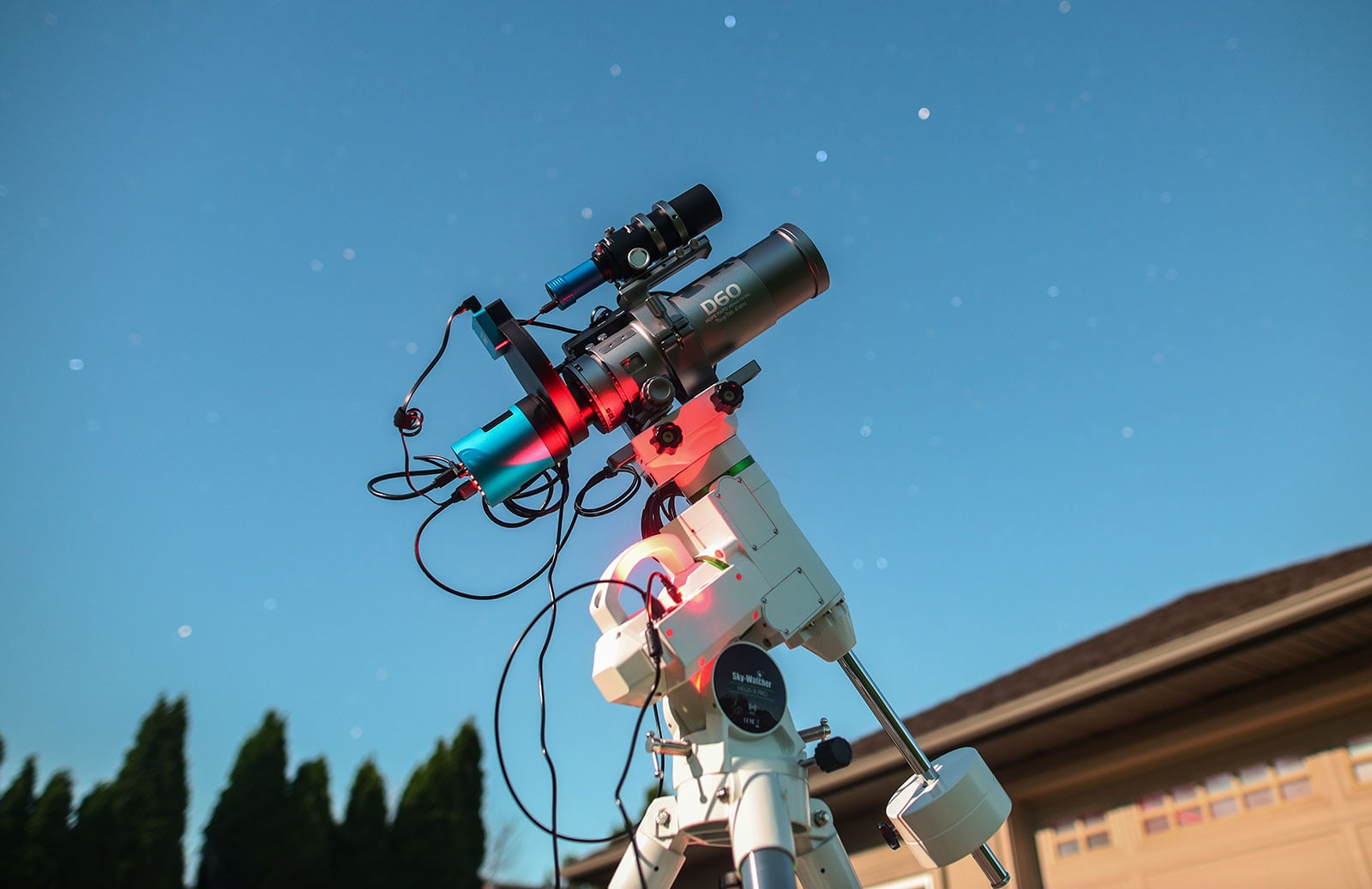
I photograph emission nebulae more than any other target type from my backyard.
FAQ
Why are emission nebulae red?
Emission nebulae often appear red because ionized hydrogen gas emits light at a specific wavelength known as hydrogen-alpha (656.3 nm). This emission line is naturally deep red and dominates the visible light produced in many H II regions.
Can I see one with my eyes?
Some emission nebulae can be seen visually, but most appear faint and colorless to the human eye. The Orion Nebula (M42) is the easiest example, showing up as a soft gray smudge under dark skies. Small and/or more distant emission nebulae require long-exposure photography to reveal their color and structure.
How big are emission nebulae?
Sizes vary, but many emission nebulae span tens to hundreds of light-years, making them some of the largest structures visible in amateur astrophotography.
Final Thoughts: Why Emission Nebulae Are So Special
Emission nebulae are glowing clouds of ionized gas, usually found in active star-forming regions where young, massive stars are energizing the material around them. Their light comes from gases such as hydrogen, oxygen, and sulfur, which respond to intense ultraviolet radiation. In many cases, the beautiful red glow we see in photographs comes from hydrogen-alpha light, one of the strongest emission lines from ionized hydrogen gas.
As a backyard astrophotographer, emission nebulae are some of my favorite deep-sky objects to photograph through a telescope. They are huge, colorful, and full of structure, from sweeping clouds of gas to dark dust lanes and bright star-forming knots. Every target has its own personality, whether it is the delicate shape of the Rosette Nebula, the intricate detail of the North America Nebula, or the dramatic pillars and clouds inside the Eagle Nebula.

The North America Nebula and the nearby Pelican Nebula in the constellation Cygnus.
One of the best things about emission nebulae is that they are surprisingly obtainable from the city. By using narrowband filters, especially filters that isolate the H-alpha wavelength, I can capture the light from glowing hydrogen gas while blocking much of the surrounding light pollution. This makes it possible to photograph faint nebulae from a backyard, driveway, or urban observing spot that would otherwise seem completely washed out under city skies.
That is what makes emission nebulae so rewarding. They are not just beautiful objects in space; they are active stellar nurseries where new stars are being born. And with the right telescope, camera, and filters, you can reveal those glowing clouds of hydrogen from your own backyard.
 Trevor Jones is an astrophotographer and a valued member of the RASC. His passion is inspiring others to start their astrophotography journey on YouTube so they can appreciate the night sky as much as he does. His images have been featured in astronomy books & online publications, including the NASA Astronomy Picture of the Day (APOD).
Related Content