
What is a Dark Nebula?

Many people recognize nebulae as the bright, colorful clouds seen in images like the Orion Nebula, but not all nebulae emit or reflect light. Some are made of dense dust that block the starlight behind them, appearing as dark patches or shapes against the brighter regions of the Milky Way.
These are dark nebulae. To the naked eye or a camera, they can look like empty patches or inky gaps, but hidden inside are often clouds of gas and dust where stars are quietly forming.
In this post, we’ll explore what makes dark nebulae so fascinating, highlight some examples, and share tips for spotting and photographing these cosmic shadows.
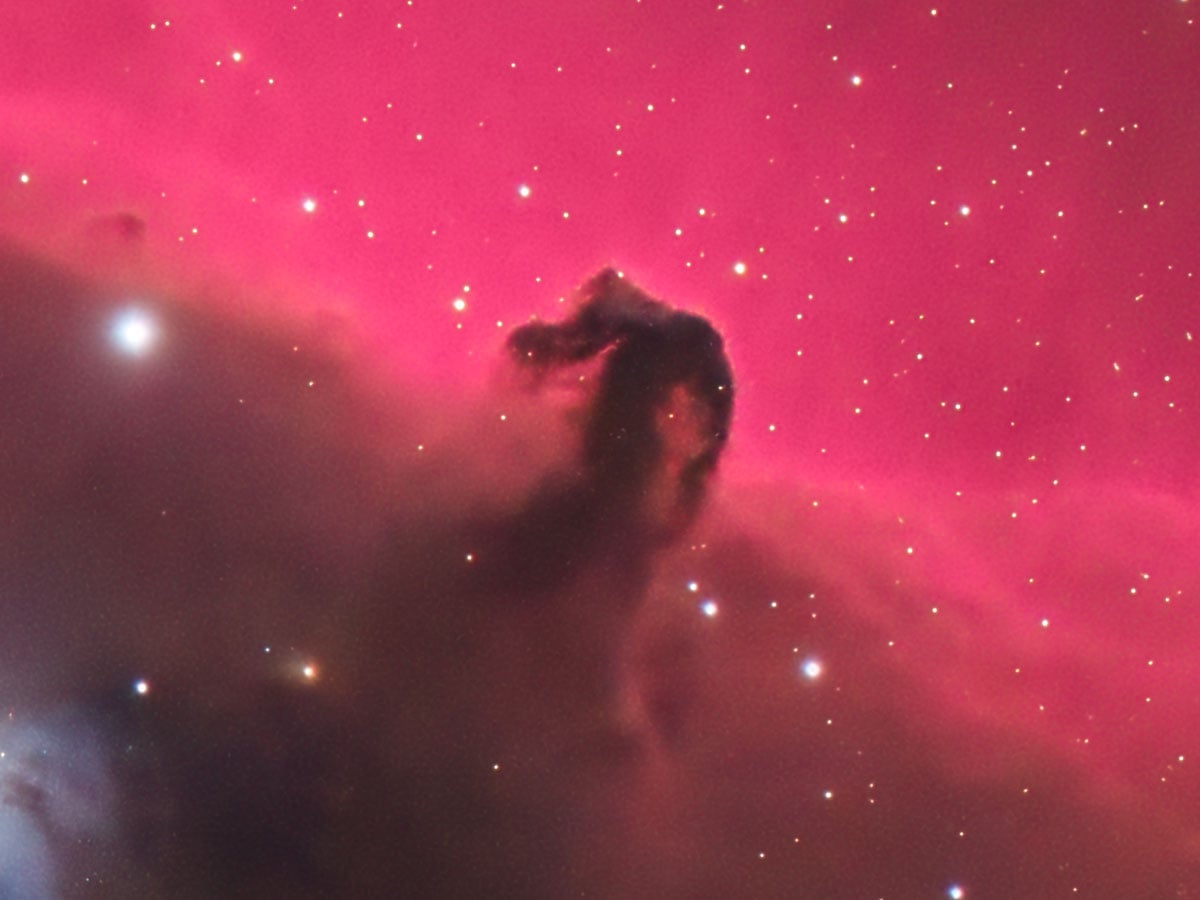
The Horsehead Nebula (Barnard 33) rises from the glowing background of IC 434, one of the most recognizable examples of a dark nebula in the night sky.
What Is a Dark Nebula?
A dark nebula (or absorption nebula) is a dense cloud of interstellar gas and dust so thick that it blocks visible light from the stars and nebulae behind it.
These clouds are made up of fine dust grains (carbon, silicates, and icy molecules) that effectively absorb and scatter starlight, creating dramatic dark shapes against the bright background of the Milky Way. Think of it as a cosmic fog that doesn’t glow, but hides.
While they appear as empty voids through a telescope, dark nebulae are far from lifeless. Deep within their cold, opaque interiors, gravity slowly pulls matter together to form new stars and planetary systems.
Some of the most famous examples include the Horsehead Nebula in Orion and the Northern Coalsack in Cygnus, which are both easily visible in long-exposure astrophotography as striking silhouettes that reveal the complex, dusty structure of our galaxy.
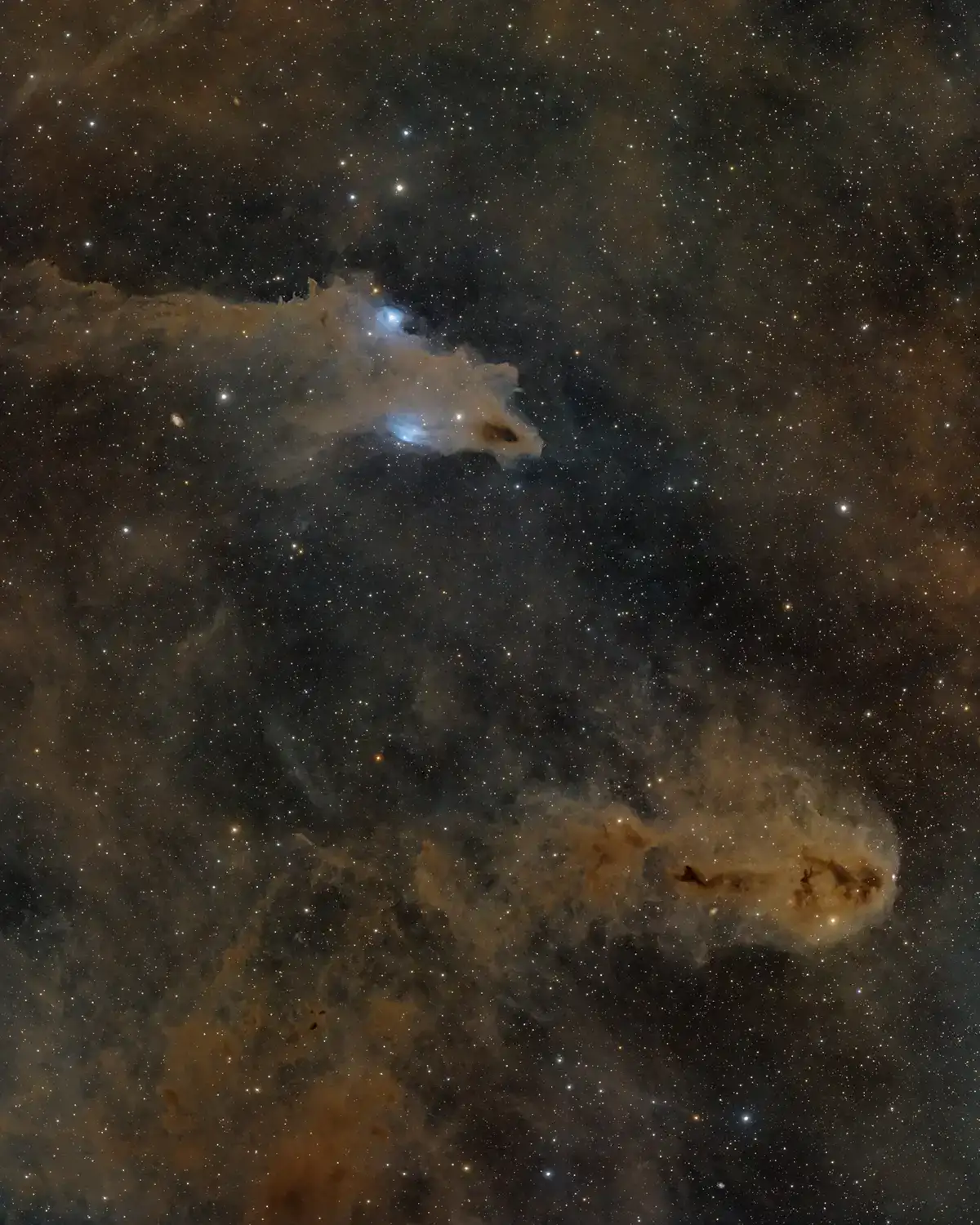
Popular LDN objects (Lynds’ Catalogue of Dark Nebulae) lie in Cepheus, including the Dark Shark Nebula and Angler Fish Nebula shown above. Photo by Trevor Jones.
Dark Nebula Fast Facts
- Definition: A dense cloud of dust and gas that blocks background starlight rather than emitting or reflecting it.
- Also called: Absorption nebulae
- Typical temperature: 10–20 Kelvin (−263°C)
- Composition: Cold molecular hydrogen, carbon compounds, and microscopic dust grains
- Star-forming regions: Many dark nebulae eventually collapse under gravity to form new stars
- Famous examples: Horsehead Nebula (Orion), Northern Coalsack (Cygnus), Pipe Nebula (Ophiuchus), and the Dark Doodad (Musca)
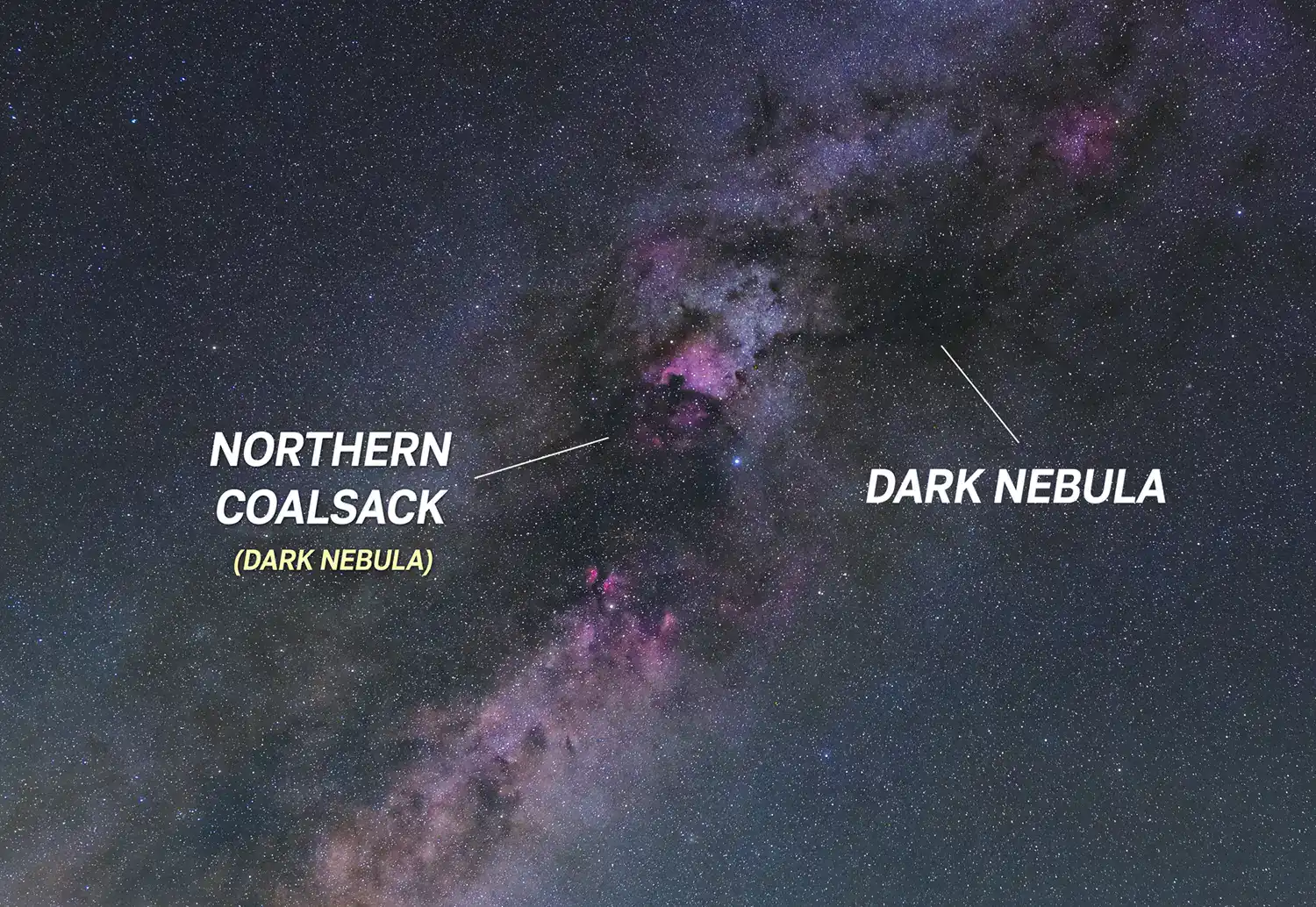
The Northern Coalsack in Cygnus is a beautiful example of a dark nebula. When photographed through long exposures, these silent clouds stand out as intricate silhouettes, marking the birthplaces of future stars hidden deep within.
What Do Dark Nebulae Look Like?
Through a telescope, dark nebulae often appear as empty voids. They almost look like patches of sky where the stars seem to vanish. But in reality, these regions are thick clouds of interstellar dust silhouetted against the bright backdrop of the Milky Way.
In wide-field astrophotography, they create dramatic contrast, tracing the dusty lanes and filaments that weave through our galaxy. Long exposures reveal delicate structure: wispy edges, fine textures, and soft gradients where starlight is gradually absorbed.
Some dark nebulae form recognizable shapes, like the Horsehead Nebula in Orion or the Pipe Nebula in Ophiuchus. In contrast, others appear as sprawling curtains of darkness stretching across rich star fields.
Their beauty lies in subtlety. Capturing them often requires deep imaging and careful post-processing to bring out the faint glow around their edges and the intricate details that hint at the birthplaces of new stars within.
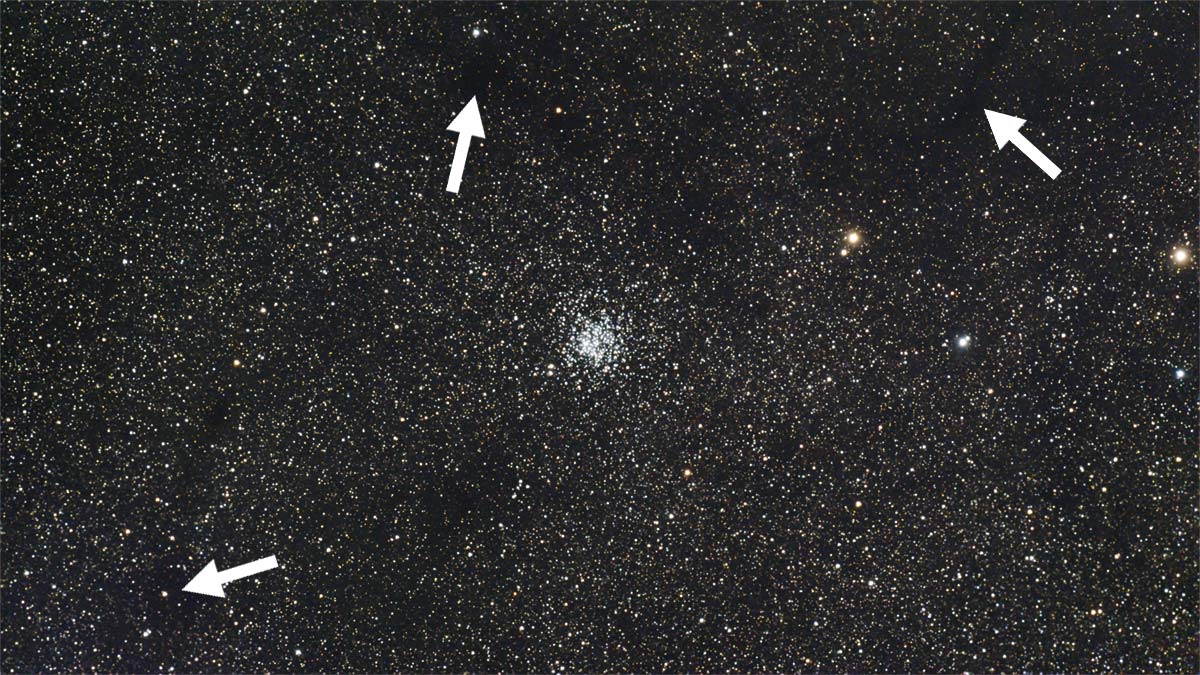
Several dark nebulae surround Messier 11 (Wild Duck Cluster). They appear as ’empty’ patches of sky, devoid of stars.
Types of Dark Nebulae
Large Molecular Clouds
Some dark nebulae are enormous, stretching across dozens or even hundreds of light-years. These massive clouds of gas and dust are where stars are born, forming inside dense shadows (Shu, Adams & Lizano, 1987).
One of the most famous examples is the area around the Horsehead Nebula in Orion, where dark lanes of dust create dramatic silhouettes against glowing gas.
Even small telescopes or binoculars can reveal the edges of these giant clouds, making them exciting targets for beginners.
Bok Globules
On the smaller end, Bok globules are compact, dark clouds just a few light-years across that can collapse to form individual stars (Bok & Reilly, 1947).
Examples visible from the northern hemisphere include LDN 1622 in Orion and Bok 1 near Barnard 68.
These isolated dark pockets are perfect for beginner astrophotographers because they stand out clearly against the starry background and are easy to frame in a single shot.
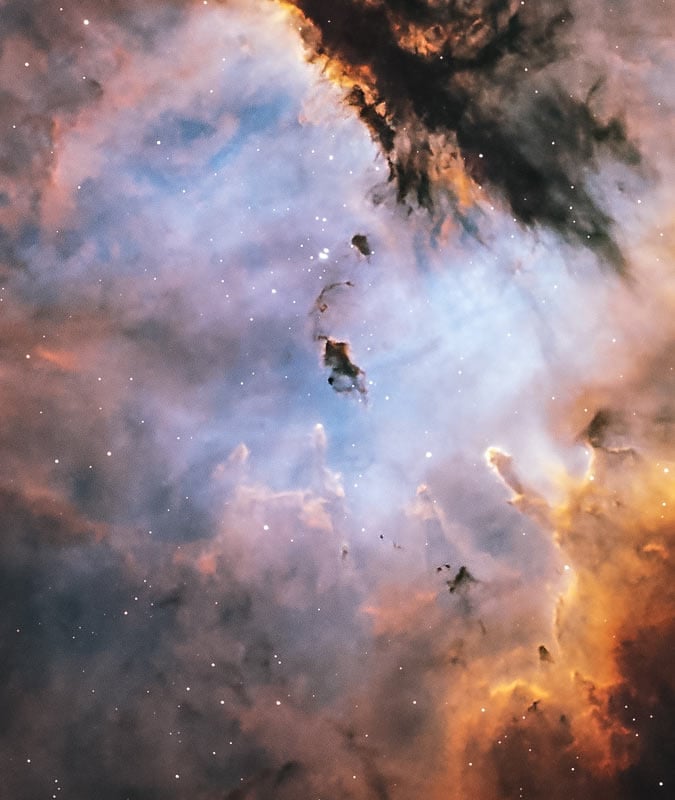
A Bok Globule in the Pacman Nebula. Photo by Trevor Jones.
Cataloged Dark Nebulae
Many dark nebulae are included in historical catalogs that are still widely used today. E. E. Barnard’s catalog lists hundreds of “Barnard Objects” across the sky (Barnard, 1927).
Beginner-friendly examples include Barnard 68, a dark, almost spherical nebula in Ophiuchus, and Barnard 142–143 (Barnard’s E) in Aquila, which forms a striking E-shaped shadow.
Another popular catalog is ‘Lynds’ Catalogue of Dark Nebulae‘ (abbreviation: LDN), an astronomical catalogue of dark nebulae.
These cataloged targets provide a roadmap for observers and photographers looking for well-defined, accessible dark nebulae.
List of the Best Dark Nebulae to See Through a Telescope
Dark nebulae can be some of the most intriguing sights in the night sky. While many are subtle and best captured through long-exposure astrophotography, some of the larger examples are visible visually through a telescope under dark skies.
Using low magnification and wide-field eyepieces will help reveal their structure against the dense star fields of the Milky Way. Below is a list of some of the best-known dark nebulae from the Barnard and Lynds Dark Nebula (LDN) catalogs.
| Catalog / Name | Common Name | Constellation | Best Viewing Months |
|---|---|---|---|
| B33 | Horsehead Nebula | Orion | December–February |
| B86 | Ink Spot Nebula | Sagittarius | June–August |
| B142 + B143 | “E” Nebula | Aquila | July–September |
| B168 | Dark Nebula near the Cocoon Nebula | Cygnus | July–September |
| B92 + B93 | Dark Lanes in M24 | Sagittarius | June–August |
| B253 | Coalsack Nebula (Southern) | Crux | March–May |
| LDN 183 | Dark Nebula in Serpens | Serpens | May–July |
| LDN 1622 | Boogeyman Nebula | Orion | December–February |
| LDN 673 | Dark Nebula Complex | Aquila | July–September |
| LDN 1773 | Dark Nebula near Barnard’s Loop | Orion | December–February |
A Closer Look at Famous Dark Nebulae
There are several interesting dark nebula astrophotography targets to capture.
Horsehead Nebula (Barnard 33)
Perhaps the most iconic dark nebula silhouette is located in Orion.
The “horsehead” shape is a compact region of dust silhouetted against glowing hydrogen emission, and is often photographed alongside the Flame Nebula, as shown below.
Long focal lengths are recommended to capture its distinctive form. If you own a smart telescope, the Horsehead Nebula is one of the best dark nebulae targets in the sky to capture with it.
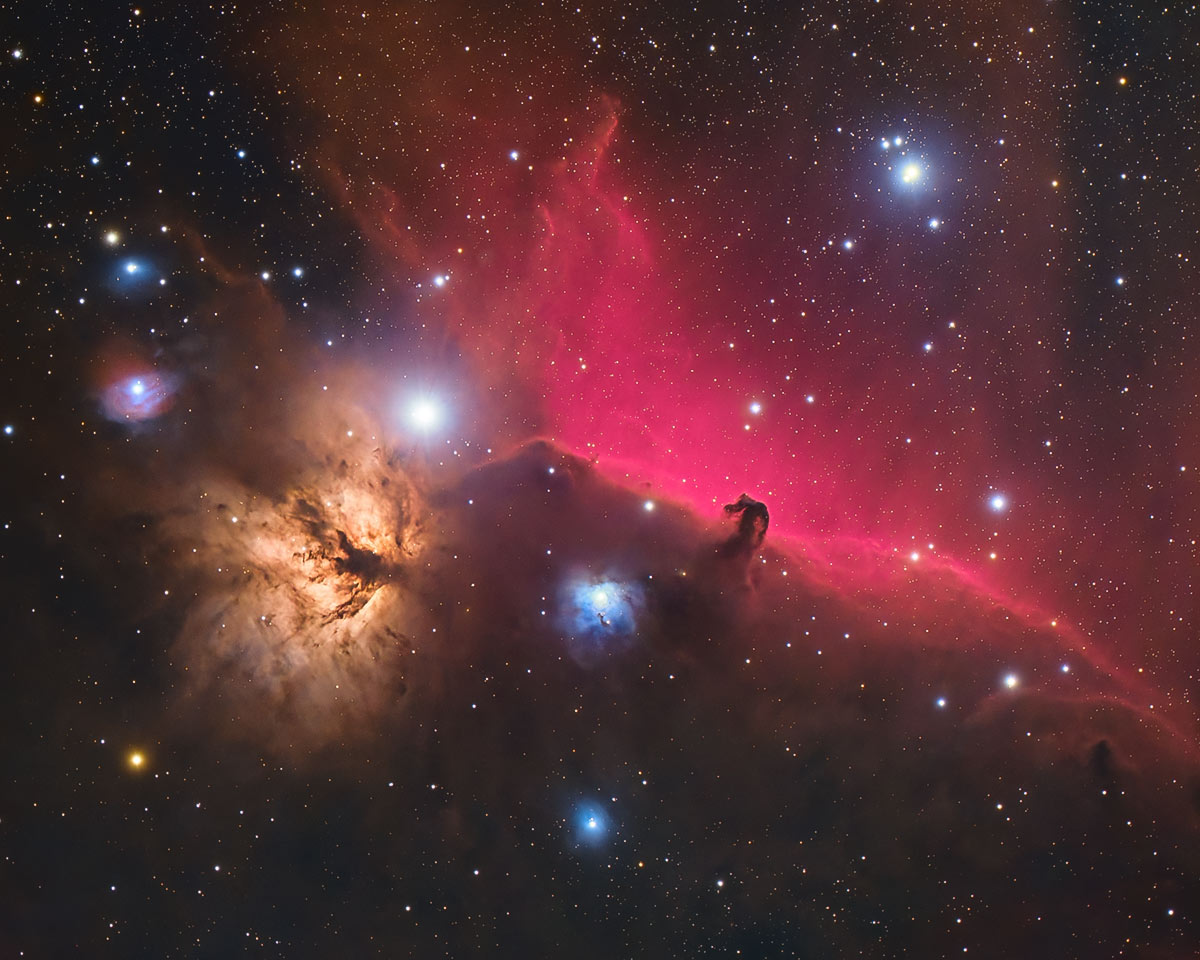
The Horsehead Nebula (right), also known as Barnard 33 or B33, is a small dark nebula in the constellation Orion.
Pipe Nebula (Barnard 59–64)
A long, meandering dark nebula in Ophiuchus, the Pipe Nebula is perfect for wide-field astrophotography.
Its curving shape is easy to spot against the Milky Way, and it’s incredibly photogenic in both monochrome and color images.
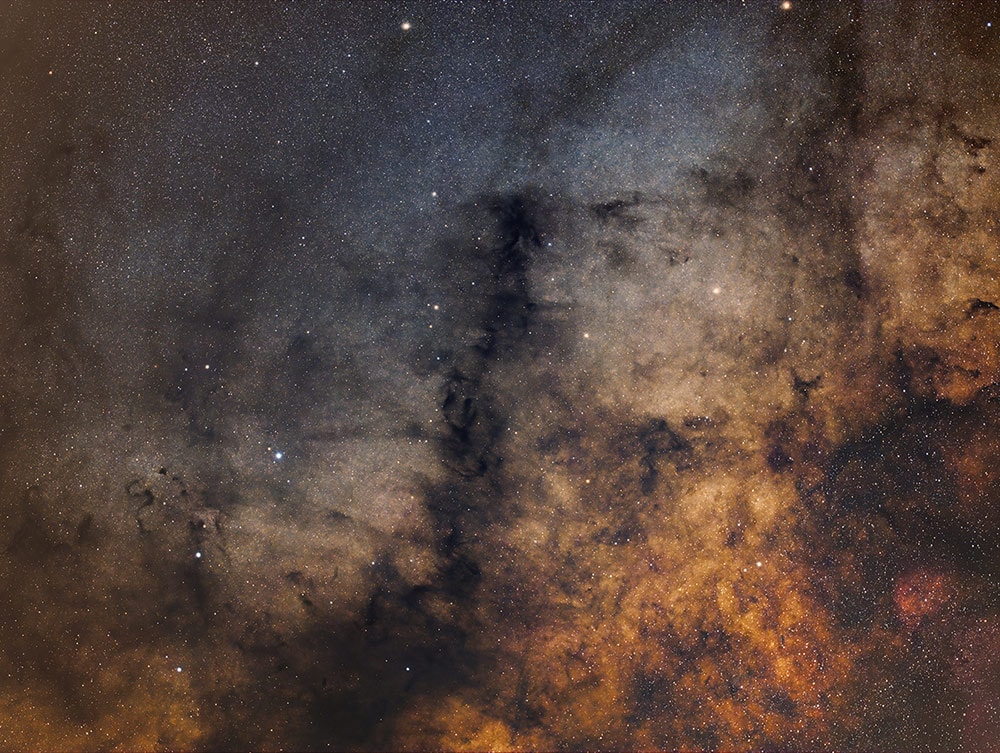
LDN 89
A compact dark nebula in Cepheus, often captured together with the surrounding Lynds Dark Nebulae.
It forms part of a dense molecular cloud complex and is a great target for wide-field astrophotography, especially when paired with nearby Barnard objects or other LDN clouds. Its small size and defined edges make it stand out in deep-sky images.
LDN 897, LDN 899, and LDN 900
There are several dramatic dark nebulae near the reflection nebula NGC 6914 in the constellation Cygnus. It lies within one of the brightest regions of the Milky Way, surrounded by glowing hydrogen clouds.
The blue hue of NGC 6914 comes from starlight scattering off interstellar dust, contrasting beautifully with the surrounding red emission nebulae.
Long exposures through broadband and narrowband filters can reveal incredible depth and texture, highlighting the interaction between starlight and the surrounding molecular clouds.
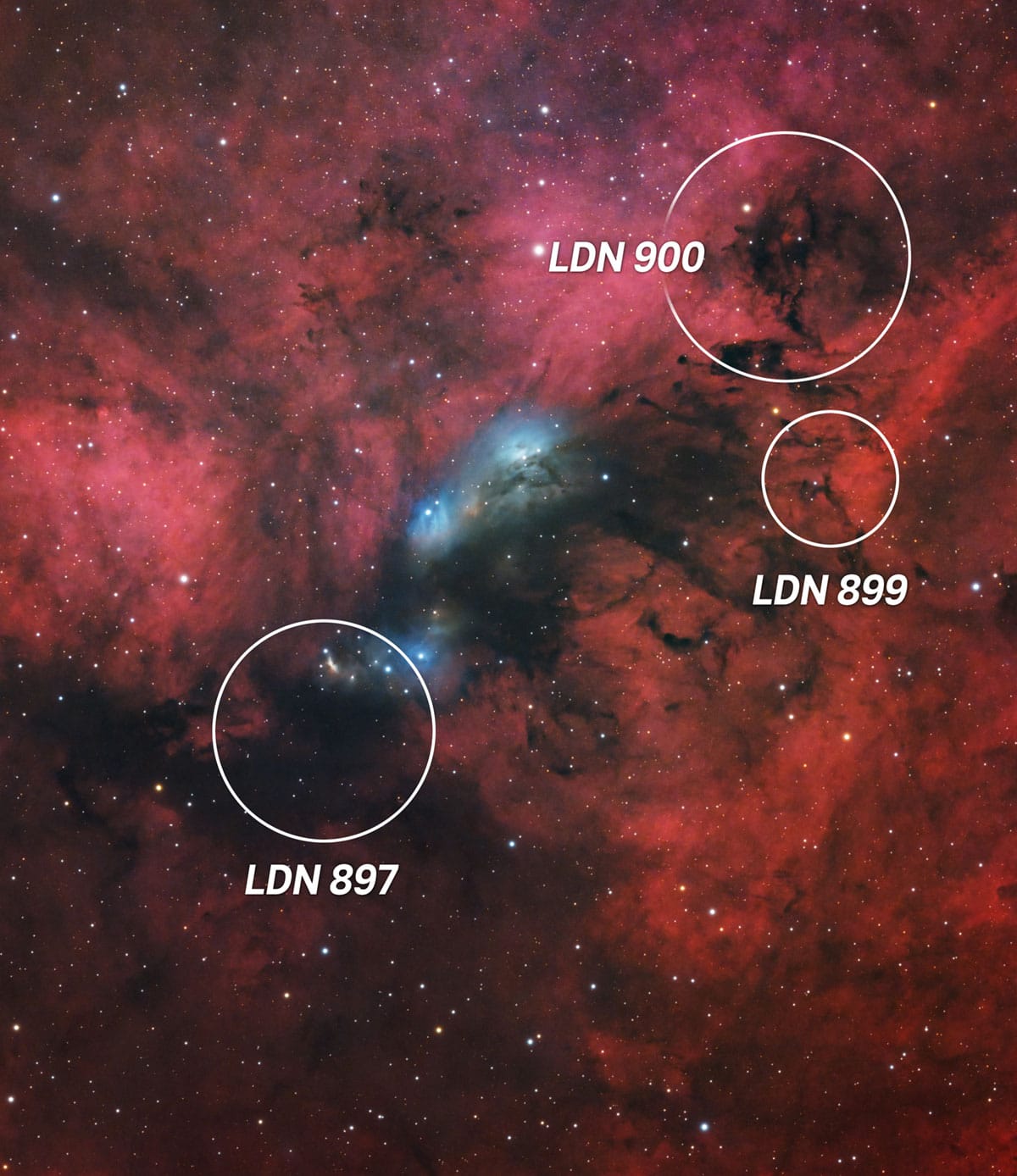
There are many LDN objects in this image of NGC 6914 in Cygnus. Photo by Trevor Jones.
How to Observe Dark Nebulae
You don’t need a large telescope to appreciate dark nebulae. In fact, binoculars or even your naked eyes are often enough.
These objects are best seen as silhouettes against the rich star fields of the Milky Way, and the darker your sky, the better the contrast will be.
Tips for Beginners
-
Head for dark skies: Light pollution is the enemy of contrast. The ‘inky’ shapes of dark nebulae disappear completely in bright urban skies, so seek out a rural observing site or dark-sky park whenever possible.
-
Let your eyes adjust: Give yourself 20–30 minutes to adapt to the dark. Avoid looking at bright screens or white lights—even for a few seconds can ruin your night vision.
-
Follow the Milky Way: Most dark nebulae lie along the dusty plane of our galaxy. From mid-northern latitudes, focus your search on Ophiuchus, Scorpius, Sagittarius, Cygnus, Cepheus, and Orion throughout the year.
-
Use star charts or apps: SkySafari, Stellarium, and similar tools can help you track down specific dark nebulae.
Photographing Dark Nebulae
Dark nebulae are among the most dramatic and mysterious subjects in astrophotography. They’re often best captured as part of a wider field that shows how their shapes twist through the star clouds of the Milky Way.
For long-exposure images of dark nebulae (and all other deep-sky objects), you will need a tracking mount (such as a star tracker) to compensate for the rotation of the Earth.
Basic Setup
-
Camera & Lens: A DSLR or mirrorless camera with a wide-angle lens (14–50 mm) works great for large-scale Milky Way dust lanes.
-
Exposure Settings: Try 15–120 second exposures at a high ISO (1600–6400), depending on your sky brightness and tracking setup.
-
Stack Your Frames: Use image-stacking software such as DeepSkyStacker or PixInsight to reduce noise and bring out fainter structure.
-
Emphasize Contrast: In post-processing, carefully adjust curves and black levels to bring out the subtle variations between dust and starlight without crushing detail.

Use a simple star tracker to take long-exposure images of the night sky without star trails.
Advanced Tips
-
Longer Focal Lengths: For close-ups of dark nebulae, use a small refractor (250–500 mm focal length).
-
Narrowband Filters: While dark nebulae themselves don’t emit light, filters like Hα or RGB imaging can enhance nearby emission regions and add depth to your image.
-
Control Star Brightness: During processing, reduce star intensity slightly to keep the viewer’s attention on the soft, dark shapes of the nebula.
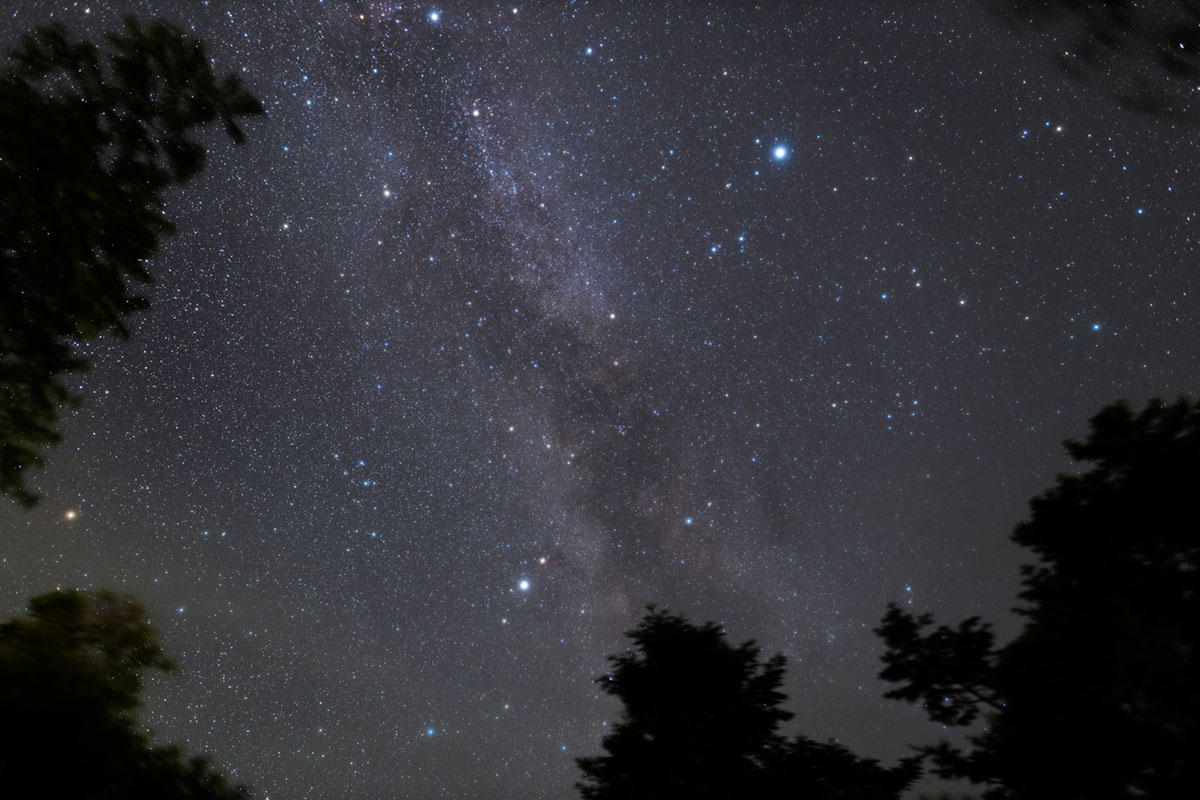
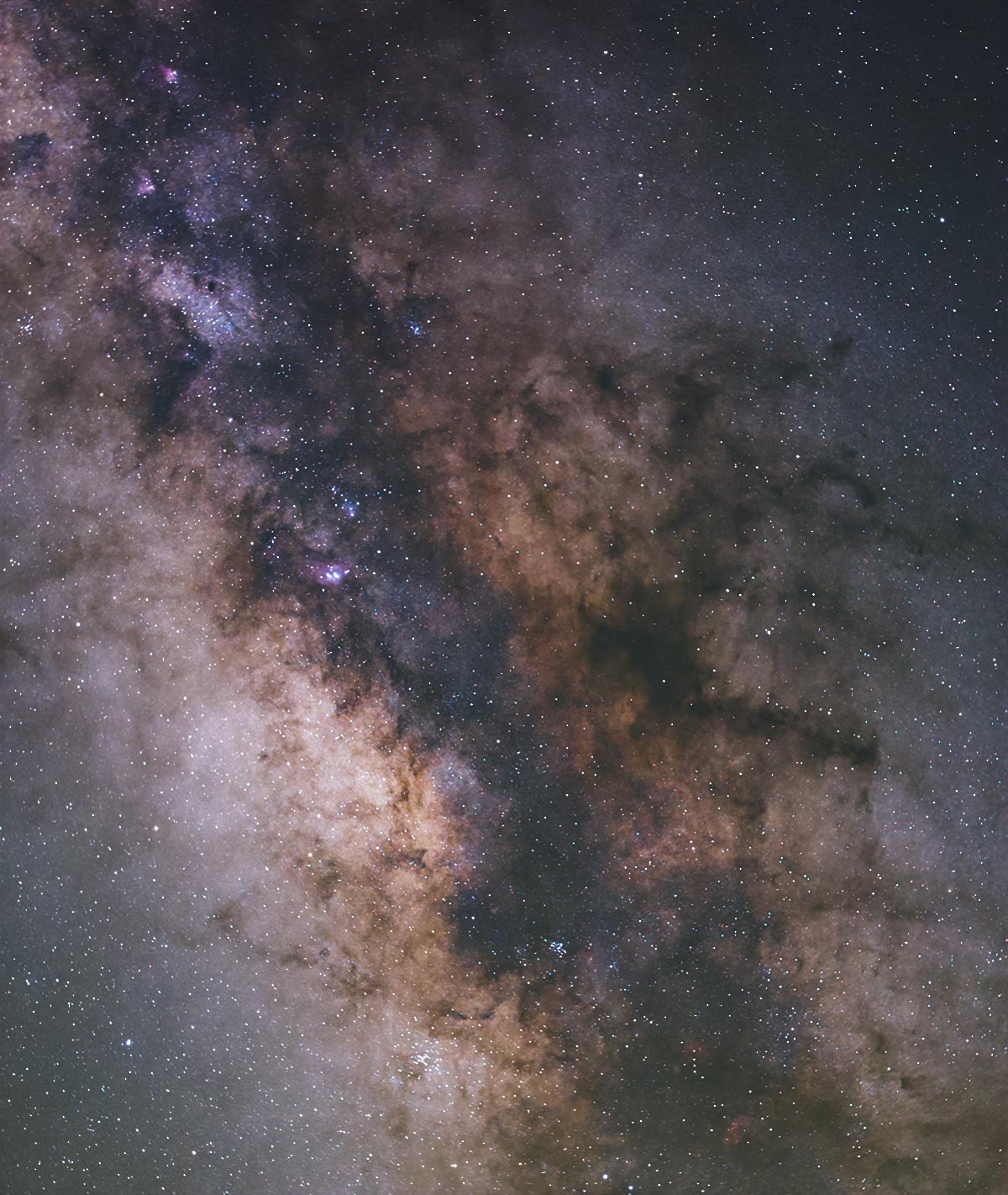
The dark lane running through the Milky Way (The Great Rift). Canon EOS Ra camera + Sigma 24mm F/1.4 Lens on a star tracker (6 x 90-seconds).
Dark Nebulae & Dark-Sky Conservation
Dark nebulae are subtle. They don’t glow or stand out on their own. They reveal themselves through contrast, and that means we need truly dark skies to appreciate them.
Even moderate light pollution can wash out these delicate structures and erase their texture. And we know that skyglow from artificial lighting significantly reduces the visibility of faint night-sky features, including dust lanes and dark nebulae.
At home, you can help protect these views by using fully shielded outdoor lights, warmer bulbs, and lighting only when needed. Supporting dark-sky parks and advocating for thoughtful lighting in your community also makes a difference.
Dark nebulae remind us that some of the most interesting places in the universe aren’t the brightest. They’re the quiet, hidden corners worth preserving.
Conclusion
Dark nebulae are some of the most intriguing and beautiful objects in the night sky.
At first glance, they may look like empty patches or shadows, but within them, clouds of gas and dust are slowly collapsing to form new stars.
Grab a star chart, head to a dark-sky site, and see if you can follow the twists and turns of these inky clouds stretching across the Milky Way.

Ashley is an environmental educator, communication professional, and astrophotographer. She has extensive experience writing for diverse audiences to increase public awareness and engagement. Ashley is an active Advocate and Delegate with DarkSky International, helping to protect the nighttime environment from the harmful effects of light pollution through advocacy and outreach.