
What Telescope Aperture Means (and Why its So Important)

When choosing a telescope, you’ll quickly discover that aperture is the most important specification. Aperture is the diameter of a telescope’s main lens or mirror, and it determines how much light the telescope gathers and how much detail you can see.
Unlike the photography world, where aperture refers to the camera lens’ focal ratio (f-stop), in the telescope world, aperture means the overall size (diameter) of the telescope’s optics.

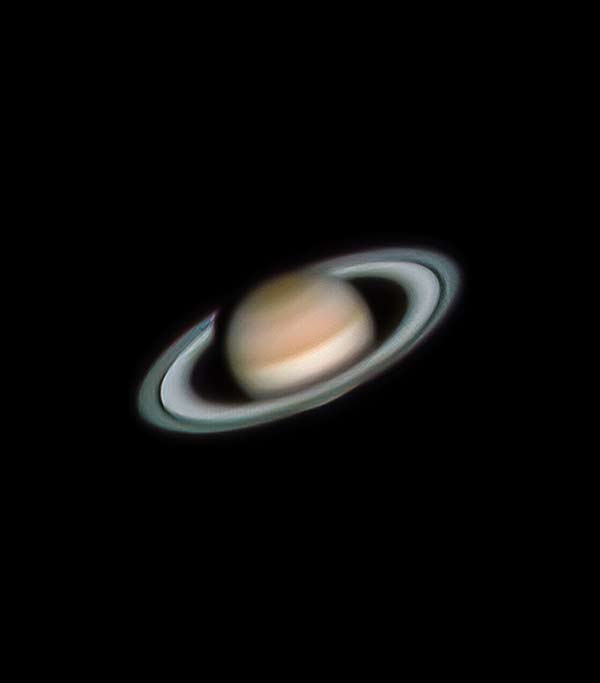
I took this picture of Saturn using a telescope with a large aperture (Celestron Edge HD 11). Large apertures are highly beneficial for viewing and photographing planets.
What Is Telescope Aperture?
The aperture of a telescope is the diameter of its primary optical element. In a refractor telescope, it’s the diameter of the lens; in a reflector telescope, it’s the size of the mirror.
This measurement, usually given in millimeters or inches, sets the foundation for what the telescope is capable of. In general, the more aperture the better, but larger telescopes come with added challenges and cost.
- A beginner refractor might have a 70mm aperture.
- A mid-sized Dobsonian telescope may feature a 200mm (8-inch) mirror.
- Professional observatories use mirrors several meters across.
Unlike magnification, which can be changed with different eyepieces, aperture is fixed and directly tied to performance.
Certain types of telescopes lend themselves well to larger apertures, such as mirror-based Newtonian reflectors. Refractors, on the other hand, become cost-prohibitive after a certain point (6 inches or more).
Astrophotography telescopes come in many different sizes, and the aperture has a significant impact on the types of images you can capture.

One of my smallest refractor telescopes (William Optics RedCat 51), compared to my largest (Sky-Watcher Esprit 150).
Why Aperture Matters More Than Magnification
Magnification is often advertised as the main selling point, but it can be misleading. Any telescope can achieve high magnification with the right eyepiece, but without enough light (aperture), high magnification only creates a dim and blurry image.
Aperture affects two essential qualities:
- Light-Gathering Power
A larger aperture collects more light, making faint galaxies, nebulae, and star clusters visible. For deep-sky observing and astrophotography, this is critical. - Resolution
The wider the aperture, the finer the details you can resolve. This means sharper views of lunar craters, the cloud bands of Jupiter, or the spiral arms of galaxies.
In other words, aperture determines both brightness and clarity. In the example below, the Celestron NexStar 8SE Schmidt-Cassegrain telescope uses a large 8-inch aperture to provide crisp views at a long focal length (2032mm).
The Celestron NexStar 8SE provides the brightest views in the NexStar lineup, thanks to 8 inches of aperture (over the 4,5, and 6 inch versions).
Why Aperture Controls Brightness and Clarity
The aperture of a telescope determines two critical factors in astronomy: brightness and clarity. A wider aperture collects more light, which makes faint objects like galaxies and nebulae appear brighter in the eyepiece. At the same time, a larger aperture increases resolution, meaning you’ll see sharper details on planets, star clusters, and the Moon’s surface.
What Different Apertures Show You
Here’s what you can expect to see at common aperture sizes:
- 70–90 mm (2.7–3.5″)
Perfect for the Moon, planets, and bright double stars. Limited for deep-sky objects. - 130–150 mm (5–6″)
A versatile choice. Many galaxies and nebulae are within reach under dark skies. - 200 mm (8″) and above
Serious visual astronomy. Spiral galaxy structure, planetary detail, and faint nebulae begin to shine.
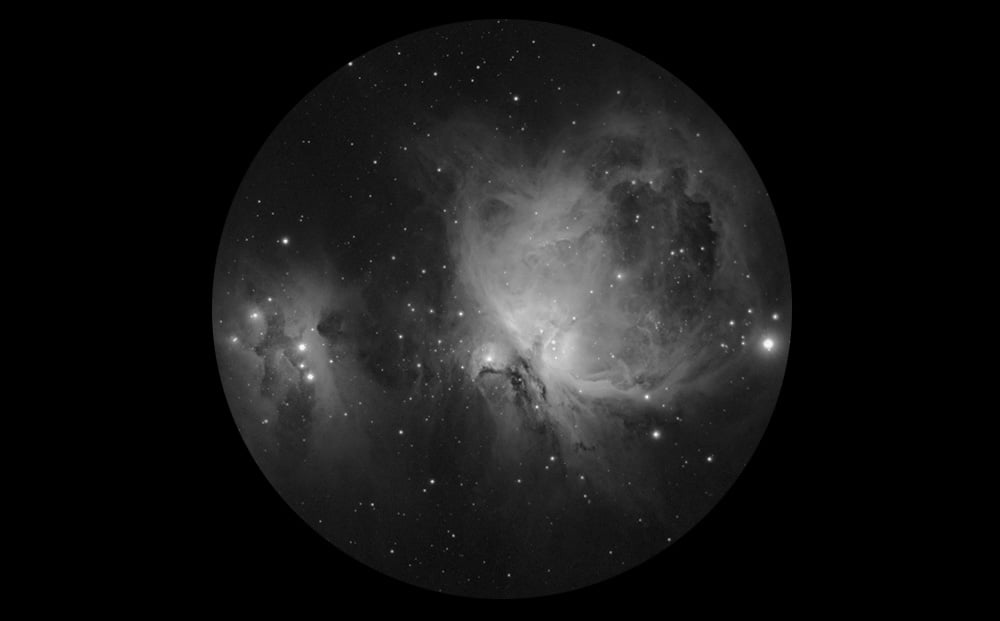
A simulated view of the Orion Nebula through a large aperture telescope like the one below.
Every step up in aperture makes a noticeable difference, especially away from light pollution. If you are looking to buy your first telescope, I consider an 8-inch Dobsonian to be the best telescope for beginners.
While larger Dobsonian reflector models (10 inch+) can deliver even better views, they are also heavier and can be more complicated to set up.

My largest telescope of all is a 14-inch Dobsonian Reflector. This large-aperture telescope is heavy and cumbersome, but it has provided me with some of the best views of the moon and planets I have ever seen.

The surface of the moon as seen through my Dobsonian telescope. If detailed views of the lunar surface are important to you, invest in a telescope with an 8-inch aperture or above.
Telescope Aperture Comparison
Here is a handy reference you can use to decide which telescope aperture is right for you. While the phrase ‘the bigger, the better’ definitely applies to telescopes, this often comes at the expense of portability.
| Aperture | Moon & Planets | Deep-Sky Objects | Portability |
|---|---|---|---|
| 60–80 mm | Good | Fair (only bright DSOs) | Excellent |
| 100–130 mm | Very Good | Good (clusters, brighter nebulae & galaxies) | Good |
| 150–200 mm | Excellent | Very Good (faint galaxies, globular clusters) | Fair to Good |
| 250–300 mm | Excellent+ | Excellent (spiral arms, nebula structure) | Fair |
| 350 mm+ | Outstanding | Outstanding (maximum reach) | Poor |
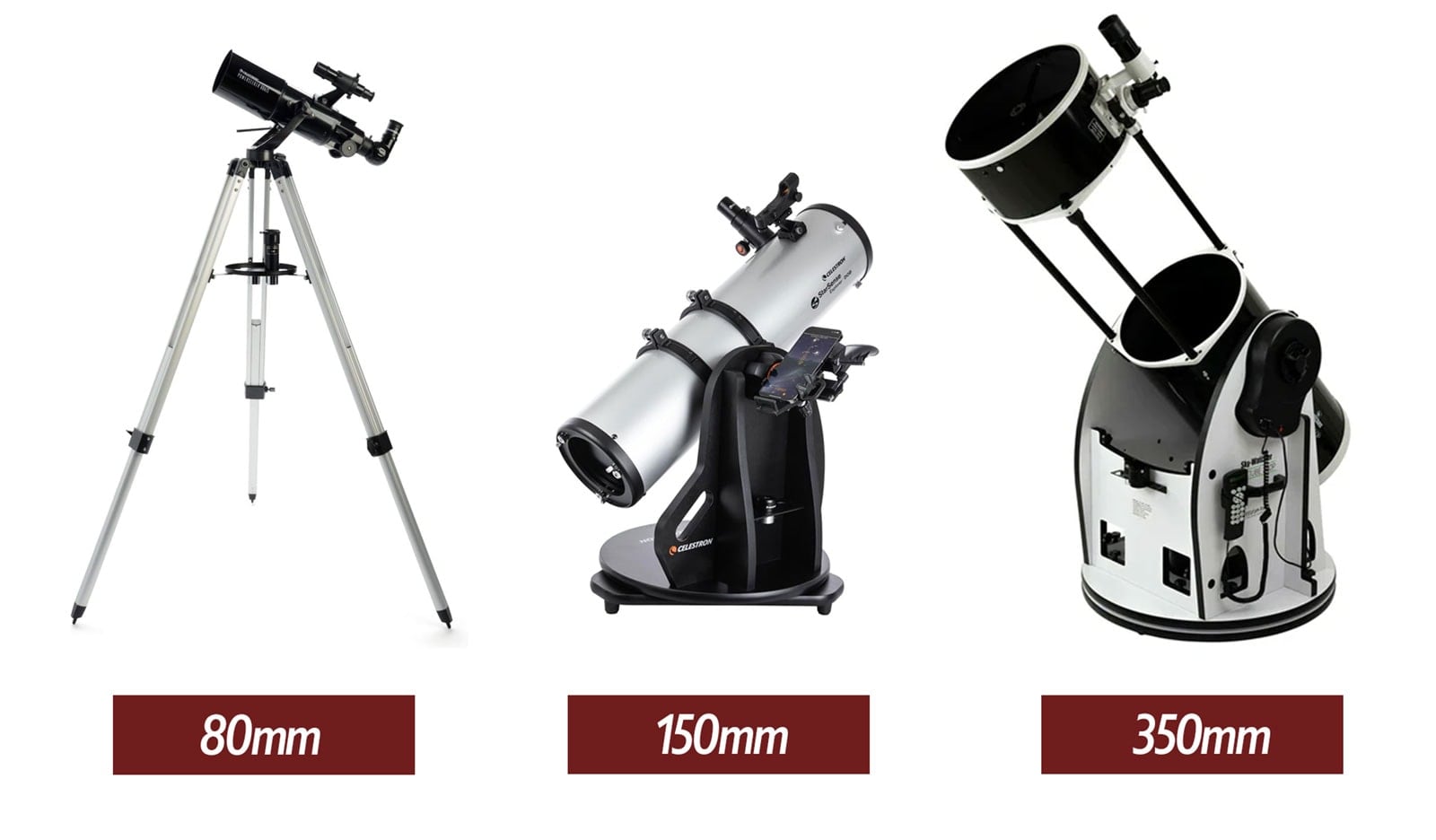
Light-Gathering Power Scales With the Area
One of the most important things to understand about telescope aperture is that light-gathering power increases with the area of the lens or mirror, not just its diameter.
Since area is proportional to the square of the radius, even a modest increase in aperture size results in a dramatic boost in how much light the telescope collects.
- A 100mm telescope gathers about four times more light than a 50mm telescope, because the area of the lens is four times larger.
- A 200 mm telescope gathers 16 times more light than a 50 mm telescope.
This is why experienced astronomers often recommend choosing the largest aperture you can comfortably manage. Every step up doesn’t just add a little more brightness; it multiplies what you can see.
Star clusters break into pinpoint stars instead of fuzzy patches, and subtle structures in nebulae become noticeable.
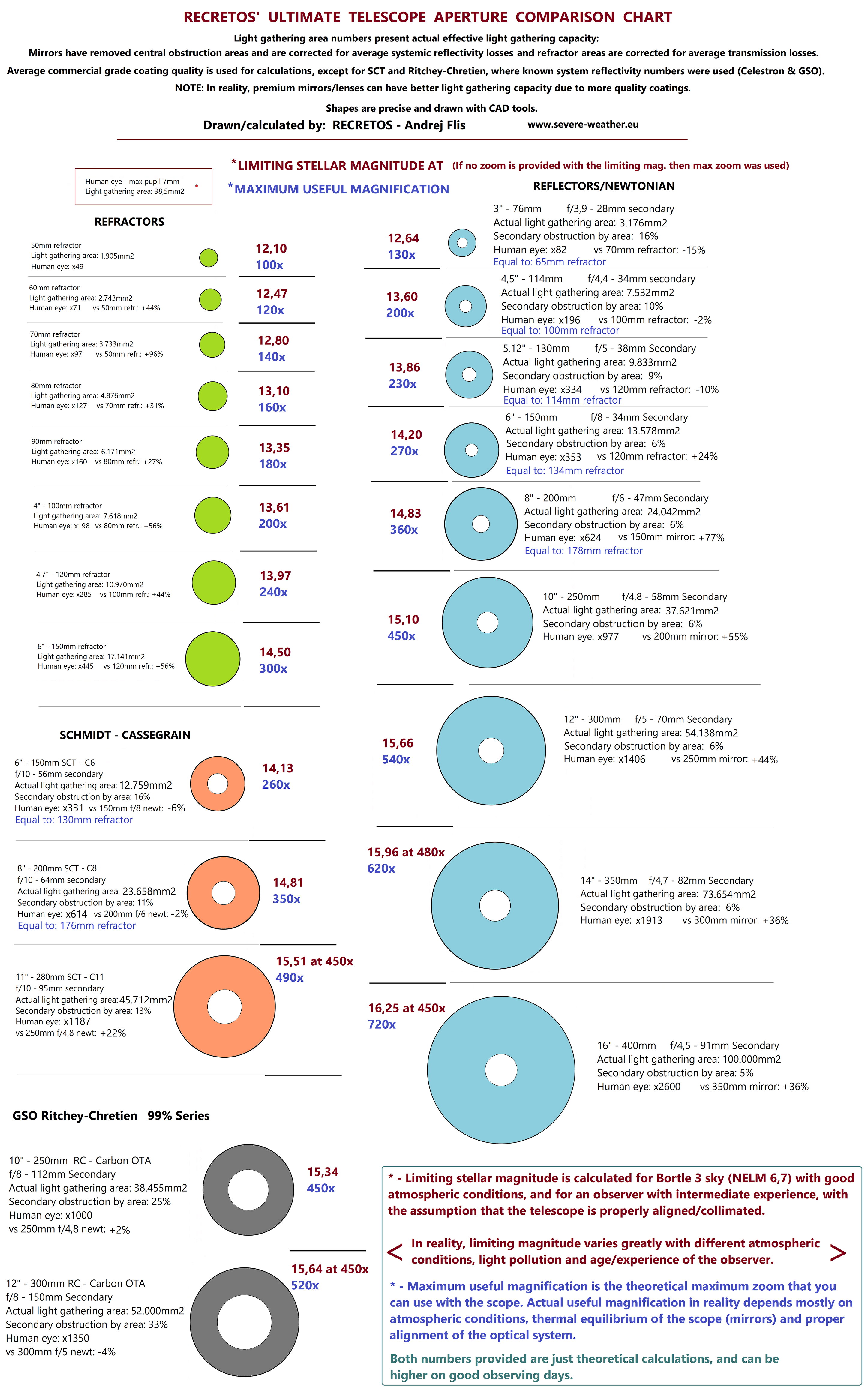
This incredible telescope aperture comparison chart serves as a simple guide to the light-gathering power of different types/sizes of telescopes. (Severe Weather Europe website)
Balancing Aperture With Practicality
While aperture is the key to performance, there are trade-offs to consider. A large telescope is exciting to use, but storing it and setting it up can be a lot of work.
- Portability – Large telescopes are heavier and more difficult to move or store.
- Cost – Bigger apertures generally cost more, though reflectors offer better value per inch of aperture than refractors.
- Sky Conditions – A huge telescope under city light pollution won’t outperform a modest one under rural skies.
For most amateur astronomers, the best telescope is the one they will use often, balancing aperture with practicality. This is why many amateur astronomers consider an 8-inch model to be ‘the sweet spot’, balancing performance and practicality.
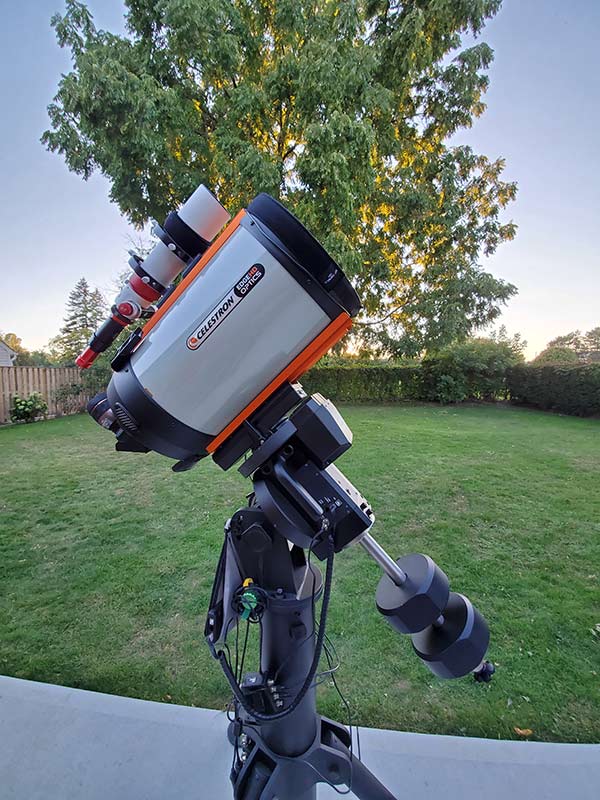
The Celestron Edge HD 11 is a popular choice for both visual astronomers and astrophotographers. While this telescope is impressive optically, it is very heavy and requires a heavy-duty equatorial mount to operate efficiently.
Telescope Aperture for Astrophotography
For astrophotographers, aperture is also linked to exposure time. A larger aperture telescope gathers more light in less time, revealing fainter nebulae and galaxies more efficiently.
However, focal length and optics design also play a role, which is why many imagers use small-aperture refractors with wide fields of view for deep-sky imaging.
Unlike visual astronomy, where the user is limited by their eyes to see objects in space, a camera can record light for long periods of time to reveal faint structures and incredible detail.
This is why smart telescopes (often with apertures less than 50mm) can capture incredible deep-sky images despite their small size. By live stacking images, these telescopes can produce bright, exciting views of deep-sky objects.
Aperture is much less critical in the deep-sky astrophotography world than in visual photography. However, if capturing planets up close is important to you, a large-aperture telescope is necessary.
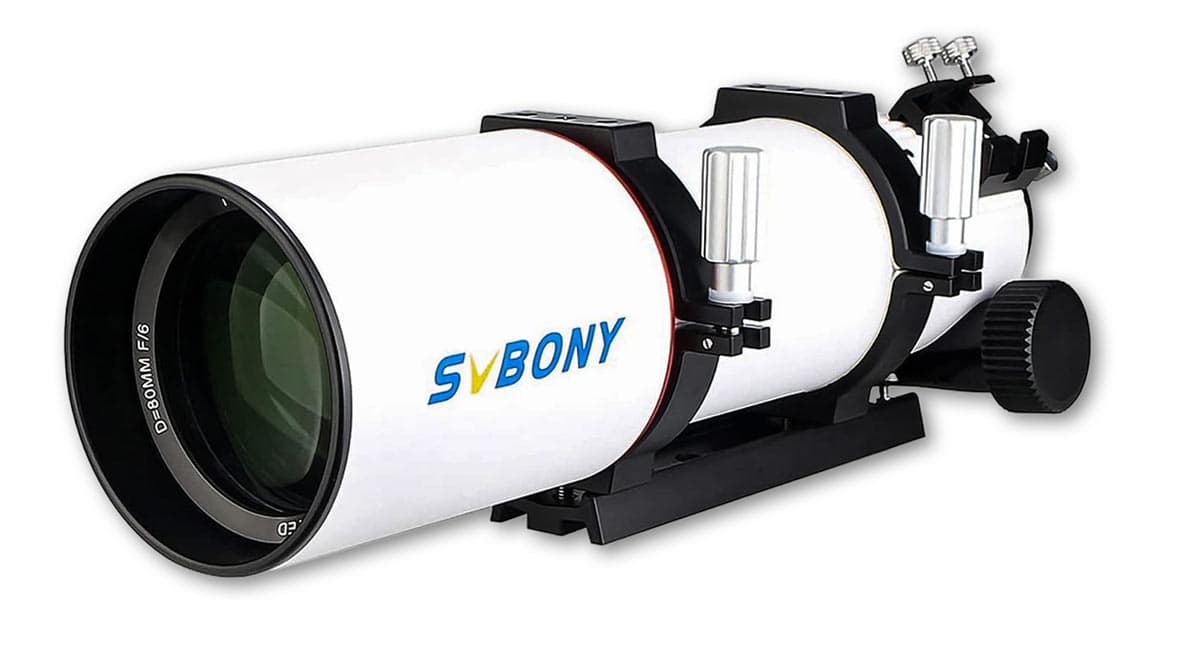
If your interests lie in deep-sky astrophotography, a small-aperture, compact refractor telescope (80mm or even smaller) can produce incredible images. (SVBONY SV550)
The Bottom Line
Telescope aperture is the most important factor when it comes to astronomy. A larger aperture means brighter images, sharper resolution, and access to faint objects you could never see otherwise.
While magnification and accessories matter, nothing transforms your view of the night sky like aperture.
When choosing your telescope, start with this question: “How much aperture can I comfortably handle, transport, and afford?”
The answer will lead you to the right telescope for your needs. For even more tips about choosing a telescope, be sure to visit my complete telescope buying guide.

For visual astronomy, an 8-inch diameter aperture is the sweet spot for most people. (Apertura AD8 pictured).
FAQ: Telescope Aperture
What is the aperture of a telescope?
The aperture is the diameter of a telescope’s main lens or mirror, measured in millimeters or inches. It controls how much light the telescope gathers.
Why is aperture more important than magnification?
Magnification can be adjusted with eyepieces, but without sufficient aperture, images will be dim and blurry. Aperture determines both brightness and clarity.
What size aperture is best for beginners?
A telescope in the 150mm – 200mm (6″-8″) range offers a balance of performance, portability, and affordability for beginners.
Does a bigger aperture always mean better views?
Not always. Larger telescopes reveal more detail, but factors like light pollution, portability, and budget should be considered.

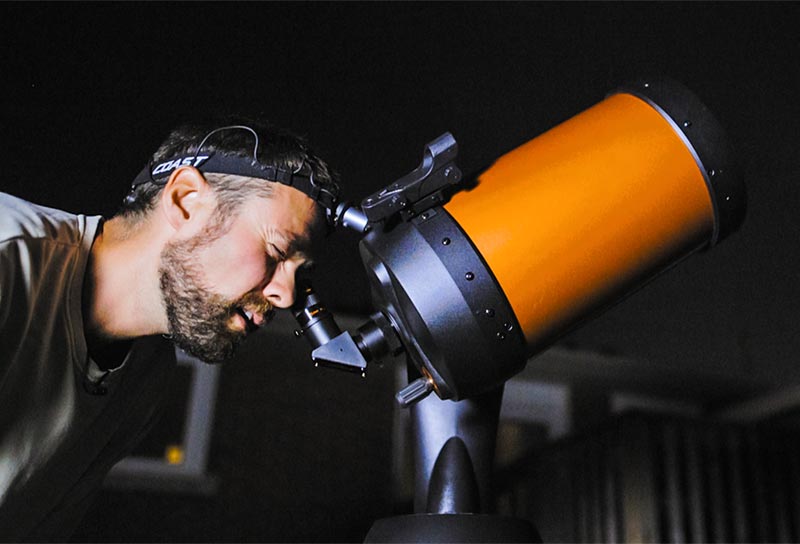
Viewing the planet Venus during its crescent phase through the eyepiece of a large Dobsonian telescope.

Trevor Jones is an astrophotographer and a valued member of the RASC. His passion is inspiring others to start their astrophotography journey on YouTube so they can appreciate the night sky as much as he does. His images have been featured in astronomy books & online publications, including the NASA Astronomy Picture of the Day (APOD).