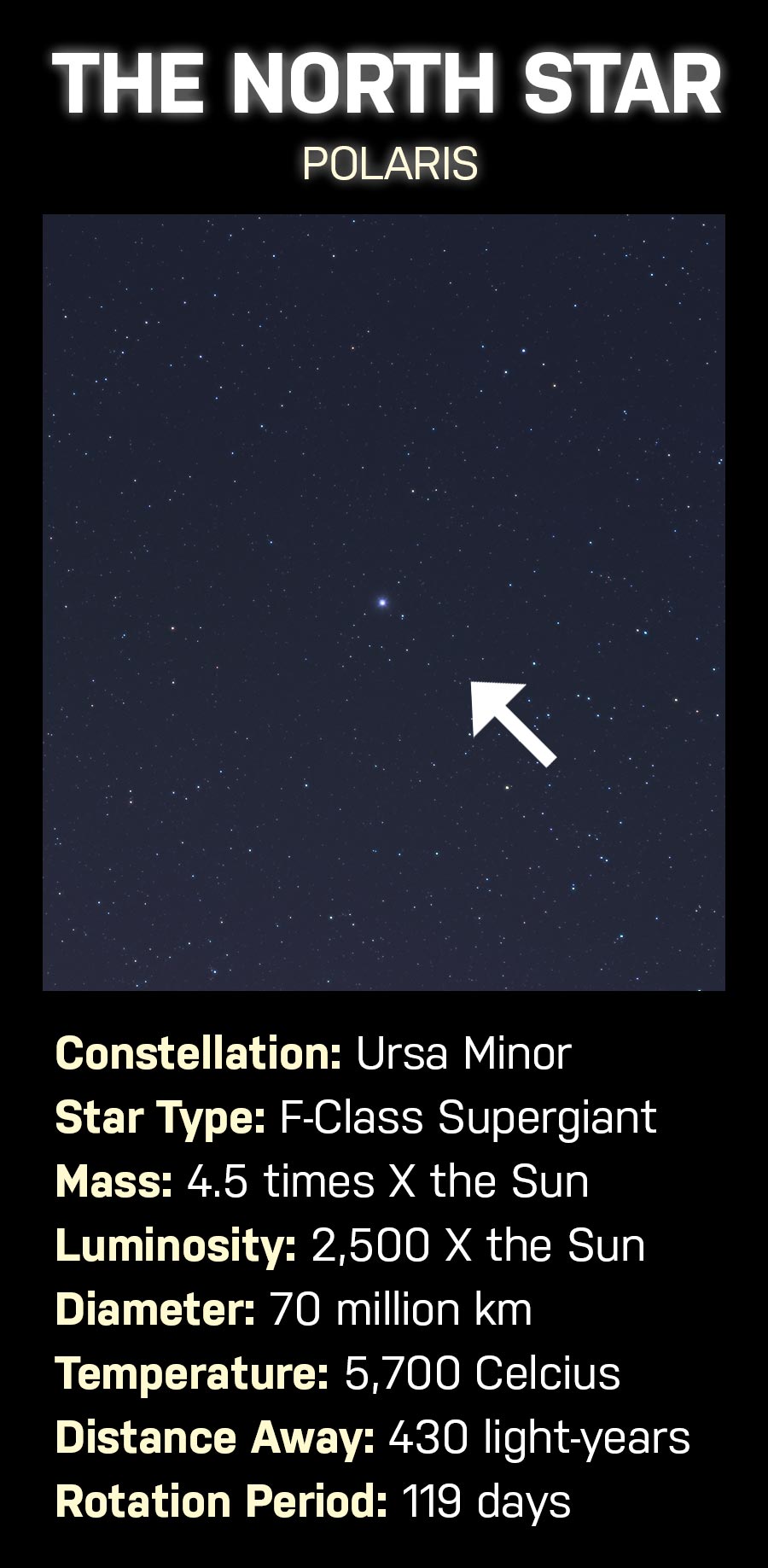
What is the North Star?

At a Glance: Polaris is the North Star, a second-magnitude star less than one degree from the north celestial pole. Find it by extending a line from the Big Dipper’s pointer stars, Merak through Dubhe.
Last updated: August 9, 2026
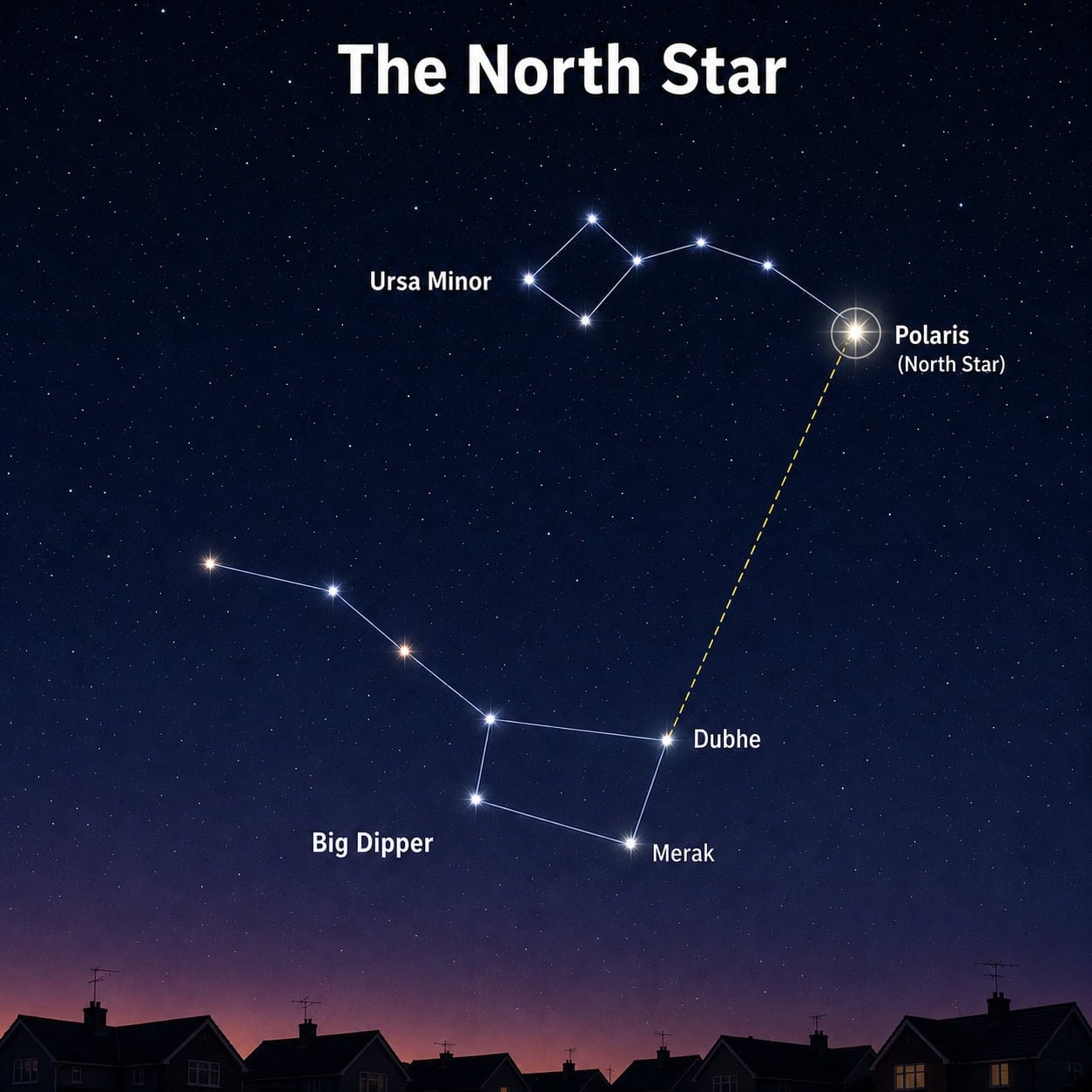
The North Star is Polaris, located in the constellation Ursa Minor. It does not sit directly on the Earth’s north celestial pole, but it is very close. In the Northern Hemisphere, Polaris is easy to identify using the Little Dipper as a reference.
The stars and constellations in the night sky appear to rotate around the North Star throughout the year. A common misconception about the North Star is that it is the brightest star in the sky, but that is not true.

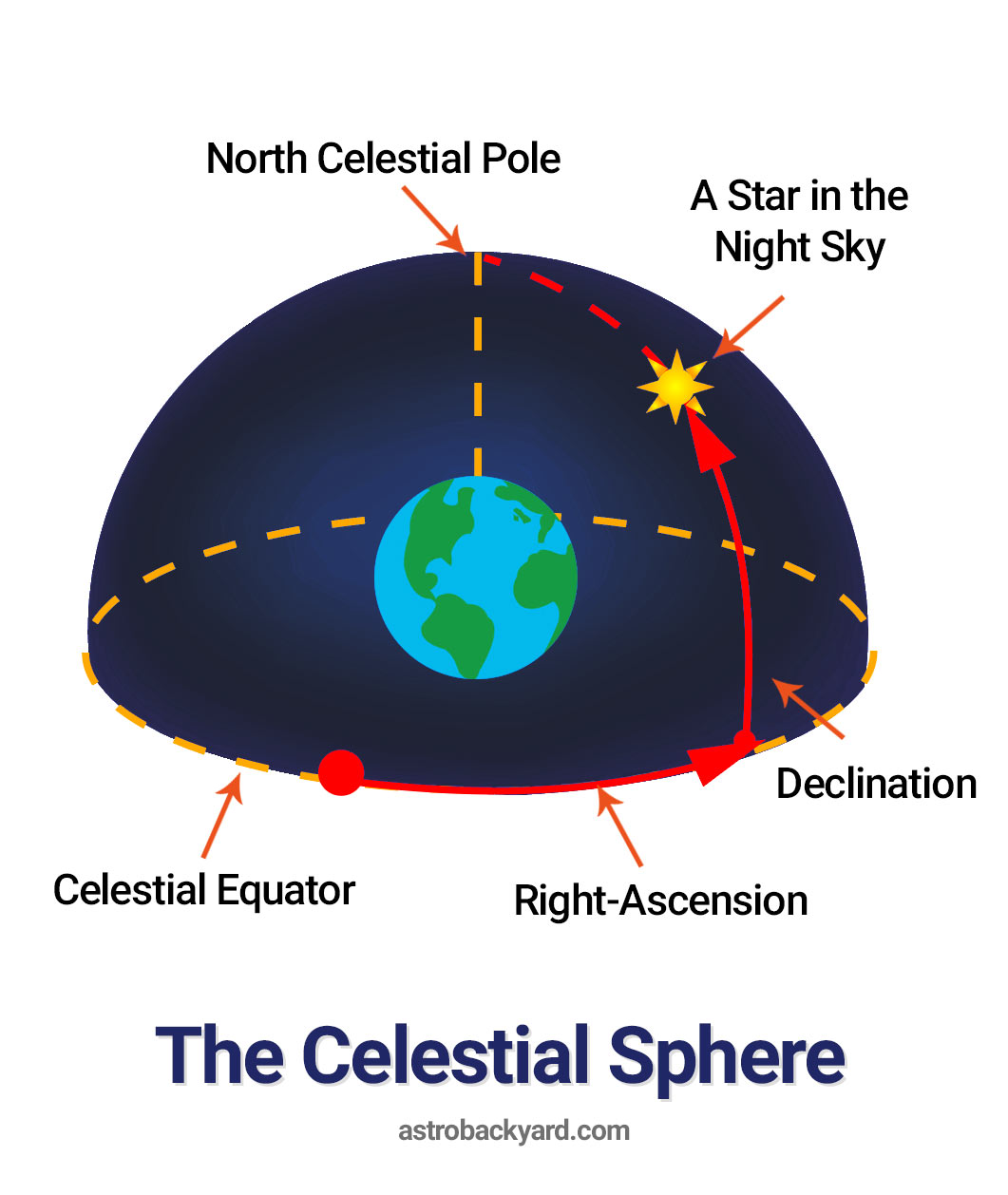
Polaris, commonly known as the North Star, is located almost directly above the north celestial pole, marking the way due north.
Polaris is not the brightest star in the night sky. However, it is easily located, making it a reliable gauge of north for travelers without a compass.
In this article, I’ll explain how to find the North Star in the night sky and share some interesting facts about Earth’s pole star.
The North Star: Polaris
- Constellation: Ursa Minor
- Star Type: F7 Ib supergiant and classical Cepheid variable
- Mass: 5.13 ± 0.28 times the mass of the Sun
- Luminosity: Roughly 2,000–2,500 times brighter than the Sun
- Radius: Approximately 46 times the Sun
- Temperature: Approximately 6,000 K (5,700°C)
- Distance From Earth: Approximately 430–450 light-years
- Apparent Magnitude: Approximately 2.0
- Rotation Period: Approximately 120 days
- Alternate Names: Polaris Aa, Alpha Ursae Minoris, Pole Star, North Star
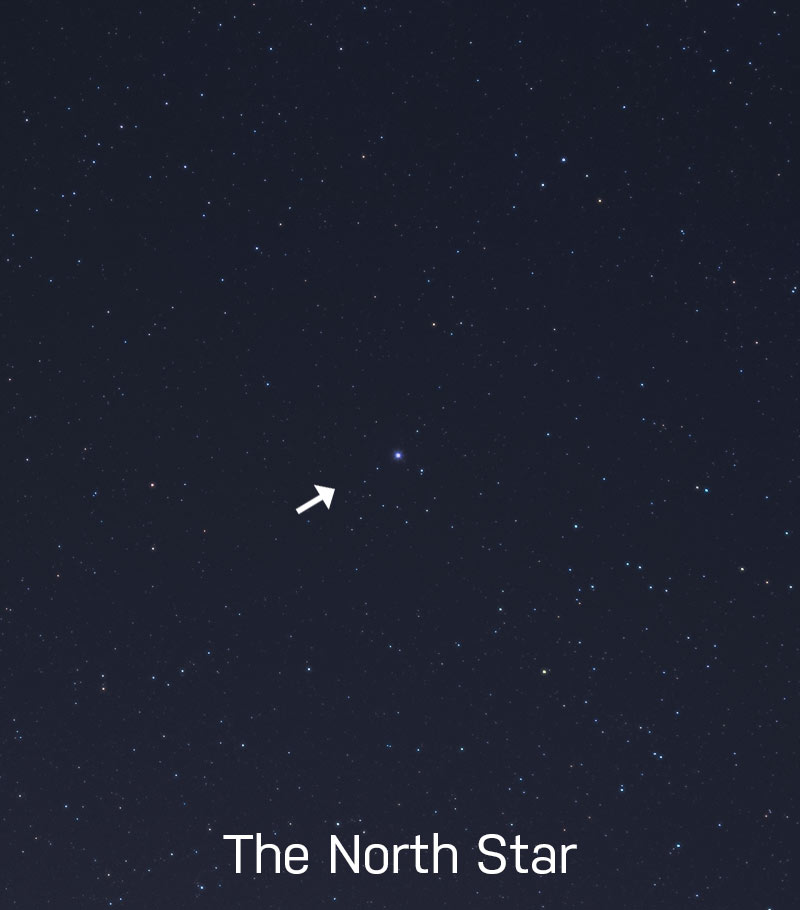
Why Does Polaris Appear Stationary?
Earth rotates around an imaginary axis that meets the northern sky at the north celestial pole. Because Polaris lies less than one degree from this point, it traces only a tiny circle each day while other stars sweep across larger arcs. Polaris is not perfectly motionless, but its movement is difficult to notice without a long-exposure photograph.
As you travel northward, Polaris climbs higher in the sky. If you go as far north as the North Pole, Polaris will appear almost directly overhead. As you travel south, Polaris drops closer to the northern horizon. Its altitude above the horizon is approximately equal to your northern latitude.
From the equator, Polaris sits on the northern horizon. It is generally not visible south of the equator because it falls below the horizon. Southern Hemisphere navigators can use the Southern Cross and nearby pointer stars to estimate the direction of the south celestial pole.
With an apparent magnitude close to 2.0, the North Star is visible to the unaided eye under most clear skies and can often be seen from cities. Polaris’ J2000 position is RA: 2h 31m 49s, Dec: +89° 15′ 51″.
The following video provides a basic overview of how to locate the North Star. A little further down the post, I’ve included a really simple step-by-step guide.
Find the Little Dipper
Polaris is easy to find if you can first locate the Little Dipper, Ursa Minor.
Polaris lies at the end of the handle in the Little Dipper and can also be located by finding the Big Dipper, Ursa Major.
To locate Polaris, find the Big Dipper pointer stars Dubhe and Merak. These two stars outline the outer part of the Big Dipper’s bowl. Draw an imaginary line from Merak through Dubhe, and follow it straight to Polaris and the Little Dipper.

The Big Dipper and Little Dipper change orientation as they circle Polaris. The Big Dipper may appear above, below, or beside the North Star depending on the season and time of night. The Big Dipper, like a great big hour hand, goes a full counter-clockwise circle around Polaris in one sidereal day.
Even though the Big Dipper travels around Polaris all night long, the Big Dipper pointer stars always point to Polaris on any day of the year and at any time of the night.
How to Find the North Star
The following steps will help you locate the North Star in the Northern Hemisphere sky. It is not difficult to find as long as it sits high enough in the sky from your latitude and obstructions, such as large trees, are not blocking your view.
- Locate the Big Dipper (7 stars).
- Find the 2 bright stars that form the side of the bowl opposite the tip of the handle.
- Draw an imaginary line through these 2 bright stars.
- Extend the line until you reach a star of similar brightness, approximately 5 times the distance between these 2 stars.
- The bright star found here is Polaris, the North Star.
You can also find the North Star by locating the tip of the Little Dipper’s handle, but this asterism can be difficult to find in the city. The Little Dipper is often referred to as the “Host of the North Star.”
Using Cassiopeia
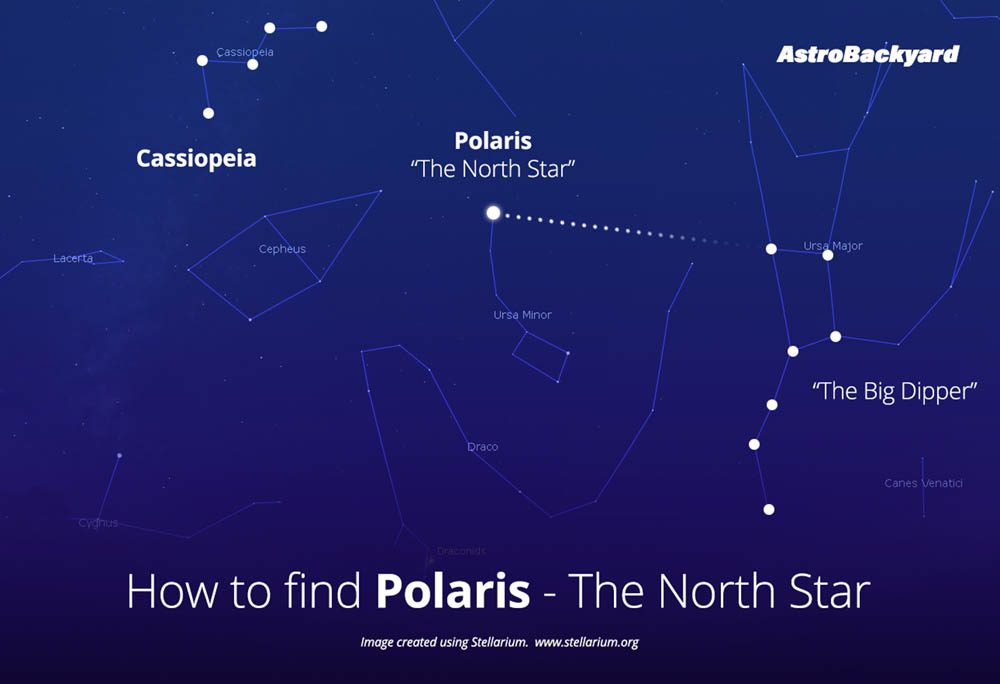
If the Big Dipper is hidden, find the W or M of Cassiopeia, which lies opposite it across Polaris. An imaginary line bisecting the deeper V points toward Polaris. This method is less precise but makes a useful backup.
The amount of local light pollution in your location can make seeing stars difficult. You can find out where your backyard falls on the Bortle Scale using this guide.
Amateur astronomers and astrophotographers must understand how to find the North Star to align their telescopes. This is referred to as polar alignment and it is a critical step of the process when using an equatorial telescope mount.
Once the mount’s polar axis is aligned with the north celestial pole, the telescope can accurately track the apparent motion of the stars across the night sky at the sidereal rate.
Will the North Star Change?
Polaris marks the center of nature’s grandest celestial clock. However, the North Star has not always been, nor will it always be, the Pole Star.
This is because the Earth’s axis changes direction slowly in a roughly 26,000-year cycle called axial precession.
Around 2700 B.C.E., the pole star was Thuban, also known as Alpha Draconis.
Gamma Cephei, also known as Errai, will become a future North Star in several thousand years. The pole will later pass near Iota Cephei and Deneb before pointing near the bright star Vega in approximately 12,000 years.
How Far Away is Polaris?
Polaris is approximately 430–450 light-years away. The range reflects the difficulty of measuring a very bright, variable multiple-star system. Revised Hipparcos data placed Polaris near 430 light-years, while Gaia measurements of its wider companion support a distance closer to 447 light-years. The single point of light that we see as Polaris is actually a triple-star system; three stars orbiting a common center of mass.
The primary star, Polaris Aa, is a supergiant more than two thousand times brighter than our Sun. The next closest companion is Polaris Ab, a main-sequence star.
Polaris Ab was separated from Polaris Aa by approximately 2 billion miles in NASA’s Hubble observations. Much farther away from the first two is the third companion, Polaris B. Polaris B is located approximately 240 billion miles from Polaris Aa.
The two companion stars are similar in temperature to Polaris Aa; however, they are dwarf stars. Polaris B can be resolved with a modest telescope, while seeing close Polaris Ab requires professional instruments.
Why Polaris is so Fascinating
By watching the motion of Polaris Aa’s companion star, Polaris Ab, astronomers expect to learn not only the stars’ orbits but also their masses. Measuring the mass of a star is one of the most difficult tasks.
Astronomers want to determine the mass of Polaris accurately because it is the nearest Cepheid variable star, a type of star that pulsates radially, varying in both diameter and temperature and producing changes in brightness with a well-defined period and amplitude.
Cepheid variable stars can be used to measure the distance to galaxies and help calibrate the expansion rate of the universe. This is why it is so important to understand their physics and evolution.
The most important part of this process is knowing a Cepheid’s mass. The North Star is a Cepheid variable, but its roughly four-day pulsation period and amplitude have changed over time.
During the 20th century, Polaris’ brightness variation decreased markedly. More recent observations uncovered an increase in variability, showing why astronomers continue to study how the brightness fluctuation has changed. Its pulsation behavior continues to evolve.
A 2024 study using the CHARA Array calculated a mass of 5.13 ± 0.28 solar masses for Polaris Aa and a radius approximately 46 times that of the Sun.
NASA’s Hubble Space Telescope has been able to photograph the close companion of Polaris directly. Researchers continue observing the Polaris system. The movement of the small companion in its 30-year orbit around Polaris Aa is now detectable, and the goal is to refine the mass of Polaris by measuring the motion of Polaris Ab in its orbit.
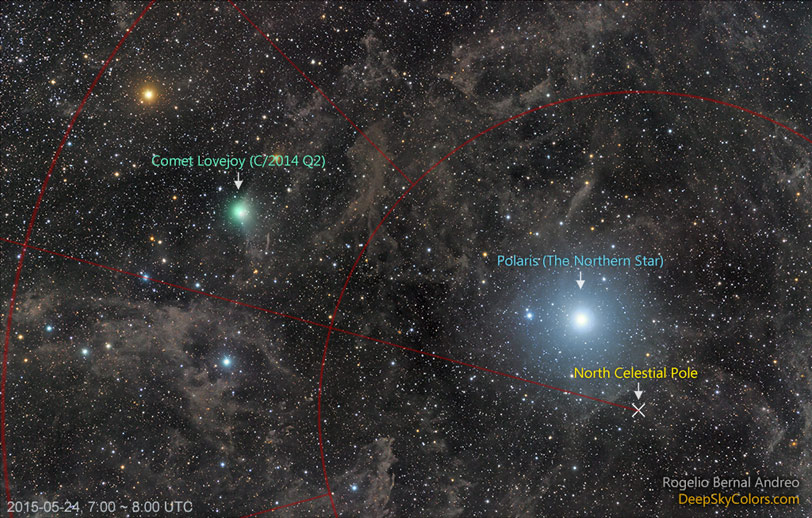
Polaris and Comet Lovejoy (NASA APOD) by Rogelio Bernal Andreo.
10 Interesting Facts About the North Star
- Polaris is generally not visible south of the equator
- Polaris has been a visual aid to navigators and astronomers for centuries
- Polaris is a three-star system (supergiant Polaris Aa and two smaller companions)
- The companion stars (Polaris Ab and Polaris B) are both yellow-white dwarfs
- Polaris is the brightest star in Ursa Minor, but not the brightest in the night sky
- Polaris appears almost stationary because it lies close to the north celestial pole
- Polaris has been aligned near the north celestial pole for around 2,000 years
- Polaris has an apparent magnitude close to 2.0
- Its altitude above the northern horizon approximately matches an observer’s latitude
- Gamma Cephei and, much later, Vega will become future northern pole stars
Helpful Resources
- What Is the North Star and How Do You Find It? (NASA)
- NASA APOD October 6, 1999 – Polaris: The North Star
- The Orbit and Dynamical Mass of Polaris (The Astrophysical Journal, 2024)