
Milky Way Photography Calendar (Month-by-Month Guide)

The Milky Way is one of the most popular subjects for astrophotography, but the bright galactic core isn’t visible all year long.
Because of Earth’s position in its orbit around the Sun, the core only appears in the night sky during certain months. At other times of the year, it remains below the horizon at night.
Knowing when the core rises, how long it’s visible, and how high it climbs can make a big difference when planning your shots.
In this guide, I’ll break down a simple Milky Way photography calendar, including how visibility changes between the Northern and Southern Hemispheres and the best times of year to capture it.
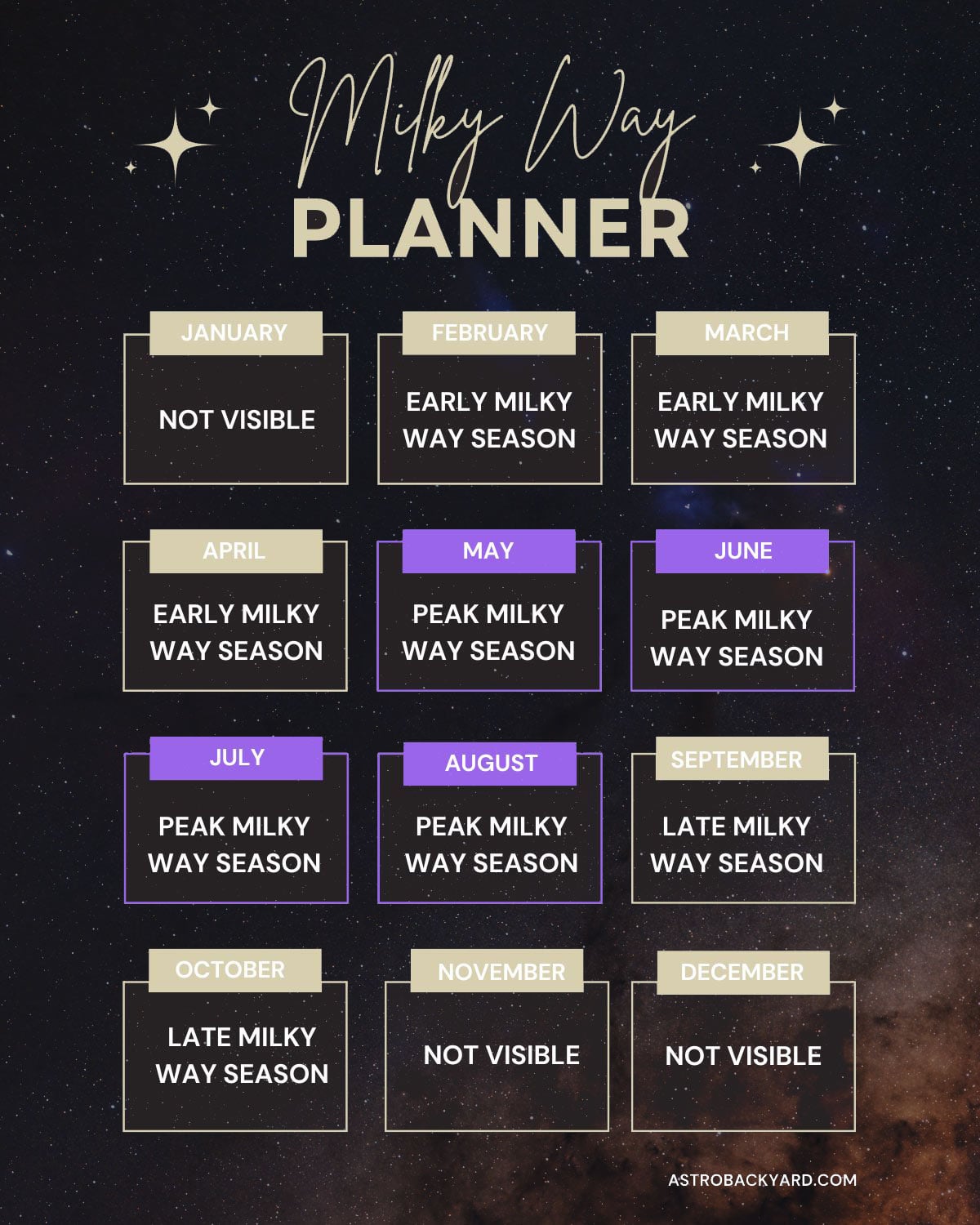
When Is the Best Time to Photograph the Milky Way?
- Northern Hemisphere: May to August (best in June and July)
- Southern Hemisphere: April to September (best in June through August)
Best Times to Capture the Milky Way in 2026 (North America)
Looking for the best times to photograph the Milky Way in 2026? This North America Milky Way photography calendar highlights the best dark-sky windows to capture the galactic core based on the week surrounding each new moon.
| Month | Best Nights | Core Visibility | Shoot Priority |
|---|---|---|---|
| February | Feb 14 to Feb 20 | Very low core visibility before dawn; the season is just starting in many areas. | Fair |
| March | Mar 15 to Mar 21 | Core visible before dawn, low in the southeast and south. | Good |
| April | Apr 14 to Apr 20 | Strong pre-dawn window; one of the best spring setups. | Very Good |
| May | May 13 to May 19 | Core visible for longer before dawn and into early morning. | Excellent |
| June | Jun 11 to Jun 17 | Core is higher and visible longer, but short nights hurt northern locations. | Excellent |
| July | Jul 11 to Jul 17 | Prime season; core visible in full darkness during the middle of the night. | Peak |
| August | Aug 9 to Aug 15 | Prime season; strong core visibility, often the easiest month. | Peak |
| September | Sep 7 to Sep 13 | Core visible in the evening and early night; great for vertical compositions. | Excellent |
| October | Oct 7 to Oct 13 | Shorter evening window; the core drops earlier in the southwest. | Good |
| November | Nov 6 to Nov 12 | The galactic core is generally no longer visible. | Poor |
Note: This calendar is most accurate for mid-latitude locations in North America, including much of the contiguous United States and southern Canada. In southern locations, the season starts earlier and lasts longer. In far northern locations, summer darkness is shorter, which can reduce usable imaging time.
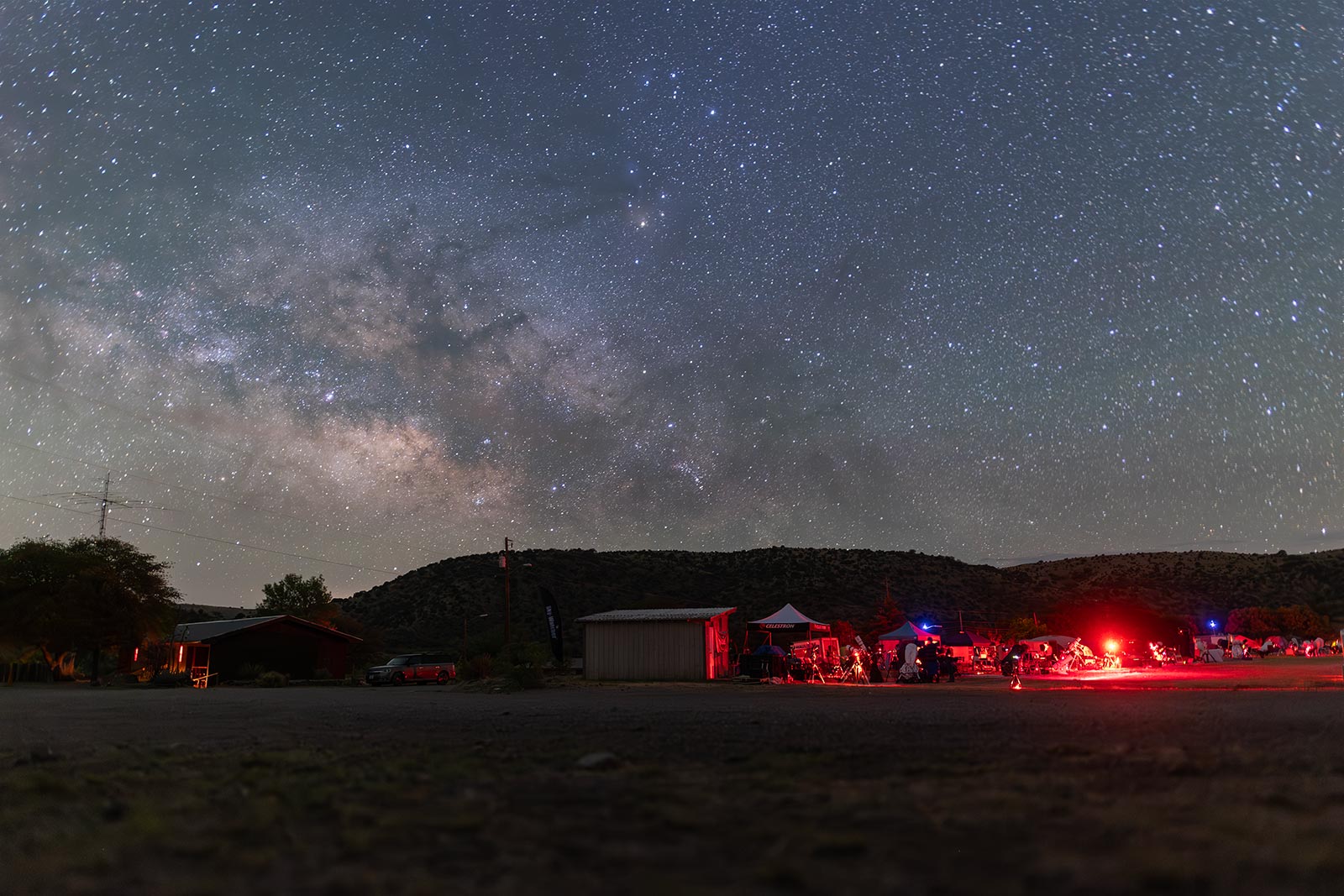
The Milky Way core rising on May 22 from the Texas Star Party 2023.
Milky Way Season
It’s worth noting that the Milky Way is technically visible all year, but the bright, detailed galactic core is seasonal.
This is the most photogenic part of the galaxy, with dense star clouds, colorful nebulae, and the bright band you see in most Milky Way photos.
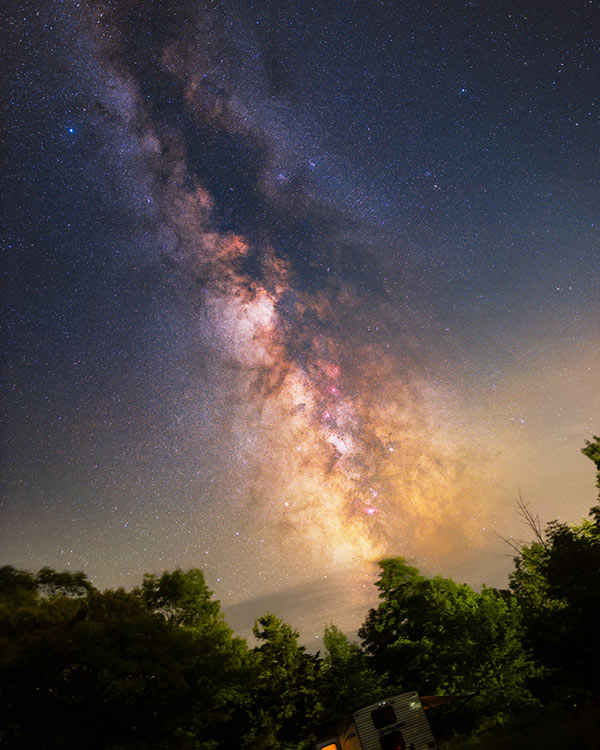
Milky Way Core from a Bortle 2 location
Northern Hemisphere
In the Northern Hemisphere, the Milky Way core is typically visible from February through October.
Early in the season, it rises just before sunrise, offering only a short window to photograph it in the early morning hours.
As the months progress, the core rises earlier and climbs higher in the sky. By late spring and early summer, it’s visible for much of the night.
The best months for Milky Way photography are May through August, with peak visibility in June and July, when the core is highest and visible for the longest periods in dark sky locations.
Southern Hemisphere
The Milky Way core is visible for much of the year in the Southern Hemisphere and climbs significantly higher in the sky.
In many locations, it can be seen from January through November, offering a much longer shooting season.
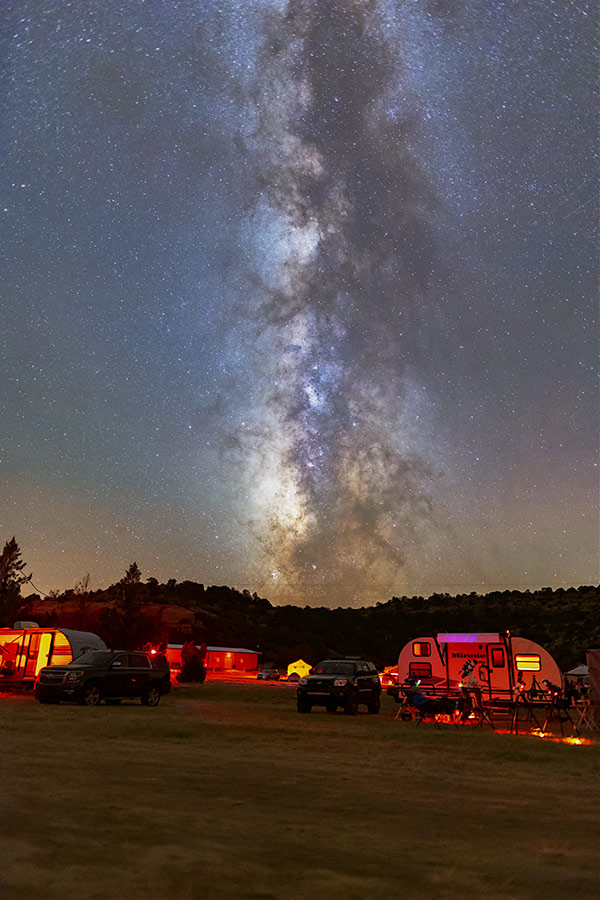
In some areas, the core passes nearly overhead, making it easier to capture dramatic wide-angle images of the galaxy arching across the sky.
The best months for Milky Way photography are typically April through September, when the core is bright, high, and visible for long stretches of the night.

The Southern Milky Way Core Overhead in Australia. Star Tracker, Canon EOS Ra, Sigma 24mm F/1.4 lens.
Months When the Milky Way Core Is Not Visible
Northern Hemisphere: November – January
During these months, the Milky Way core stays below the horizon at night for most locations in the Northern Hemisphere. While the faint band of the winter Milky Way can still be seen in very dark skies, the bright core region is not visible.
For astrophotographers, winter nights are often spent focusing on other celestial targets instead. Popular winter subjects include the Orion constellation, the Orion Nebula, and large winter star fields.
Although it isn’t Milky Way season, winter skies are incredibly rewarding for night photography.
Early Milky Way Season
Northern Hemisphere: February – April
The Milky Way season technically begins in late winter, but the viewing window is still quite limited.
During February and March, the Milky Way core rises just before sunrise, usually in the southeast. This means photographers often need to be out shooting between 3:00 and 5:00 AM to capture it.
At this time of year, the core remains fairly low on the horizon, which can make compositions more challenging depending on your location.
However, early-season images can still be beautiful, especially when combined with interesting foreground elements like mountains or rock formations.
Peak Milky Way Season
Northern Hemisphere: May – August
For many astrophotographers, this is the most exciting time of the year.
Starting in April, the Milky Way begins to rise earlier in the evening, so you don’t have to wake up in the middle of the night to see it.
By late spring and early summer, the core is visible for hours after sunset. In June and July, you can often see it for most of the night from a dark sky location.
This is the best time for:
- Milky Way landscape photos
- Wide “galactic arch” panoramas
- Creative foreground shots
The warmer weather doesn’t hurt either; it’s a lot easier to stay out longer and enjoy the experience.
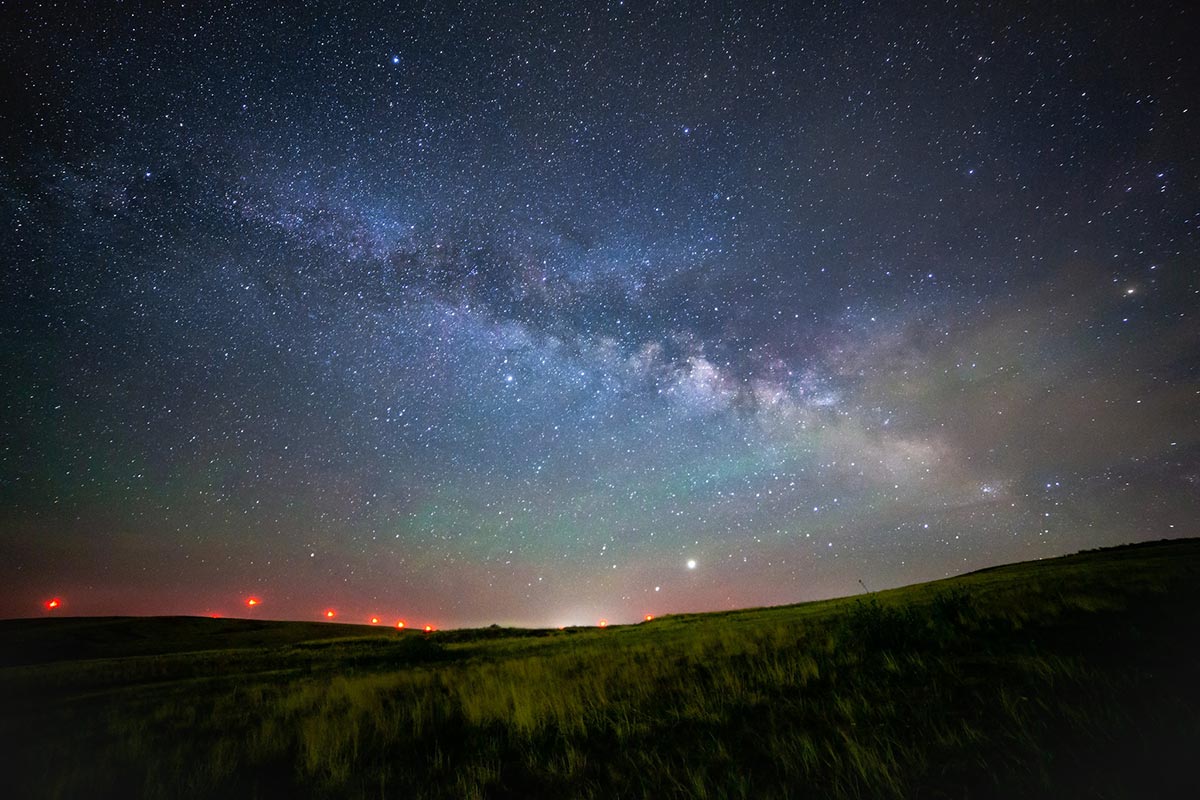
The Milky Way core rising in late May. Photo by Joel Tonyan on Flickr.
Late Milky Way Season
Northern Hemisphere: September – October
As summer turns to fall, the Milky Way core begins to set earlier each night.
The advantage during this time of year is that the galaxy is visible shortly after sunset, allowing photographers to capture Milky Way images earlier in the evening.
However, the viewing window becomes shorter with each passing week as the core gradually sinks lower in the southwestern sky.
By late October, the Milky Way core disappears from the night sky in the Northern Hemisphere until the following spring.
Month-by-Month Milky Way Overview
The table below provides a quick overview of Milky Way core visibility throughout the year.
| Month | Northern Hemisphere | Southern Hemisphere |
|---|---|---|
| January | Core not visible | Visible before sunrise |
| February | Early morning | Excellent |
| March | Early morning | Excellent |
| April | Late night | Excellent |
| May | Prime season | Prime season |
| June | Peak season | Peak season |
| July | Peak season | Peak season |
| August | Excellent | Excellent |
| September | Evening visibility | Excellent |
| October | Early evening | Very good |
| November | Not visible | Early evening |
| December | Not visible | Late night |
How the Moon Affects the Milky Way
The phase of the moon can make or break your Milky Way photos.
For the best results, aim to shoot during a new moon or when the moon is below the horizon. A bright moon can wash out the night sky and make the Milky Way much harder to see.
That said, the moon isn’t always a bad thing. A small amount of moonlight can help illuminate your foreground, especially when it’s low on the horizon.
If you’re planning a shoot, it’s worth checking both the moon phase and the moonrise and moonset times—this can give you a window of dark skies even when the moon is present.
Plan Your Milky Way Photography (Helpful Tools)
Once you know when the Milky Way core is visible, the next step is planning your shot.
A few simple tools can make a big difference in knowing exactly where to look and when to be there.
You don’t need much to get started; these three apps are more than enough:
- PhotoPills: PhotoPills is one of the most popular planning apps for Milky Way photography. It shows you exactly when and where the galactic core will appear, and how it lines up with your foreground. You can also use it to check core rise and set times, plan compositions, and even preview the Milky Way using augmented reality.
- Stellarium: A free planetarium app that lets you simulate the night sky from your location. It’s a great way to understand how the Milky Way moves across the sky and visualize where it will appear at different times of night.
- Astrospheric This app helps you check cloud cover, transparency, and overall conditions before heading out. It is my favorite overall weather forecasting app.
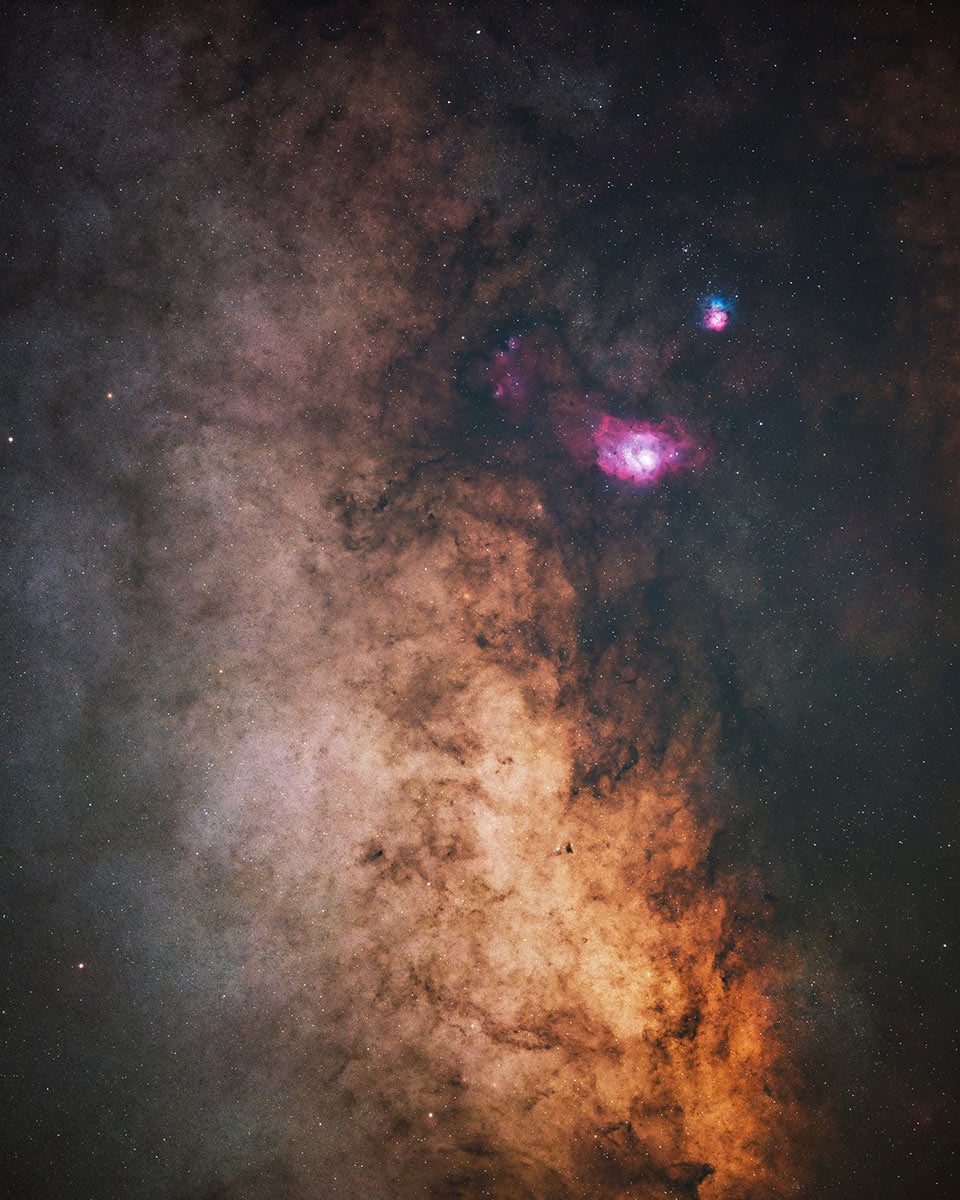
The bright core of the Milky Way galaxy, with the Lagoon Nebula and Trifid Nebula visible.
Milky Way Photography Planning Checklist
Before heading out, run through this quick checklist to make sure everything lines up:
- Check Milky Way core visibility (month and time of night)
- Confirm the moon phase (aim for a new moon or minimal moonlight)
- Check the weather forecast (cloud cover and transparency)
- Choose a dark sky location (away from city light pollution)
- Plan your composition (foreground + Milky Way position)
- Know when the core rises and sets
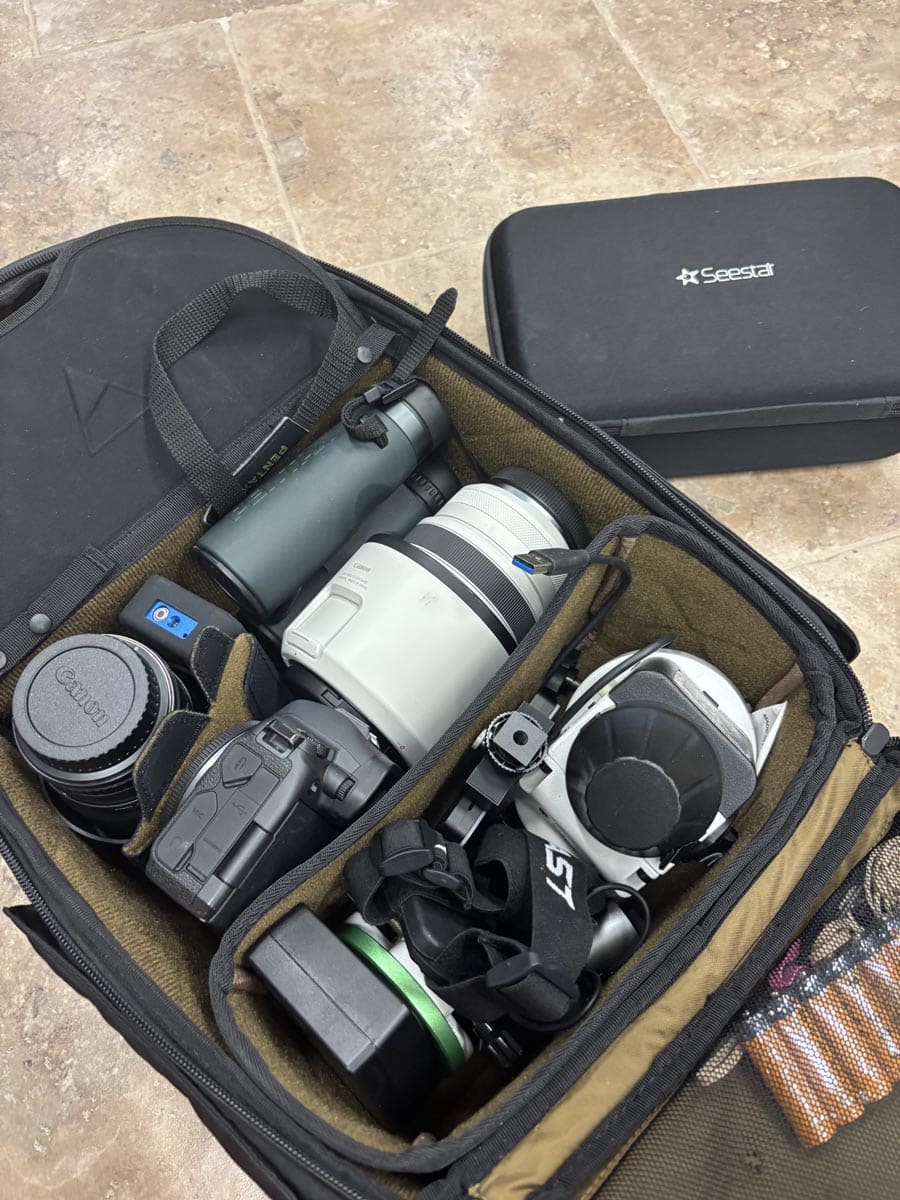
- Charge batteries and pack your gear
A little planning goes a long way, especially when you’re heading out late at night or traveling to a dark sky location.
If possible, try to visit your location during the day to scout your composition and get familiar with the area. It’s much easier (and safer) than trying to find your way around in the dark.
Best Months for Milky Way Photography (Quick Summary)
While the Milky Way core is visible for several months each year, some months offer much better conditions than others.
Northern Hemisphere:
- Best time: May through August
- Peak: June and July
This is when the core is visible for the longest periods and reaches its highest point in the sky.
Southern Hemisphere
- Best time: April through September
- Peak: June through August
During these months, the Milky Way is bright, high, and visible for extended stretches of the night.
Frequently Asked Questions
Here are a few common questions that come up when planning Milky Way photography:
Even during Milky Way season, visibility depends on several factors. Light pollution, moonlight, weather conditions, and the time of night can all affect whether you can see the core. For the best results, aim for a dark sky location on a clear, moonless night.
April marks the transition into Milky Way season in the Northern Hemisphere. The core becomes visible late at night, but the viewing window is still shorter than in summer. It’s a great time to start shooting, just be prepared to stay out later.
The position of the Milky Way changes based on your latitude. In northern locations, the core stays lower on the horizon, while closer to the equator—and in the Southern Hemisphere—it climbs much higher in the sky. This can make a big difference in how easy it is to photograph.
In most cases, yes. Light pollution from cities can make the Milky Way difficult or impossible to see. Traveling to a dark sky location, even just an hour or two away, can dramatically improve your results.
The easiest time is during peak season—typically June and July in the Northern Hemisphere—when the core is visible for most of the night and reaches its highest point in the sky.
Conclusion
Photographing the Milky Way does take a bit of planning, but once you know what to look for, it becomes much more straightforward.
With a general idea of when the core is visible, plus a few simple tools and a bit of prep, you can pick a night and head out with confidence.
Over time, you’ll start to notice the patterns – like when it rises, how it moves, and which months work best for your location.
If you’ve been thinking about giving it a try, use this calendar as a guide and pick a month that works for you.
Check the conditions, plan ahead a little, and get out there. Even a short session under a dark sky can be a great experience, and you might be surprised at what you capture.
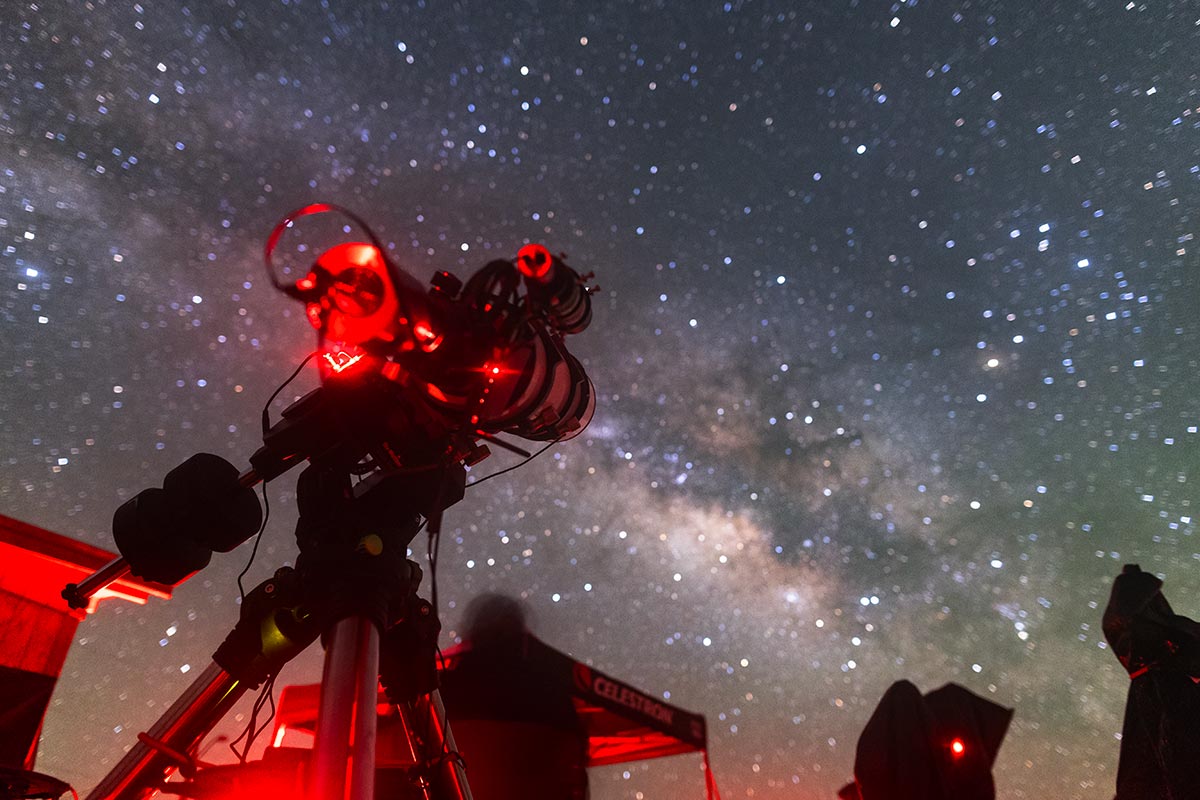

Ashley is an environmental educator, communication professional, and astrophotographer. She has extensive experience writing for diverse audiences to increase public awareness and engagement. Ashley is an active Advocate and Delegate with DarkSky International, helping to protect the nighttime environment from the harmful effects of light pollution through advocacy and outreach.