
M81 and M82 Galaxies: How to Find and Photograph Them

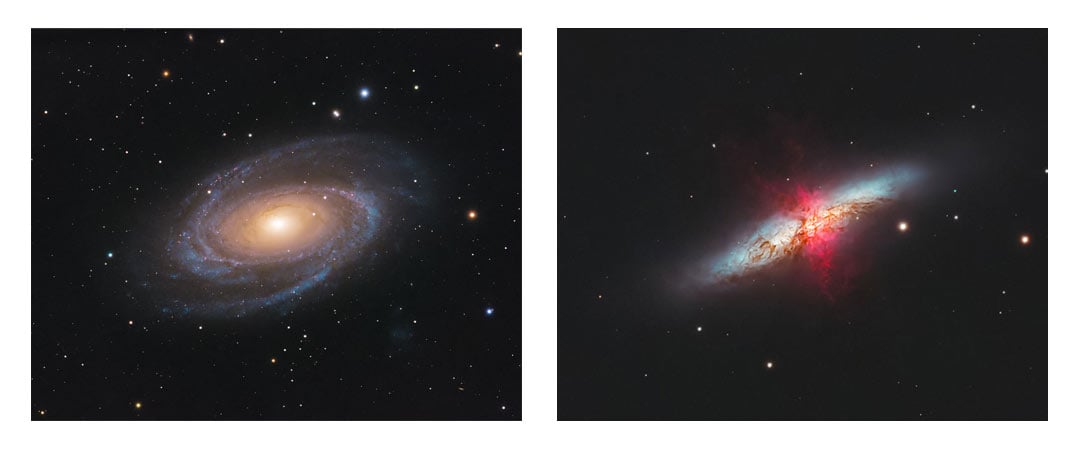
M81 and M82 are two bright galaxies in Ursa Major that are often photographed together in the same field of view. M81, also called Bode’s Galaxy, is a spiral galaxy, while M82, the Cigar Galaxy, is a distorted starburst galaxy shaped by its interaction with M81.
For backyard astrophotographers, this pair is one of the best spring galaxy targets because it is bright, visually interesting, and achievable with telescopes around 400mm to 800mm focal length. On this page, you’ll learn where to find M81 and M82, when to image them, and what equipment works best.
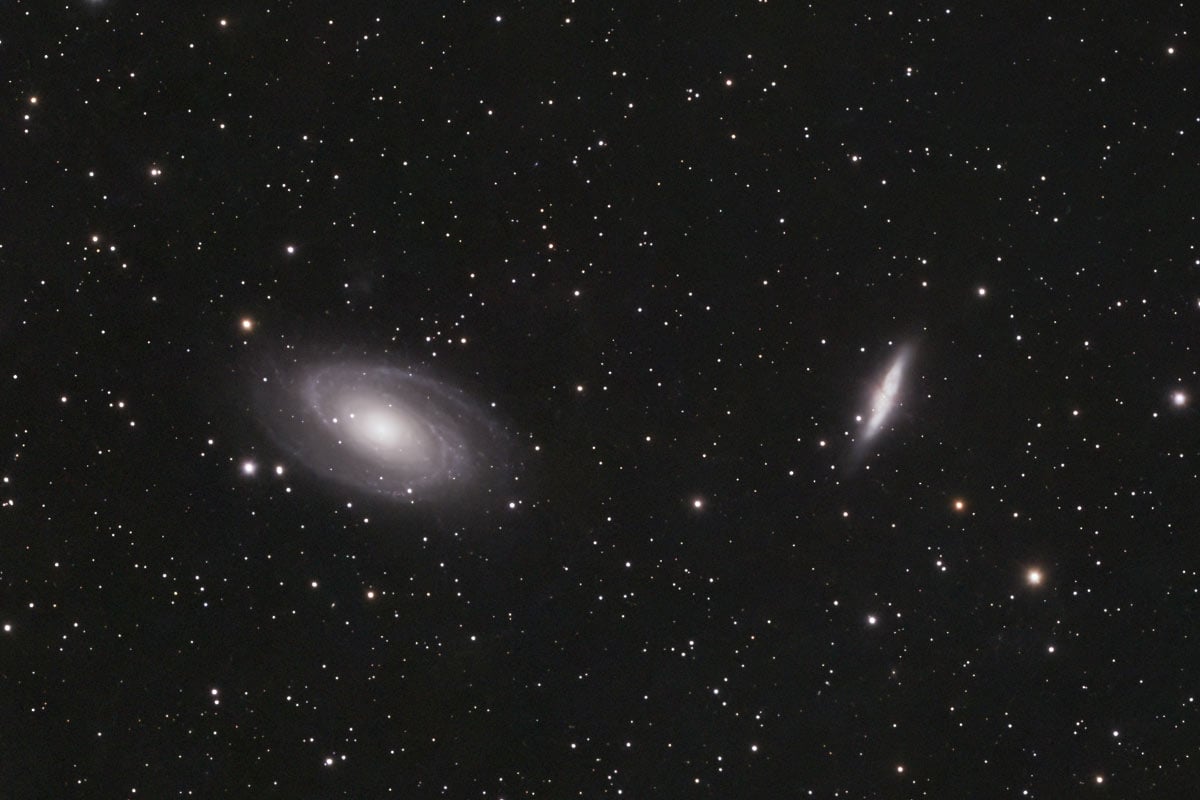
The M81 and M82 galaxies captured using a smart telescope in my backyard. (Seestar S30 Pro)
Fast Facts: M81 and M82
M81, also called Bode’s Galaxy, is a bright spiral galaxy in Ursa Major about 11.8 million light-years away.
M82, also called The Cigar Galaxy, is a nearby starburst galaxy in Ursa Major, roughly 11.4 to 12.4 million light-years away.
- Best seen from: Northern Hemisphere
- Best season: Spring
- Constellation: Ursa Major
- Best framing: Medium focal lengths that capture both galaxies together
- Popular names: Bode’s Galaxy and the Cigar Galaxy
What Are M81 and M82?
M81 and M82 are two bright galaxies in the constellation Ursa Major that are often photographed together. M81, also known as Bode’s Galaxy, is a grand-design spiral galaxy, while M82, the Cigar Galaxy, is a starburst galaxy with a more irregular, disturbed shape.
These two galaxies are part of the M81 Group and are close enough to interact gravitationally, which has influenced their structure over time. For astrophotographers, they are among the most popular spring galaxy targets because both objects are bright, visually interesting, and close enough to fit in the same field of view with many telescope setups.
M81 and M82 are also fairly easy to locate from the Big Dipper, making them a rewarding target for both binocular observers under dark skies and amateur astrophotographers. A faint patch of Integrated Flux Nebula lies in the region between them, although it is extremely dim and much more difficult to record.
Where Are M81 and M82 Located?
M81 and M82 are located in the constellation Ursa Major, in the same general region of sky as the Big Dipper. They sit well above the bowl of the Dipper, making them a convenient deep-sky target for northern observers using binoculars, a finder scope, or a GoTo mount.
Because they are positioned so close together in the sky, they are often framed in the same image, which is one of the reasons they are such a popular astrophotography target.
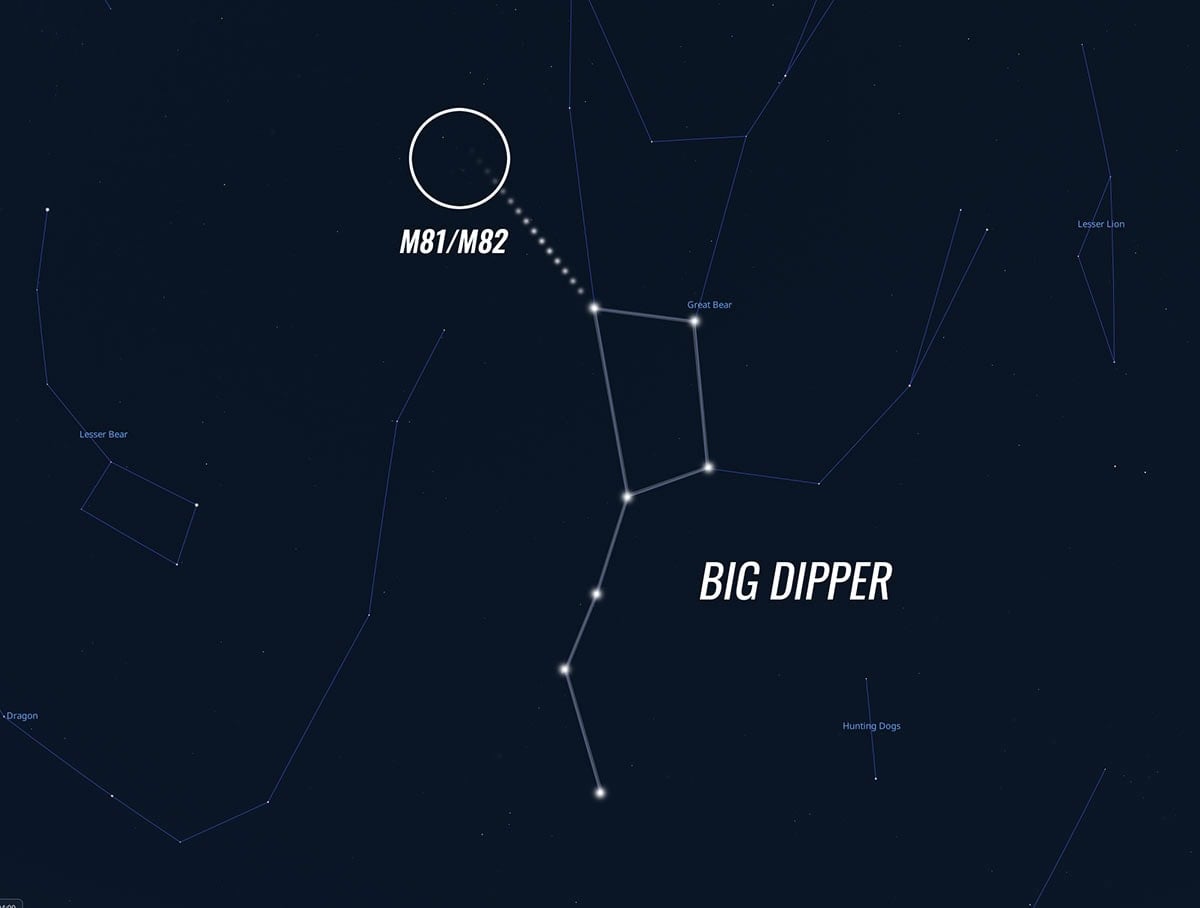
The ‘Big Dippers’ position in the night sky in early March from the Northern Hemisphere.
In the Northern Hemisphere, the best time to see and photograph M81 and M82 is during the spring months, especially from March through May.
At this time of year, Ursa Major climbs high in the evening sky, giving you a better viewing angle and less atmospheric distortion than targets closer to the horizon. They can still be seen in late winter and early summer, but spring usually offers the best combination of altitude and nighttime timing for imaging.
For backyard astrophotographers, M81 and M82 are especially appealing because they culminate high overhead for many northern locations, where the sky is often steadier and clearer. This makes it easier to capture sharper detail in both galaxies, especially when imaging from light-polluted suburban skies.
M81 – Bode’s Galaxy
M81, also known as Bode’s Galaxy or NGC 3031, is a bright spiral galaxy in Ursa Major located about 10 degrees northwest of Dubhe. For amateur astronomers and astrophotographers, it is one of the most appealing spring galaxy targets because its luminous core and spiral arms can be recorded with modest equipment under good conditions.
Bode’s Galaxy measures about 90,000 light-years across, making it somewhat smaller than the Milky Way. It is also famous for SN 1993J, a supernova discovered in M81 on March 28, 1993, which became one of the brightest supernova events observed in the twentieth century.
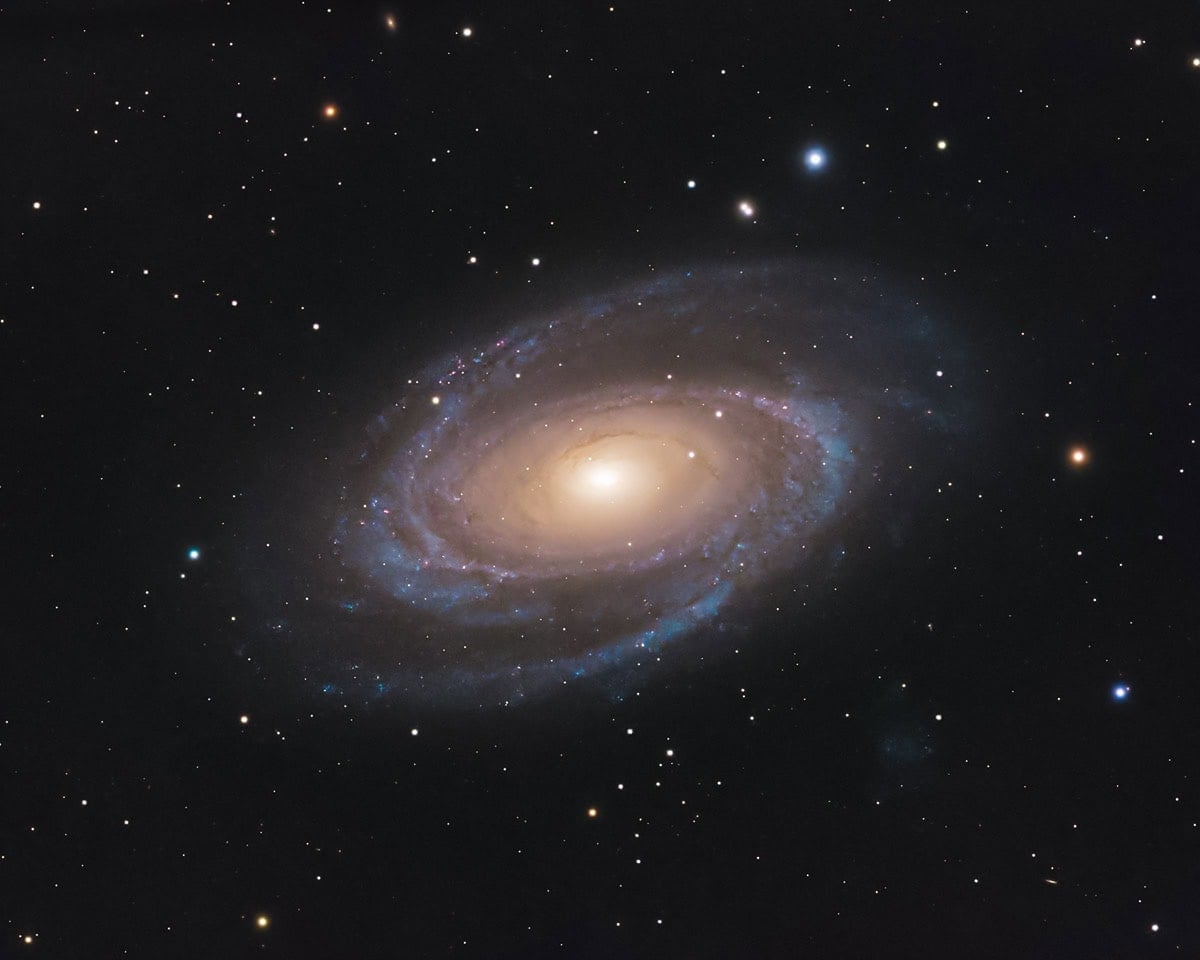
- Object Type: Spiral Galaxy
- Constellation: Ursa Major
- Distance: 11.8 million light-years
- Apparent Magnitude: 6.9
- Apparent Dimensions: 26′.9 x 14′.1
M82 – The Cigar Galaxy
M82, or the Cigar Galaxy, is a starburst galaxy located only 38 arcminutes from M81, which is why the two are so often imaged together. Through a modest telescope, M82 looks like a narrow rod of light, while larger telescopes begin to reveal dark markings and uneven structure across the galaxy.
Its unusual shape and intense starburst activity are believed to be the result of a long gravitational interaction with nearby M81. This makes M82 one of the most visually dramatic galaxies in the northern sky and a favorite target for astrophotographers.
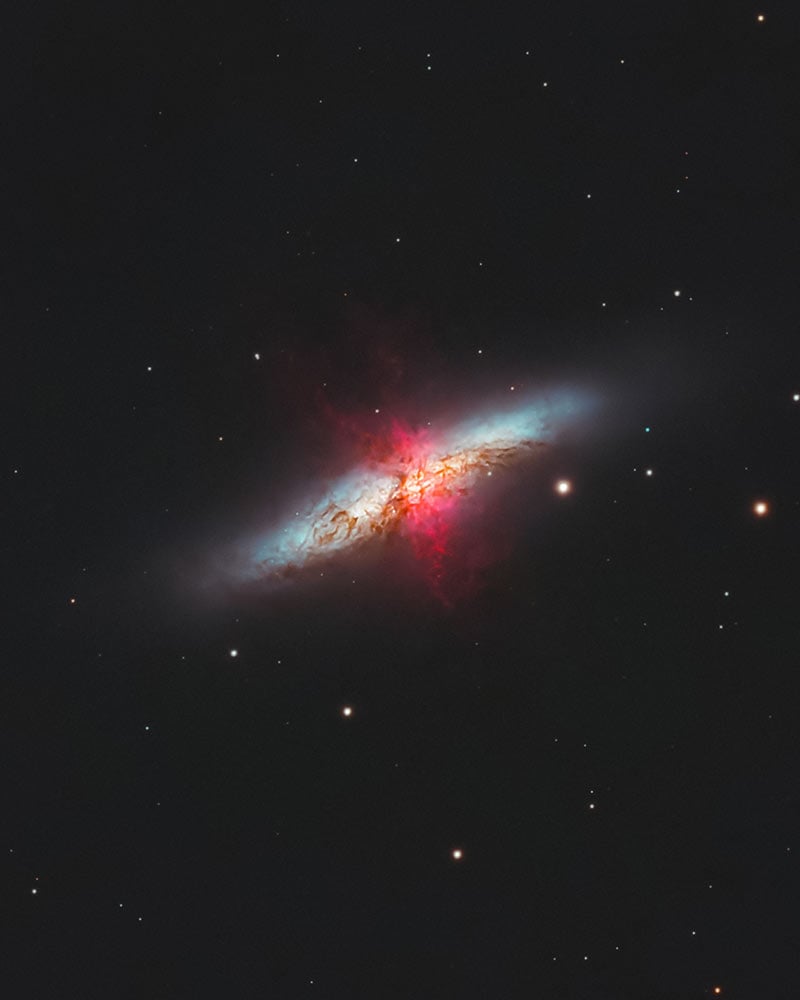
One of the most recent scientific results involving M81 is a new JWST study that produced the first robust stellar-dynamical measurement of the supermassive black hole at the galaxy’s core. By using near-infrared spectroscopy to see through the dust in M81’s nucleus, astronomers were able to better constrain the black hole’s mass than in previous studies.
- Object Type: Irregular Galaxy/Starburst Galaxy
- Constellation: Ursa Major
- Distance: 11.4 – 12.4 million light-years
- Apparent Magnitude: 8.4
- Apparent Dimensions: 11′.2 x 4′.3
From the northern hemisphere, this galactic pair is best observed in the spring. In March 2020, I photographed the M82 Galaxy from my backyard using a camera and telescope.
In the video below, you’ll see the results of my efforts in the backyard:
Results with a DSLR and Telescope
A stock (non-modified) DSLR camera is more than capable of capturing a fascinating portrait of the M81 and M82 Galaxies. For the image below, I attached a Canon EOS Rebel Xsi digital camera to my Newtonian reflector telescope using a T-ring adapter for an up-close look at M81 and M82.
The focal length of the telescope is 800mm, which is wide enough to fit both objects, yet enough magnification to reveal fascinating details in both galaxies. The Orion 8″ F/3.9 Newtonian Astrograph is a popular choice for amateur astrophotographers looking to collect a lot of signal in a single exposure.

If you want to photograph M81 and M82 using a camera and telescope, I suggest using a focal length of at least 800mm or more. This magnification is needed to record the delicate details of each galaxy.
It is tempting to shoot these targets using a wide field of view, because the area contains many other galaxies such as NGC 3077, and NGC 2976. However, expect a loss of detail in your primary subjects (M81, M82) using a shorter focal length.
The image below was captured using a telescope with a focal length of 400mm, for an exceptionally wide look at the area of sky where Bode’s Galaxy and the Cigar Galaxy reside.
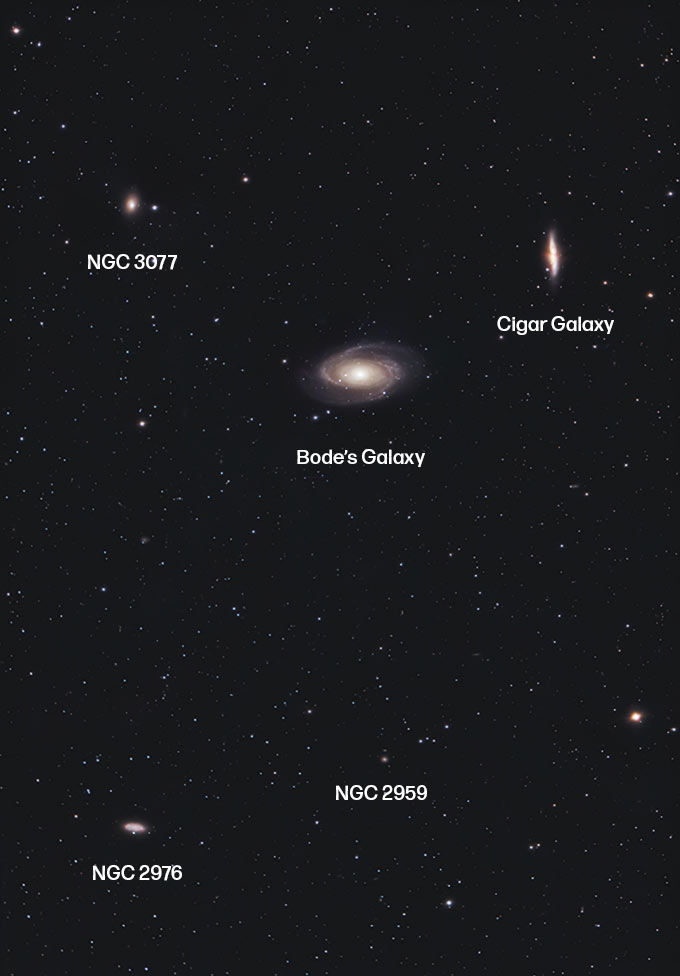
Galaxies in Ursa Major.