
Uranus: The Sideways Ice Giant

Uranus is one of the most peculiar planets in our solar system. Unlike any other planet, it rolls around the Sun on its side, spinning almost perpendicular to its orbital plane. This extreme tilt leads to bizarre, long-lasting seasons, each one stretching over two decades.
Though it may seem distant and dim, Uranus is a fascinating planet for both astronomy enthusiasts and astrophotographers. From its icy blue hue to its faint rings and dynamic weather patterns, this sideways world offers insights into how planetary systems form and evolve.
Let’s explore what makes Uranus so unique, why its seasons are so strange, and how you can observe it from your own backyard.
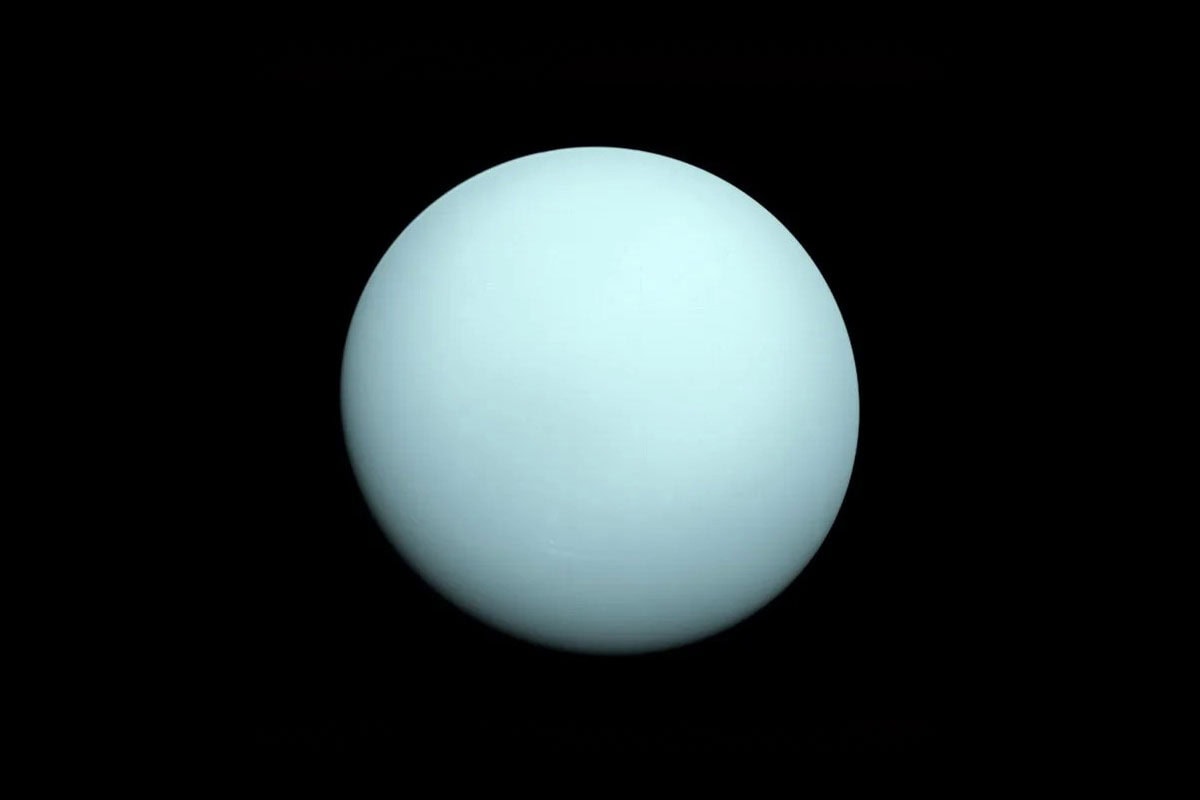
Planet Uranus photographed by NASA’s Voyager 2 spacecraft. ( NASA/JPL)
Planet Uranus
Uranus is the seventh planet from the Sun, orbiting at an average distance of about 2.9 billion kilometers (1.8 billion miles). It takes roughly 84 Earth years to complete a single orbit, which means that each season on Uranus lasts about 21 years.
The planet’s pale blue-green color comes from methane gas in its upper atmosphere, which absorbs red light and reflects blue wavelengths back into space. Its diameter of about 51,000 kilometers makes it the third-largest planet in our solar system, smaller than Jupiter and Saturn but slightly larger than Neptune.
Despite its size, Uranus has a relatively low mass (just 14 times that of Earth) and a very low density, meaning it’s made mostly of lighter materials. Scientists classify Uranus (and Neptune) as ice giants rather than gas giants because they contain more icy elements, such as water, ammonia, and methane, rather than mostly hydrogen and helium.
For astrophotographers, this composition affects how light scatters in the atmosphere, giving Uranus a soft, diffuse appearance through a telescope. Capturing surface features is difficult, but the planet’s disc is bright enough to stand out clearly against the backdrop of space.
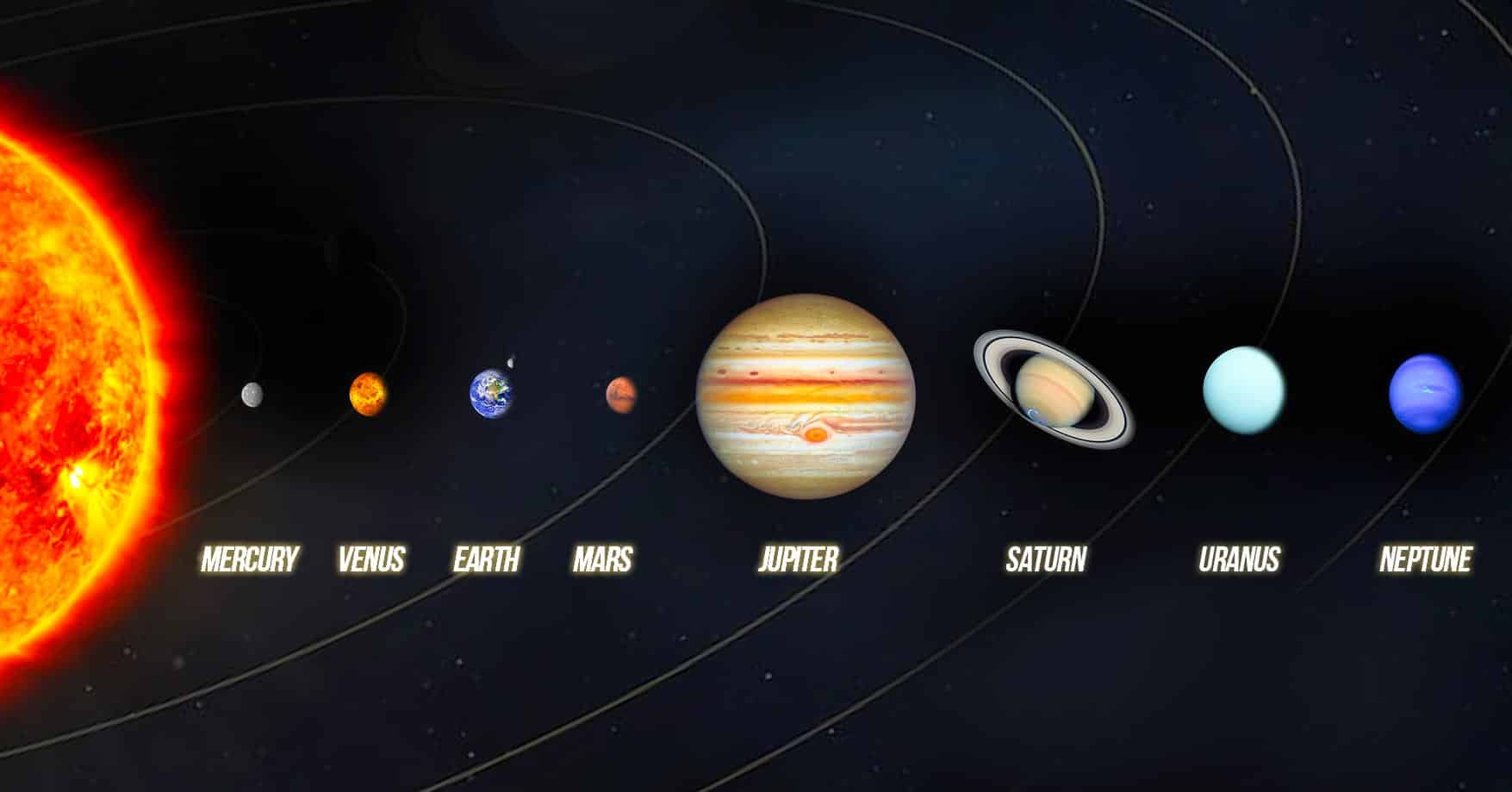
Uranus is the 7th planet from the sun.
Did you know?
The Tilt and Its Strange Seasons
Uranus’ most defining characteristic is its dramatic tilt. While Earth’s axis leans just 23.5 degrees, Uranus is tipped over nearly 98 degrees. In other words, it essentially rolls around the Sun like a barrel.
This extreme orientation means that one hemisphere of Uranus experiences continuous daylight for years, while the other remains in darkness. As the planet moves along its 84-year orbit, the roles gradually reverse.
For instance, when the north pole faces the Sun, the northern hemisphere basks in constant sunlight for more than two decades, while the south is shrouded in a prolonged winter night. Then, at the halfway point in its orbit, Uranus reaches an equinox, when sunlight strikes the equator and both hemispheres share day and night cycles similar to Earth’s, but lasting about 17 hours each (Uranus’ rotation period).
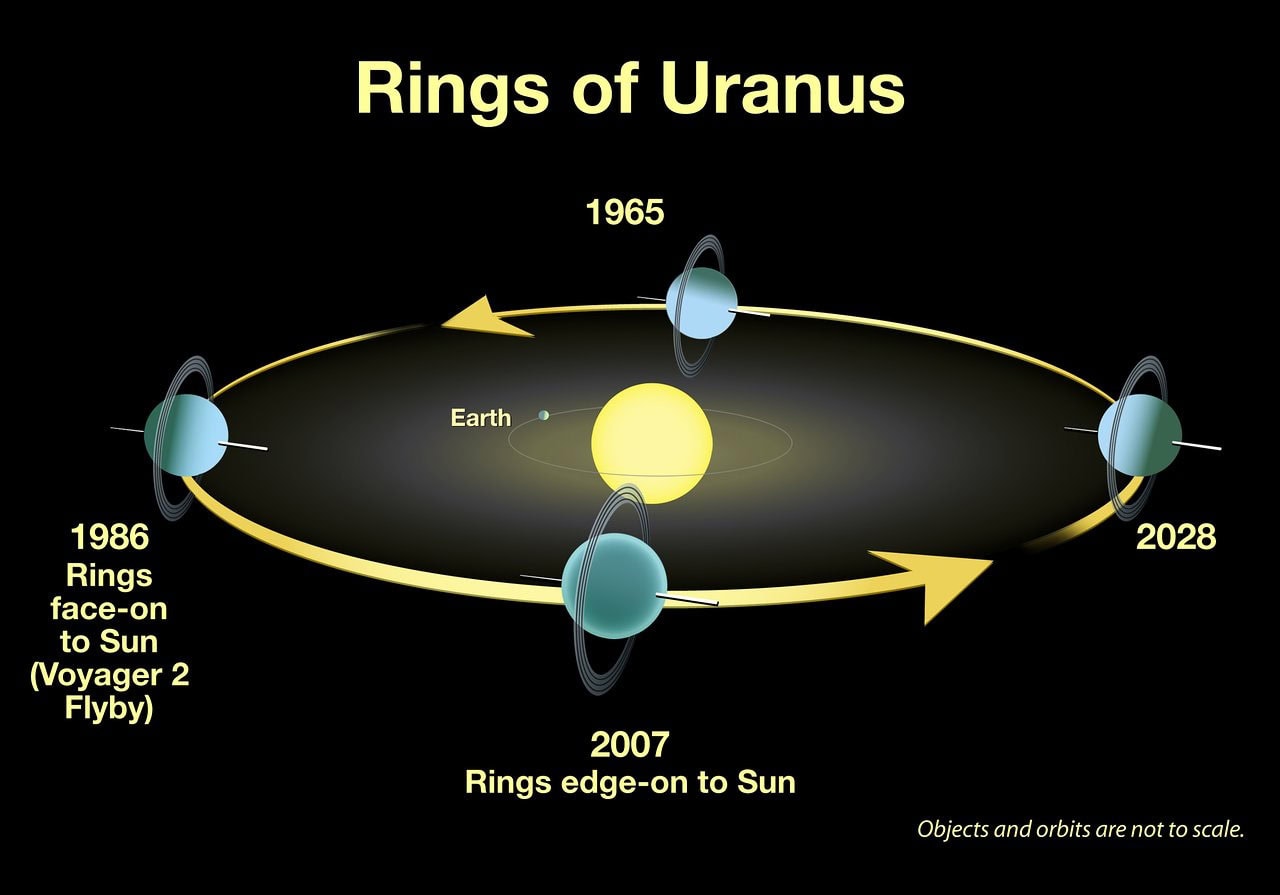
An illustration showing the position of the rings of Uranus from 1965 to 2028. NASA, ESA, and M. Showalter (SETI Institute).
These transitions between extremes create dramatic changes in the planet’s atmosphere. During its equinoxes, Uranus often shows increased cloud activity, storms, and shifting banded patterns. When Voyager 2 flew by in 1986, it captured a featureless, pale planet, because the probe happened to visit during Uranus’ long southern summer, when sunlight was constant and the atmosphere was relatively calm.
Today, powerful Earth-based telescopes and the James Webb Space Telescope reveal a much more dynamic world. As Uranus moves toward its next equinox, astronomers are seeing new bright storms, swirling clouds, and distinct banding emerge, all tied to how sunlight warms the planet’s atmosphere after decades of cold.
In short
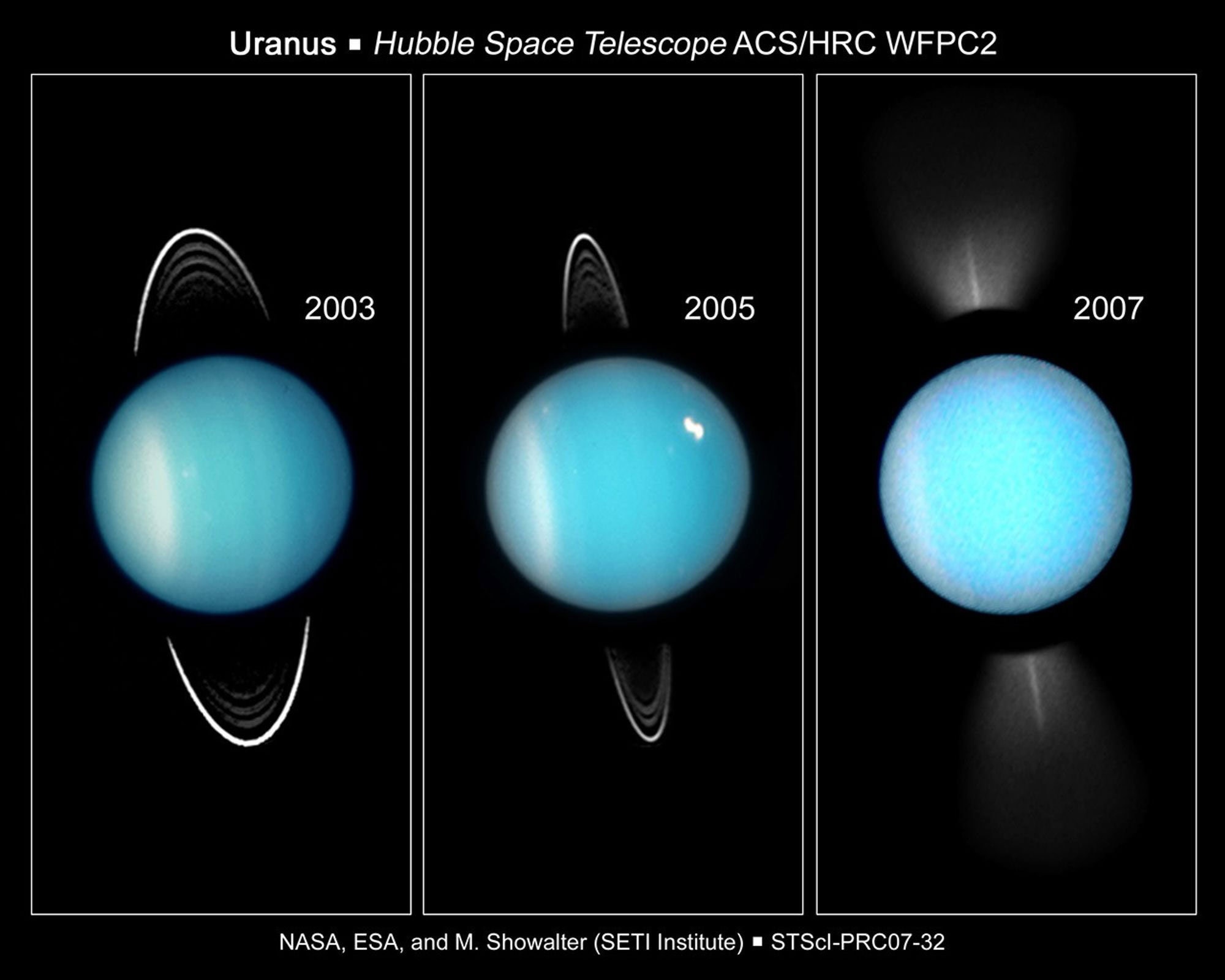
A series of images showing how Uranus’ ring system appears at shallower tilts as viewed from Earth. (Hubble Space Telescope)
The Atmosphere, Rings, and Moons of Uranus
Uranus’ upper atmosphere is dominated by hydrogen and helium, with a significant amount of methane. Below this layer lies a deep ocean of icy water and ammonia under immense pressure.
Despite its frigid average temperature of about −224 °C (−371 °F), Uranus shows signs of dynamic weather, including winds that can reach 900 km/h (560 mph) and bright methane clouds that form and dissipate seasonally.
One reason Uranus appeared featureless to Voyager 2 is that it was illuminated from directly above the south pole. With sunlight striking only one hemisphere, there was little contrast for the spacecraft’s cameras to detect.
But as the planet’s seasons have shifted since then, we now see more dramatic features and patterns, thanks to changing solar illumination.
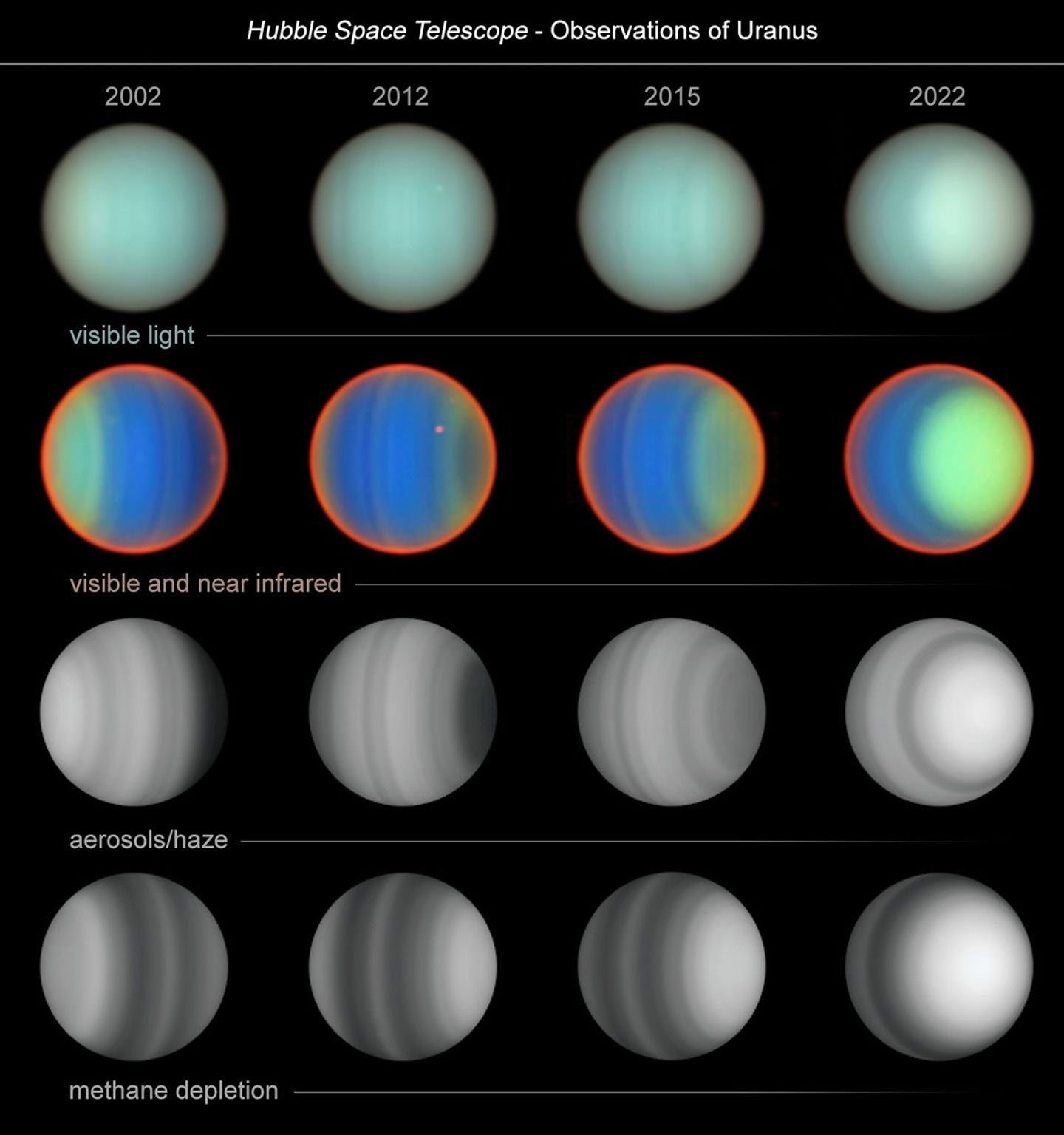
Uranus also has a faint but complex ring system. Its 13 known rings are narrow, dark, and composed mostly of small icy particles mixed with radiation-darkened dust. Unlike Saturn’s bright, broad rings, Uranus’s are subtle. They are visible only in deep exposures or through powerful telescopes.
Because the planet is tipped on its side, the rings sometimes appear edge-on from Earth and then slowly open up again as Uranus progresses through its orbit.
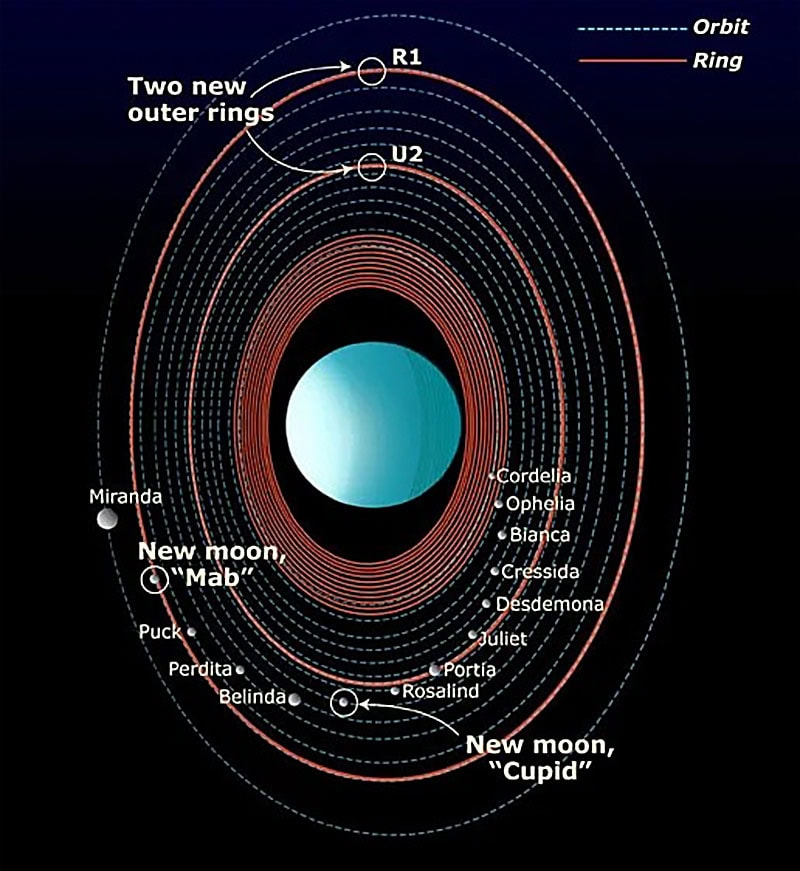
Its moons add another layer of intrigue. Uranus has at least 27 known satellites, most of which are named after characters from the works of Shakespeare and Alexander Pope. The five major ones (Miranda, Ariel, Umbriel, Titania, and Oberon) each have their own distinct surface and geological history.
- Miranda features enormous cliffs and fractures that hint at past internal activity.
- Ariel shows signs of resurfacing and cryovolcanism.
- Titania and Oberon are heavily cratered, with hints of icy canyons.
Because of the planet’s tilt, each moon’s orbit and lighting conditions change dramatically over Uranus’ long seasons. For observers on Earth, this means that sometimes the moons and rings align edge-on, a rare opportunity for imaging or occultation studies.
Observing Uranus from Earth
For most people, Uranus appears as a faint, bluish star in binoculars. With a magnitude around +5.7, it’s just within naked-eye visibility under very dark skies. Through a telescope, even a modest 8-inch Dobsonian or small refractor will reveal its tiny, turquoise disc.
The best time to view Uranus is during opposition, when it lies opposite the Sun in the sky and shines brightest for the year. Oppositions occur annually, typically in late October or early November, when Uranus rises around sunset and remains visible all night.
From mid-northern latitudes, Uranus currently sits in the constellation Aries, moving slowly eastward each year. You can find it by star-hopping from Jupiter or using a stargazing app to plot its position.
For astrophotographers, Uranus presents a challenge but also a rewarding niche target. Long exposures with high-magnification optics can capture its soft bluish glow and sometimes even its brightest moons.
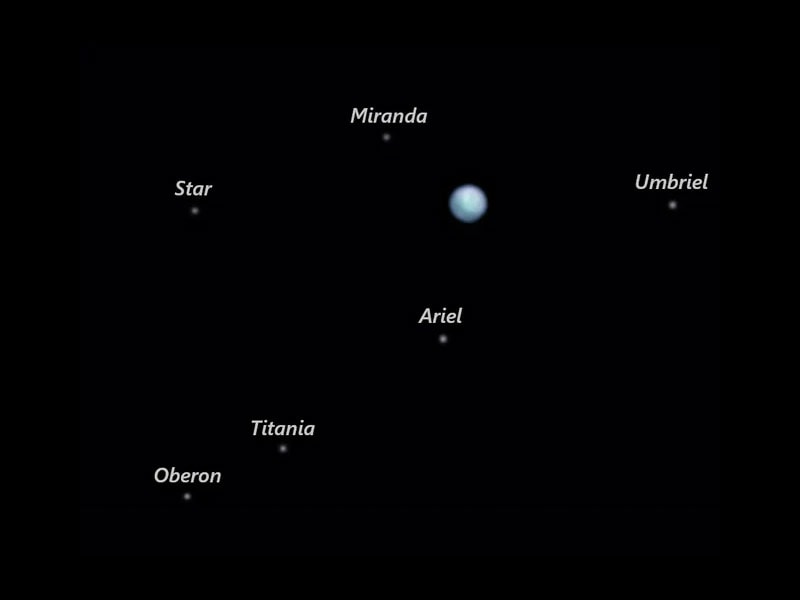
Planet Uranus and its moons through an amateur telescope (Sky-Watcher 10″ GoTo Dob) shared by Redditor ‘J3RRYLIKESCHEESE‘ in 2023.
To Photograph Uranus Effectively:
- Use high frame-rate planetary cameras and capture many short exposures for stacking.
- Apply infrared or methane-band filters to enhance atmospheric contrast.
- Keep your scope well-collimated and thermally stable to minimize seeing distortion.
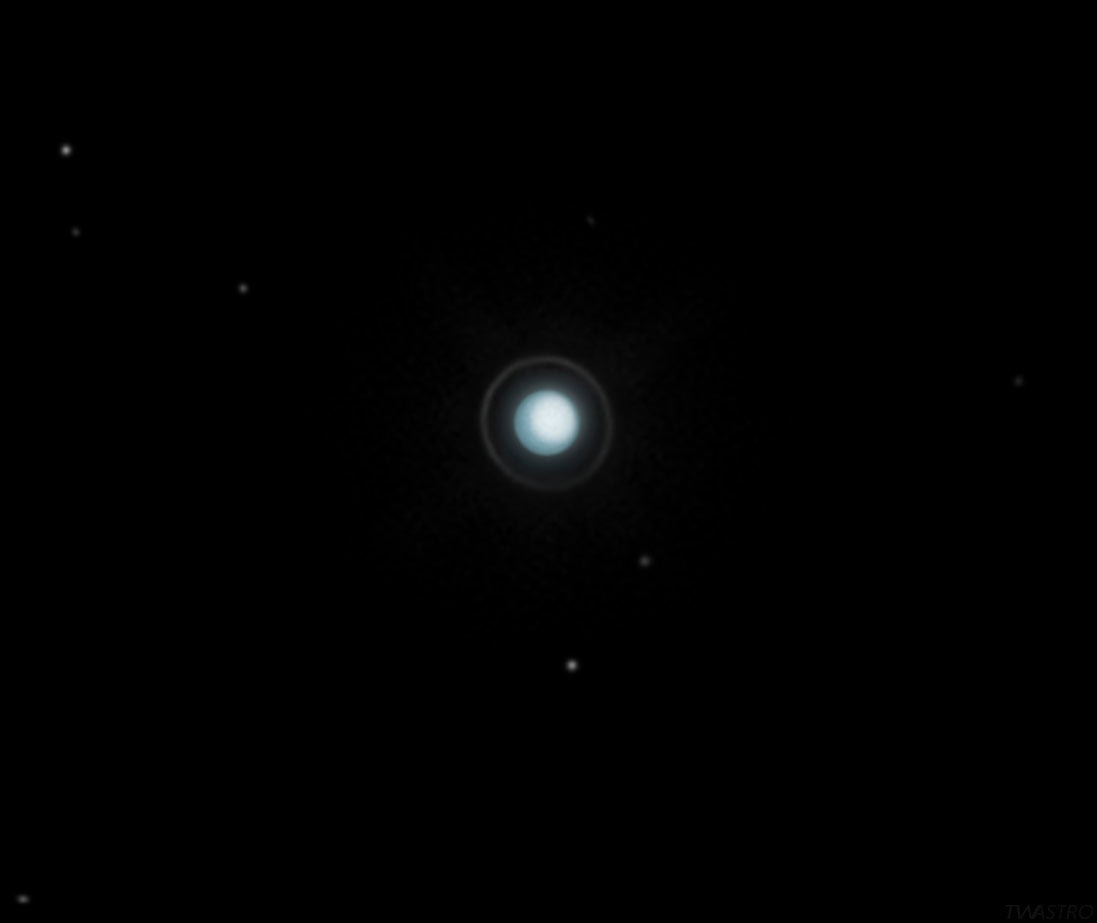
Because the planet’s rings are faint, they’re only visible in high-resolution, stacked images under excellent conditions. When the rings are most open to Earth (around the equinox), dedicated imagers using large telescopes can record them as a delicate, tilted ellipse around the planet.
Related Article: How to Photograph Planets
Citizen Science and the Next Frontier
With no dedicated Uranus orbiter yet launched, astronomers are eager to return. NASA’s Decadal Survey has prioritized a Uranus Orbiter and Probe mission as a top exploration goal for the 2030s. Until that happens, observations from both professionals and amateur astrophotographers play a vital role.
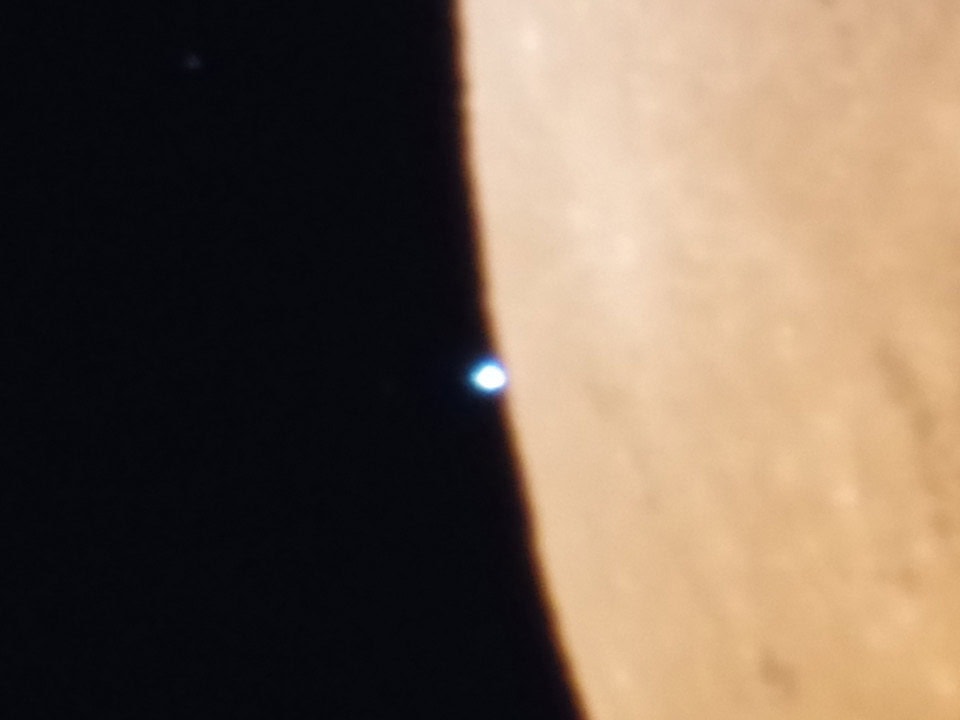
Uranus seen through an amateur telescope, shortly after lunar occultation, during the November 2022 lunar eclipse. Wikipedia.
Citizen scientists can track storms, watch for ring plane crossings, and compare Uranus’ brightness year over year. As new instruments like the James Webb Space Telescope continue to observe the planet in infrared, amateur contributions will help verify changes over time.
For backyard imagers, documenting Uranus over the years offers a chance to contribute to real planetary science. The planet’s seasons shift slowly, so even one or two images each year build a valuable long-term record.
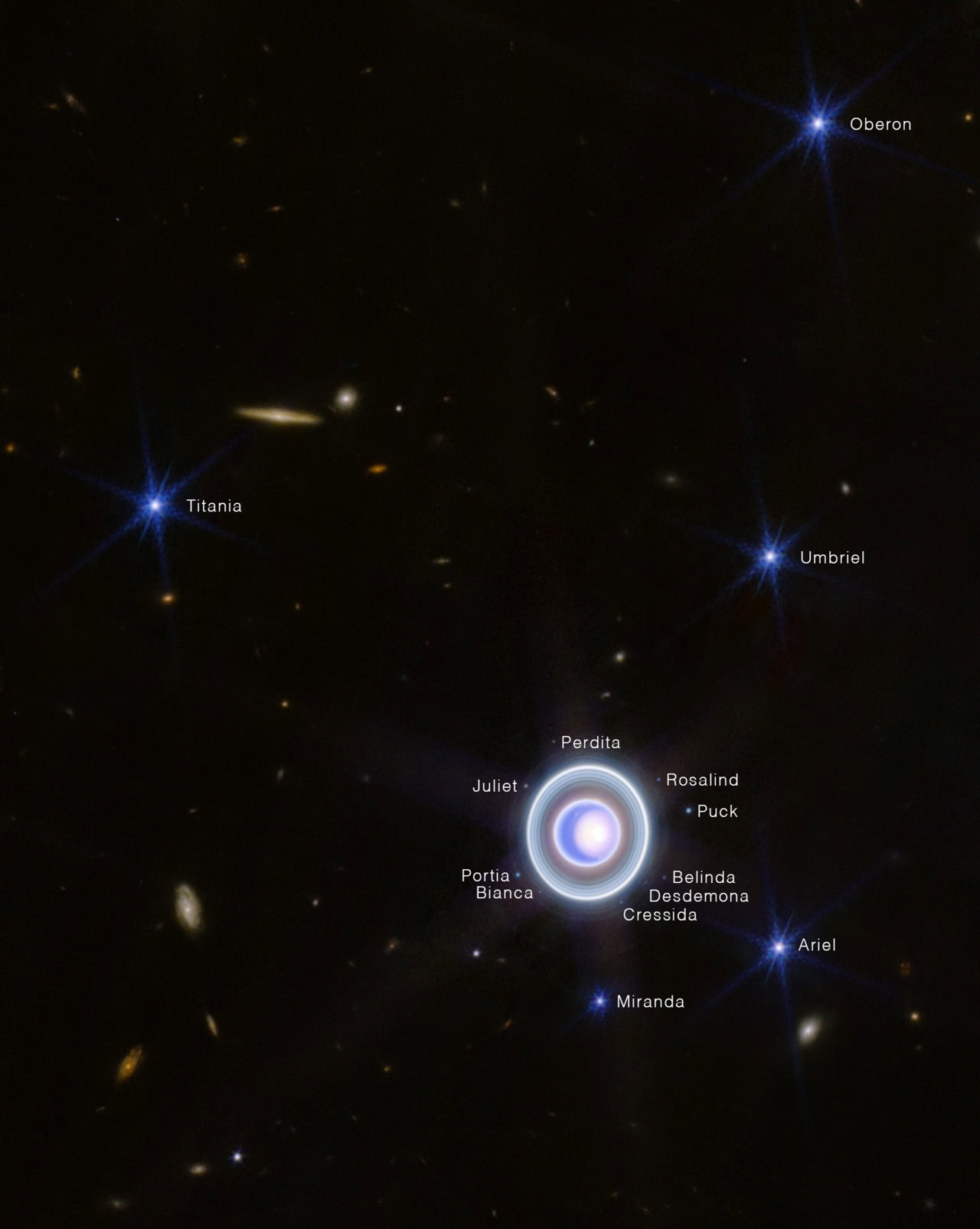
The six largest moons and the eight largest inner moons of Uranus (in near-infrared). Captured by the JWST.
Why Uranus Matters Beyond Our Solar System
Studying Uranus gives scientists a window into the most common type of exoplanet in our galaxy. Many planets discovered around other stars are roughly the same size and composition as Uranus and Neptune—ice giants with thick atmospheres and deep, icy interiors.
By understanding how Uranus behaves under such extreme conditions—its tilt, atmosphere, magnetic field, and internal heat—we gain insight into the physics of these distant worlds. Its 98-degree tilt also helps scientists test theories about how planetary systems evolve after massive collisions or gravitational encounters.
For backyard astronomers, Uranus represents the bridge between what we can directly observe and what astronomers infer about exoplanets. Every image taken, every light curve recorded, adds one more pixel to our broader understanding of planetary diversity.
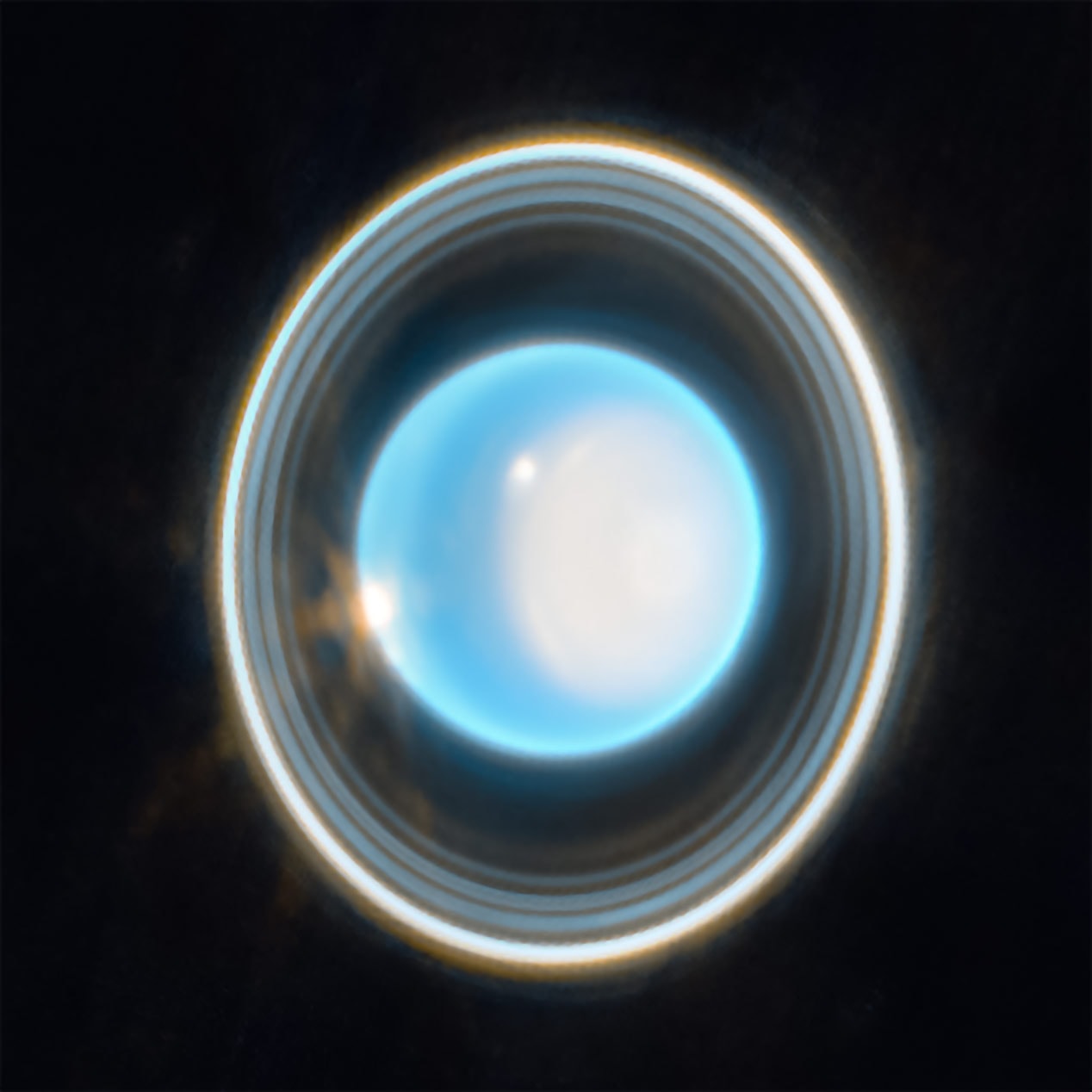
An Image of Uranus, captured by Webb’s Near-Infrared Camera (NIRCam) on Feb. 6, 2023, reveals stunning views of the planet’s rings. NASA, ESA, CSA, STScI; Image Processing: Joseph DePasquale (STScI)
Conclusion
Uranus may not command the same attention as Jupiter’s Great Red Spot or Saturn’s majestic rings, but it stands out as one of the most extraordinary planets in our solar system. Its sideways rotation, long seasons, faint rings, and mysterious interior all challenge our understanding of how worlds evolve.
For observers on Earth, Uranus offers a subtle but deeply rewarding target. Capturing its blue-green disc through a telescope connects you to a world more than 2.9 billion kilometers away—one that experiences daylight and darkness on a timescale far beyond a human lifetime.
As Uranus continues its slow 84-year orbit, we’re only beginning to appreciate its complexity. Whether you’re viewing it visually, imaging it through your camera, or simply learning about it, Uranus reminds us just how diverse and surprising our solar system can be.
Quick Facts: Uranus
- Distance from Sun: ~2.9 billion km (19.2 AU)
- Orbital period: 84 Earth years
- Rotation period: 17 hours 14 minutes
- Axial tilt: 98 degrees
- Mean temperature: −224 °C (−371 °F)
- Number of moons: 27 known
- Ring system: 13 known rings
- First visited by: Voyager 2 (1986)