
What Is a Supernova?

A supernova is the powerful explosion of a massive star at the end of its life, briefly outshining entire galaxies as it releases an immense burst of energy and light.
It is the most powerful explosion known in the universe. Each one marks the spectacular death of a star, releasing more energy in a few seconds than our Sun will emit in its entire 10-billion-year lifetime. These cosmic fireworks are so bright that they can briefly outshine entire galaxies before fading away.
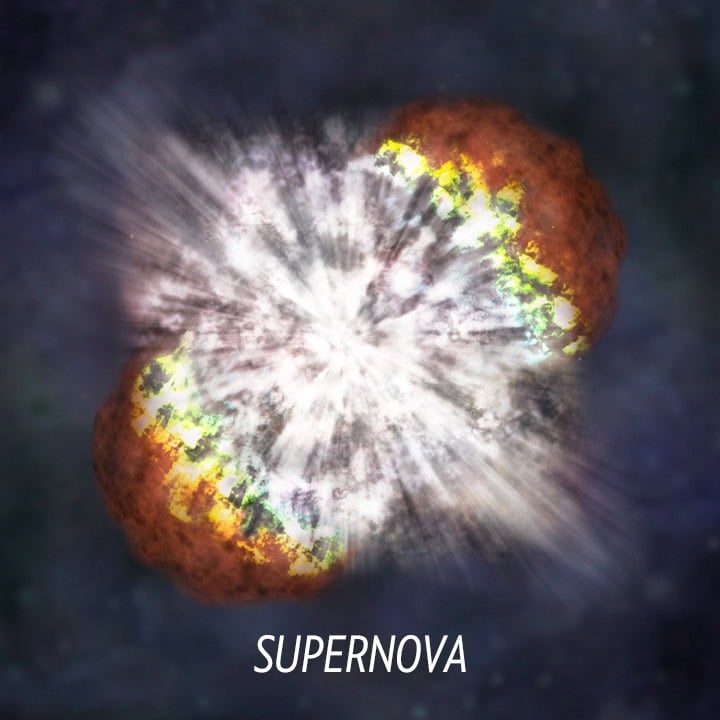
Artist’s impression of SN 2006gy, the brightest supernova ever observed: white ejecta from the blast slam into red lobes of cool gas shed earlier by the star, heating them into green–blue–yellow shock fronts that push the gas back. (Illustration: NASA/CXC/M.Weiss)
A supernova blasts out shells of gas and dust that expand, shock-heat, and sweep up surrounding material, creating a glowing supernova remnant nebula.
What Causes a Supernova?
There are two main types of supernovas, each with a different cause:
1. The Death of a Massive Star (Core-Collapse Supernova)
When a star at least five times more massive than our Sun runs out of nuclear fuel, the balance that holds it together is lost. Normally, gravity pulls the star inward while the energy from nuclear fusion pushes outward.
Once the fuel is gone, pressure drops, gravity wins, and the star’s core collapses in seconds. This collapse triggers shock waves that blast the outer layers into space in a tremendous explosion.
The remains of the star form either a neutron star, a super-dense object just a few kilometers wide, or, if the star was massive enough, a black hole.
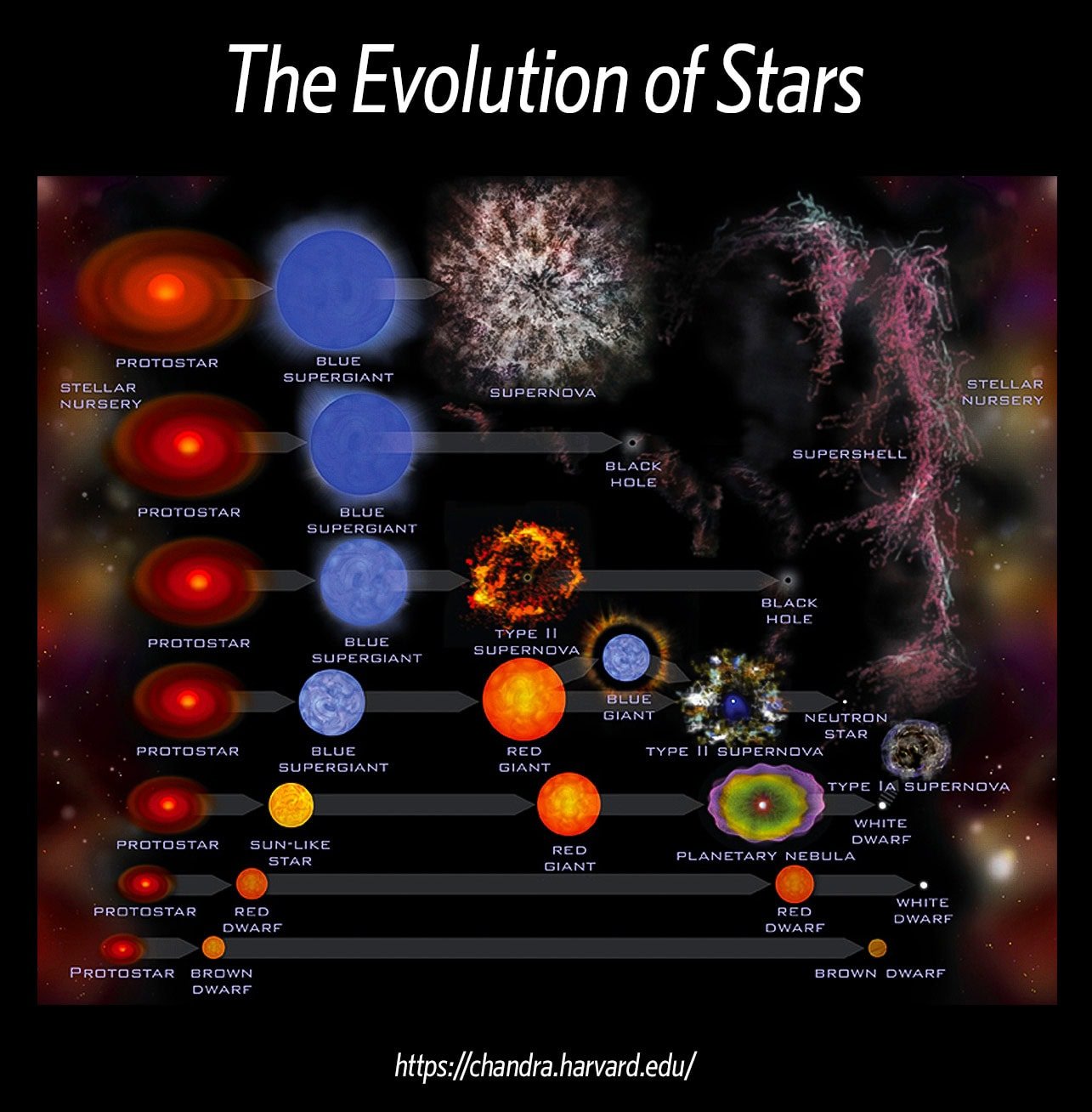
This graphic by the Chandra X-Ray Observatory provides a summary of our current understanding of the evolution of stars, showing their birth, middle age, and eventual demise.
2. White Dwarf Explosions (Thermonuclear Supernova)
In some binary star systems, a dense white dwarf steals matter from its companion star. If the white dwarf accumulates too much material, it reaches a critical mass and ignites runaway nuclear reactions.
The result is a sudden explosion that completely destroys the star. These events are called Type Ia supernovas, and they are especially important because their brightness follows predictable patterns, making them cosmic “yardsticks” for measuring distances across the universe.
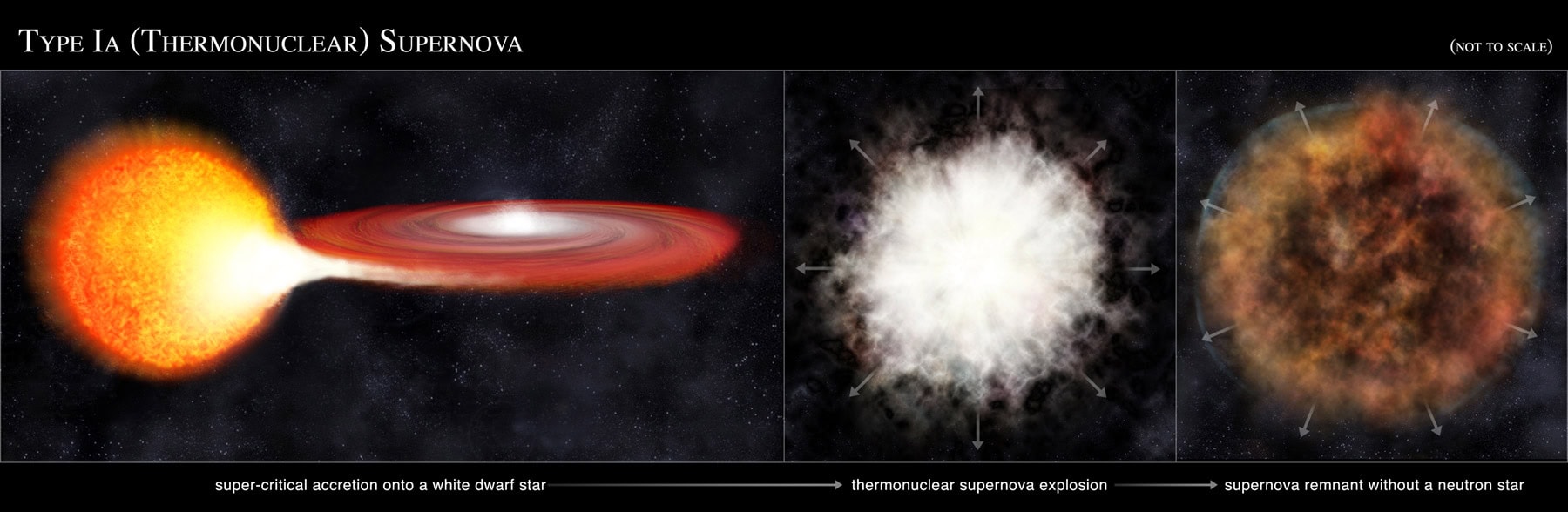
Type Ia supernovas are produced by white dwarf stars, the condensed remnant of what used to be sun-like stars. (NASA)
How Bright Are Supernovas?
Supernovae are among the brightest events in the universe. At peak, they often reach absolute magnitudes around -17 to -19.5, briefly rivaling the luminosity of an entire galaxy.
That’s why explosions in nearby galaxies can show up in small backyard telescopes (typically +10 to +15 apparent magnitude), while very near events (like in the Milky Way or its satellites) can become naked-eye objects, sometimes rivaling Venus and even casting shadows.
Their brilliance rises over days and then fades over weeks to months as the ejected material cools and expands.
One famous example is the Crab Nebula, the remnant of a massive star explosion observed by astronomers in 1054 AD.

My photo of the Crab Nebula using a 6-inch refractor telescope from my backyard.
Ancient Chinese astronomers recorded a “guest star” in 1054 CE that was visible in daylight for weeks, precisely noting its position in Taurus. Though they didn’t realize it was the explosion that created the Crab Nebula, their meticulous records enabled modern astronomers in 1921 to link that historic sighting to the nebula we know today.

The Crab Nebula – five observatories (NASA animation)
How Often Do Supernovas Occur?
- In the Milky Way, astronomers estimate that two or three supernovas happen each century.
- Because the universe contains trillions of galaxies, hundreds of supernovas are observed each year with powerful telescopes.
- Within our galaxy, interstellar dust often blocks our view of these rare but dramatic events.
Across the entire observable universe, a supernova occurs about once every 10 seconds. In a single galaxy like the Milky Way, this translates to just two or three per century. While these events are rare in our galaxy, astronomers can observe hundreds of supernovas each year in distant galaxies, providing valuable opportunities to study these powerful stellar explosions.

Massive blue supergiant stars end their lives with a supernova explosion. Before a massive star explodes, it ejects a shell of matter in a blue supergiant wind. (chandra.harvard.edu)
Why Are Supernovas Important?
Supernovas are not just dazzling spectacles—they are essential to the cosmic ecosystem:
- Element Factories: Stars forge elements in their cores, but only supernovas can create and scatter heavy elements such as gold, silver, and uranium.
- Seeds of Life: Elements like carbon, nitrogen, and oxygen are released into space, seeding new stars, planets, and eventually life itself.
- Measuring the Universe: Type Ia supernovas have revealed that the universe is expanding at an accelerating rate, a discovery that led to the concept of dark energy.
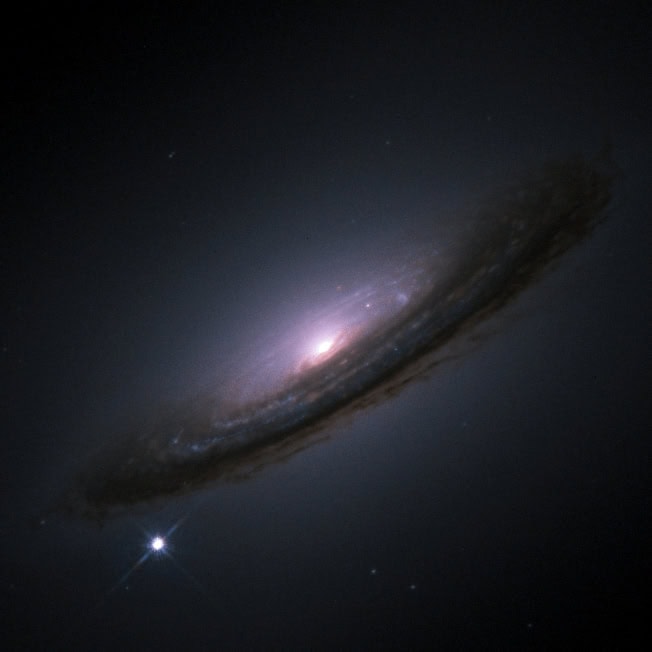
This incredible photo, taken by the Hubble Space Telescope, shows a supernova in another galaxy. SN 1994D (the bright spot on the lower left) is a Type Ia supernova within its host galaxy, NGC 4526. NASA/ESA.
How Do Scientists Study Supernovas?
Astronomers use a variety of instruments to investigate these cosmic explosions:
- X-ray telescopes like NASA’s NuSTAR mission reveal energetic processes inside supernova remnants.
- Optical and infrared telescopes capture their evolving light curves.
- Radio telescopes detect the afterglow of shock waves colliding with surrounding gas and dust.
By combining these observations, scientists piece together what happens before, during, and after a supernova explosion.
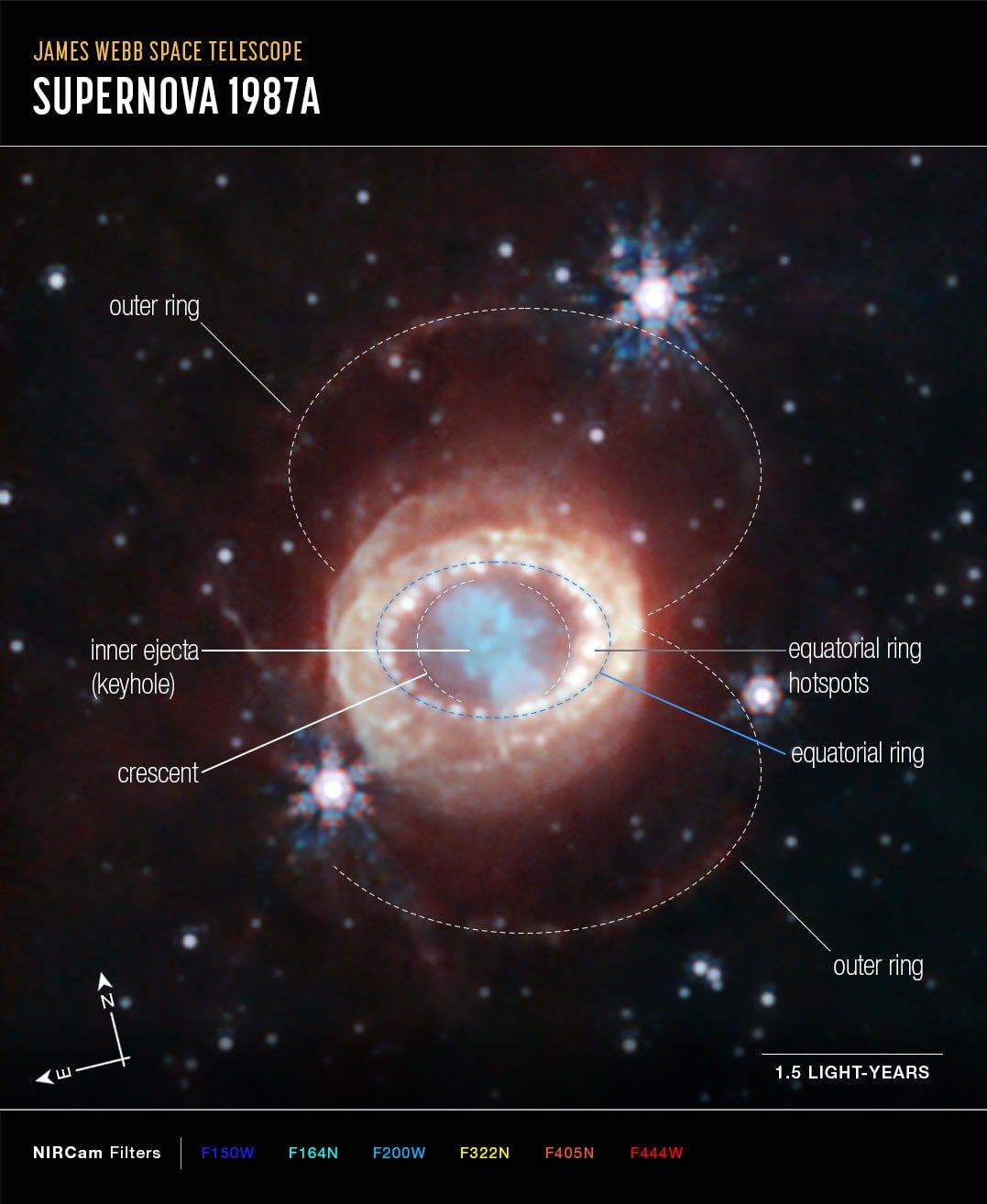
The James Webb Space Telescope’s NIRCam (Near-Infrared Camera) captured this detailed image of SN 1987A (Supernova 1987A). You can see that the material ejected from the supernova forms a keyhole shape in the center.
How the James Webb Space Telescope Studies Supernovae
The James Webb Space Telescope (JWST) is transforming how astronomers study supernovae. Thanks to its advanced infrared instruments, JWST can peer through cosmic dust that often hides the details of a stellar explosion. This allows researchers to observe the aftermath of supernovae with unmatched clarity.
One of the telescope’s biggest contributions is in studying the elements forged during a supernova. By capturing the spectral fingerprints of heavy elements such as iron, nickel, and gold, JWST helps scientists understand how exploding stars enrich galaxies and seed new stars and planets.
JWST is also sensitive enough to detect supernovae in their earliest stages. Observing the first light from these stellar explosions provides valuable insight into the mechanics of star death. JWST can look billions of years into the past, revealing some of the first supernovae in the universe and offering clues about how the early cosmos evolved.
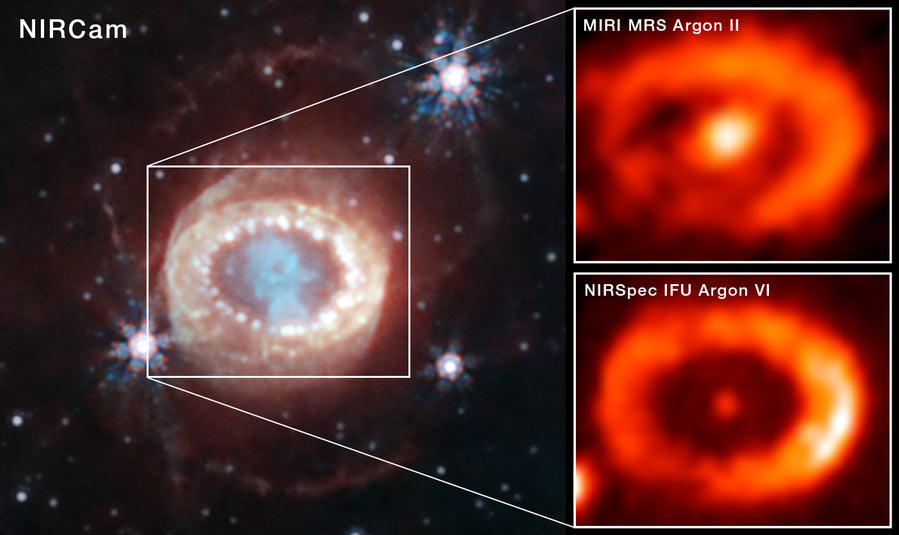
The James Webb Space Telescope has captured the strongest evidence so far of emission from a neutron star at the heart of the famous and recently observed supernova SN 1987A. (science.nasa.gov)
Finally, the telescope is helping confirm rare and exotic events, such as superluminous supernovae and pair-instability explosions, which push the limits of astrophysics. With each new observation, the James Webb Space Telescope is expanding our understanding of how stars die and how their explosive deaths shape the universe.
Supernovas and Astrophotography
As an astrophotographer, I often capture supernova remnants, the glowing gas and dust left behind after a supernova explosion. A personal favorite is the Veil Nebula in the constellation Cygnus, a vast network of glowing filaments formed by the death of a massive star thousands of years ago. With a telescope and camera from my backyard, I can still photograph the shock waves expanding across space.
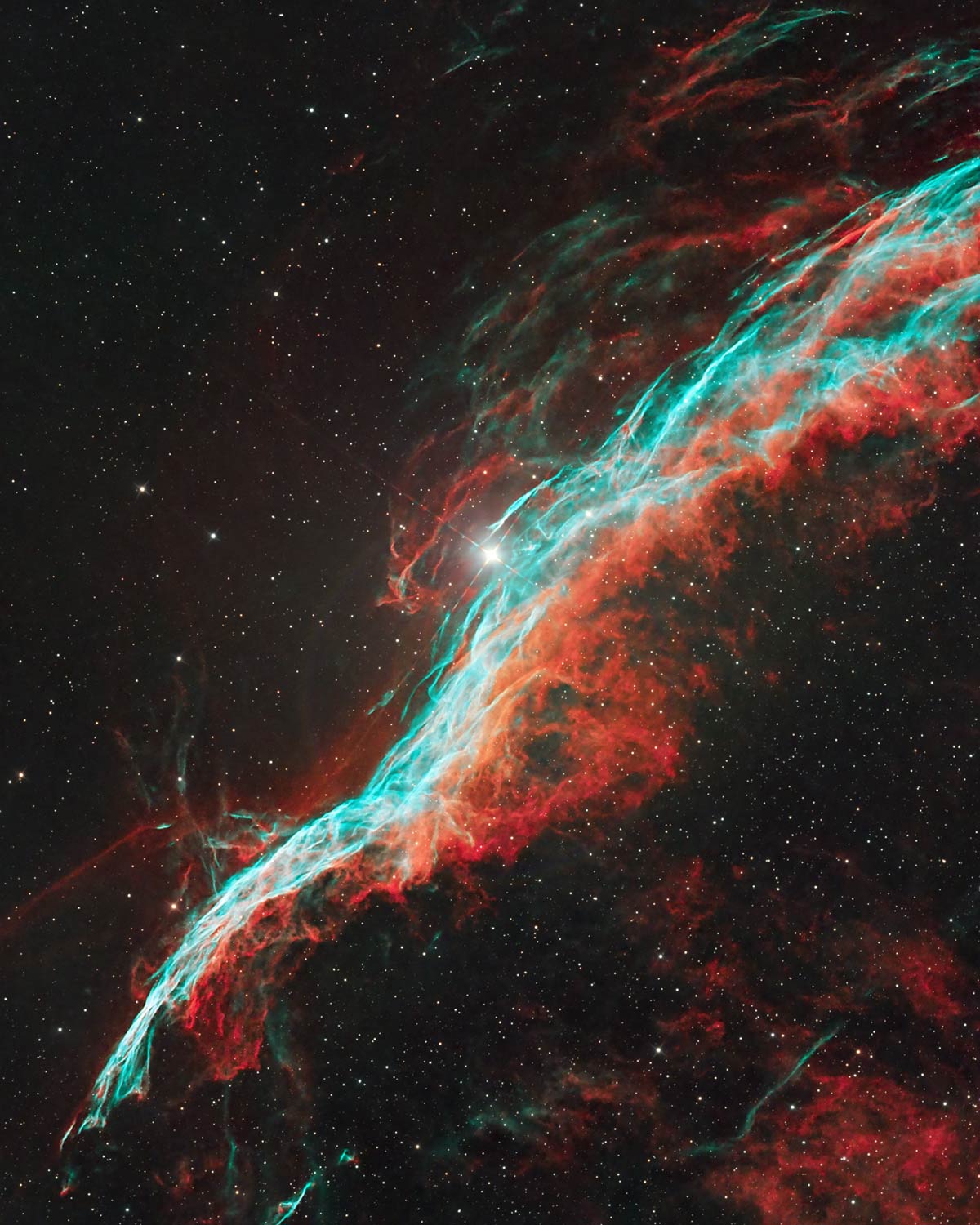
The Western Veil Nebula captured using my camera and telescope (6 hours total exposure).
If we back up even further (using a wide-field telescope), the entire Veil Nebula Complex is revealed. This incredible scene depicts the violent end of a star’s life, creating stunning supernova remnants in the night sky.
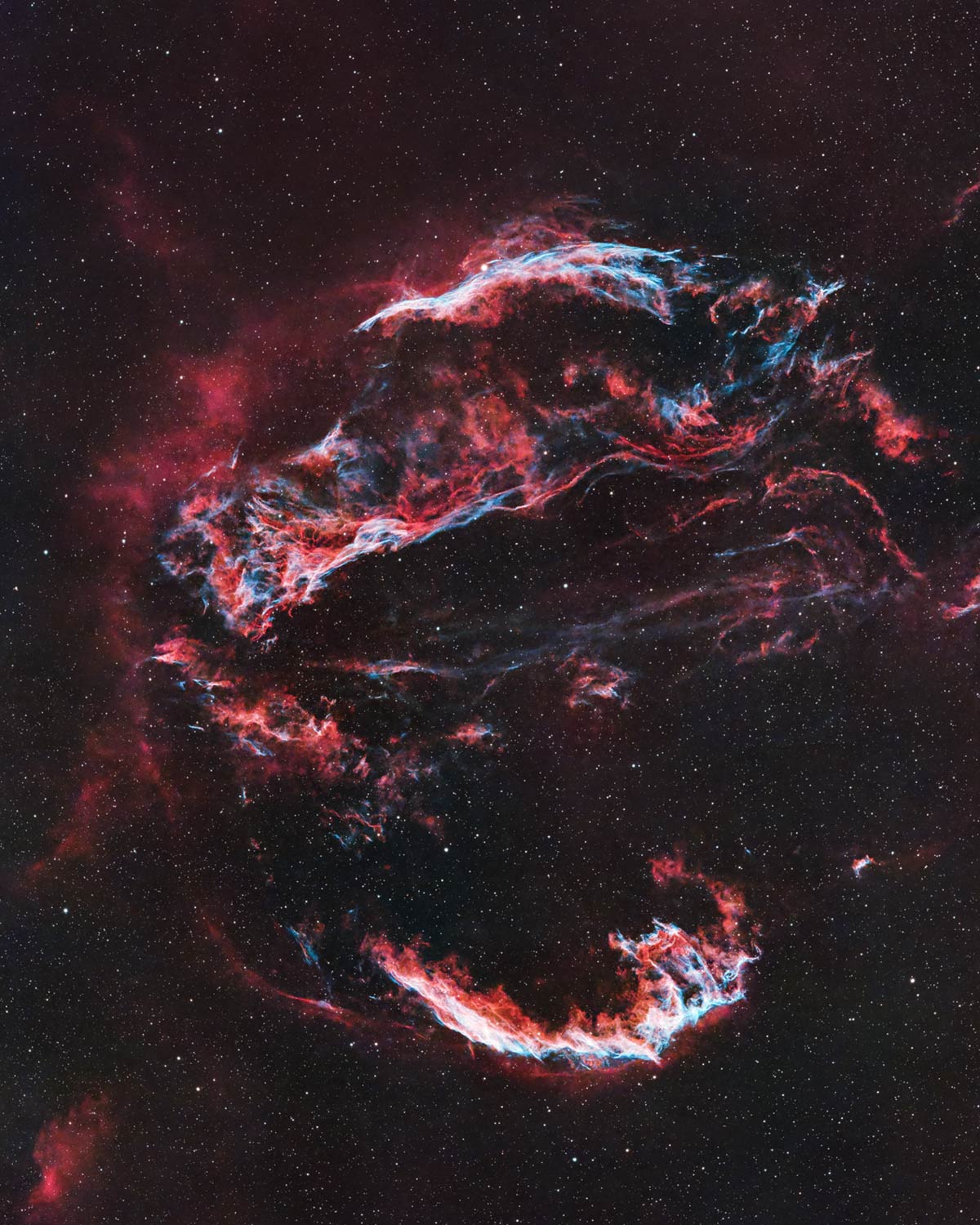
The Veil Nebula Complex, also known as the Cygnus Loop, is a vast supernova remnant in the constellation Cygnus. Astrophotographers capture its intricate structures, including famous sections like the Eastern Veil, Western Veil, and Pickering’s Triangle, which together form one of the most spectacular supernova remnants visible from Earth.
The 2023 Supernova in the Pinwheel Galaxy
In May 2023, a brilliant supernova known as SN 2023ixf erupted in the Pinwheel Galaxy (M101), roughly 21 million light-years away. First discovered by Japanese amateur astronomer Kōichi Itagaki, it quickly became one of the most closely studied nearby supernovas in recent years.
The event electrified the amateur community because M101 is already a favorite deep-sky target; many astrophotographers had fresh “before” images, making the before-and-after comparisons especially striking.
Within hours of the announcement, observers worldwide turned their telescopes toward M101, documenting its rapid rise in brightness and contributing valuable measurements that helped scientists trace its early evolution.
I shared the excitement with my audience in a dedicated YouTube video, explaining what made SN 2023ixf so remarkable and showcasing my own imaging of the Pinwheel Galaxy.
In the video, I highlight how rare it is to witness a live supernova in progress (rather than only its remnant) and explain why this was a special moment for both backyard observers and professional astronomers.
Frequently Asked Questions About Supernovas
What is a supernova?
A supernova is the explosive death of a star. It is the most powerful type of stellar explosion, briefly outshining an entire galaxy before fading away. Supernovas can occur when massive stars collapse or when a white dwarf explodes in a binary system.
How often do supernovas happen?
In galaxies like the Milky Way, astronomers estimate that supernovas occur about two to three times per century. Across the observable universe, however, they happen far more frequently—about once every 10 seconds.
Can you see a supernova from Earth?
Yes, some supernovas are bright enough to be seen with the naked eye, even if they are thousands of light-years away. Historical records show that ancient astronomers observed supernovas, such as the one that created the Crab Nebula in 1054 AD.
What happens after a supernova explosion?
After a supernova, the star’s outer layers are blasted into space, creating a glowing nebula. The core may collapse into a neutron star or, if the original star was massive enough, form a black hole.
Why are supernovas important?
Supernovas play a vital role in the universe by dispersing heavy elements such as carbon, oxygen, gold, and uranium. These elements enrich space, helping form new stars, planets, and even life itself.
How do scientists study supernovas?
Astronomers use telescopes across the electromagnetic spectrum—X-ray, optical, infrared, and radio—to study supernovas. Observations reveal how stars die, how heavy elements are formed, and how galaxies evolve.
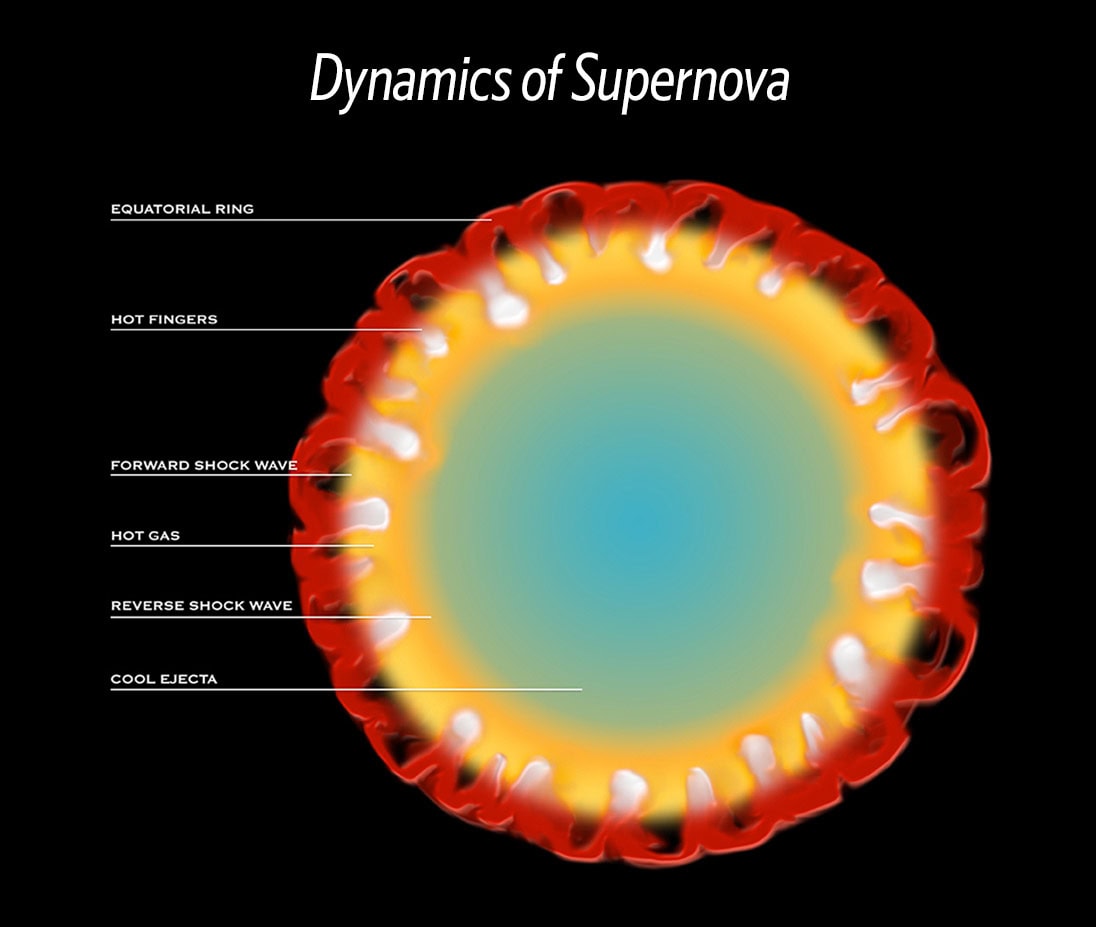
Before SN 1987A exploded, its massive progenitor shed outer layers in a slow wind that built a cool circumstellar cloud whose inner edge appears as the red ring; a later fast wind carved a cavity and sculpted inward “fingers” of dense gas, and when the supernova shock swept outward, it smashed into those fingers, creating bright optical and X-ray hotspots. At the same time, most of the trailing ejecta stayed too cool for X-rays except for a thin, hot outer shell. (Illustration: NASA/CXC/M.Weiss)
Final Thoughts
A supernova is both an ending and a beginning. It marks the violent death of a star, but also seeds the cosmos with the ingredients for future generations of stars, planets, and life.
By studying these explosions, astronomers learn not only about the life cycles of stars, but also about the origins of the very elements that make up our world.
To dive deeper into supernova science and follow the latest discoveries, visit:
- NASA — Explosive Stars: accessible explainers, images, and mission updates.
- European Southern Observatory: research highlights and gallery from world-class observatories.
- AAVSO: community observations, alerts, and how amateurs can contribute.
- IAU Transient Name Server (TNS): real-time listings of newly reported supernovae.
 Trevor Jones is an astrophotographer and a valued member of the RASC. His passion is inspiring others to start their astrophotography journey on YouTube so they can appreciate the night sky as much as he does. His images have been featured in astronomy books & online publications, including the NASA Astronomy Picture of the Day (APOD).