
Proxima Centauri: The Closest Star to the Sun

Proxima Centauri is significant because it’s the closest star to the Sun, offering our best opportunity to study a nearby stellar environment up close. Its planet, Proxima Centauri b, provides a rare chance to investigate a potentially rocky, temperate exoplanet right next door in cosmic terms.
If you’ve ever looked up at the night sky and tried to wrap your head around the distances involved, you’re not alone.
Even after years of astrophotography, deep-sky observing, and late-night sessions under the stars, I’m still amazed by how vast our cosmic neighborhood really is.
And at the heart of that curiosity is a humble little red dwarf star that holds a special place in modern astronomy: Proxima Centauri.
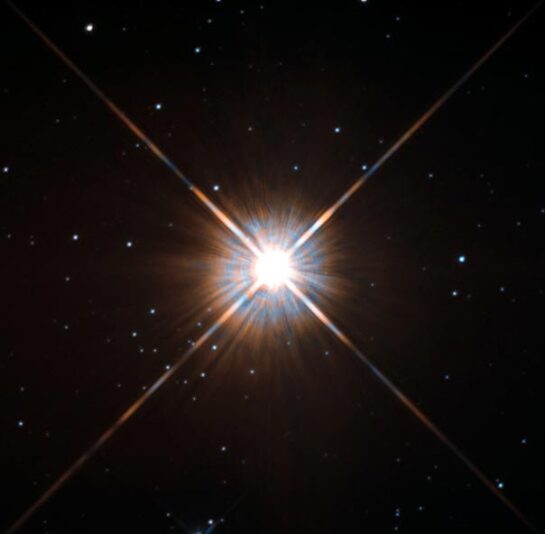
Proxima Centauri isn’t bright, it’s not large, and you certainly can’t see it with the naked eye, but it is the closest star to the Sun, and that makes it one of the most fascinating objects in our galactic backyard.
From nearby exoplanets to the future of interstellar travel, Proxima Centauri sits at the center of a lot of exciting research.
Let’s explore what we currently know, what we’re still trying to figure out, and what the future may hold for studying this tiny but incredibly important star.

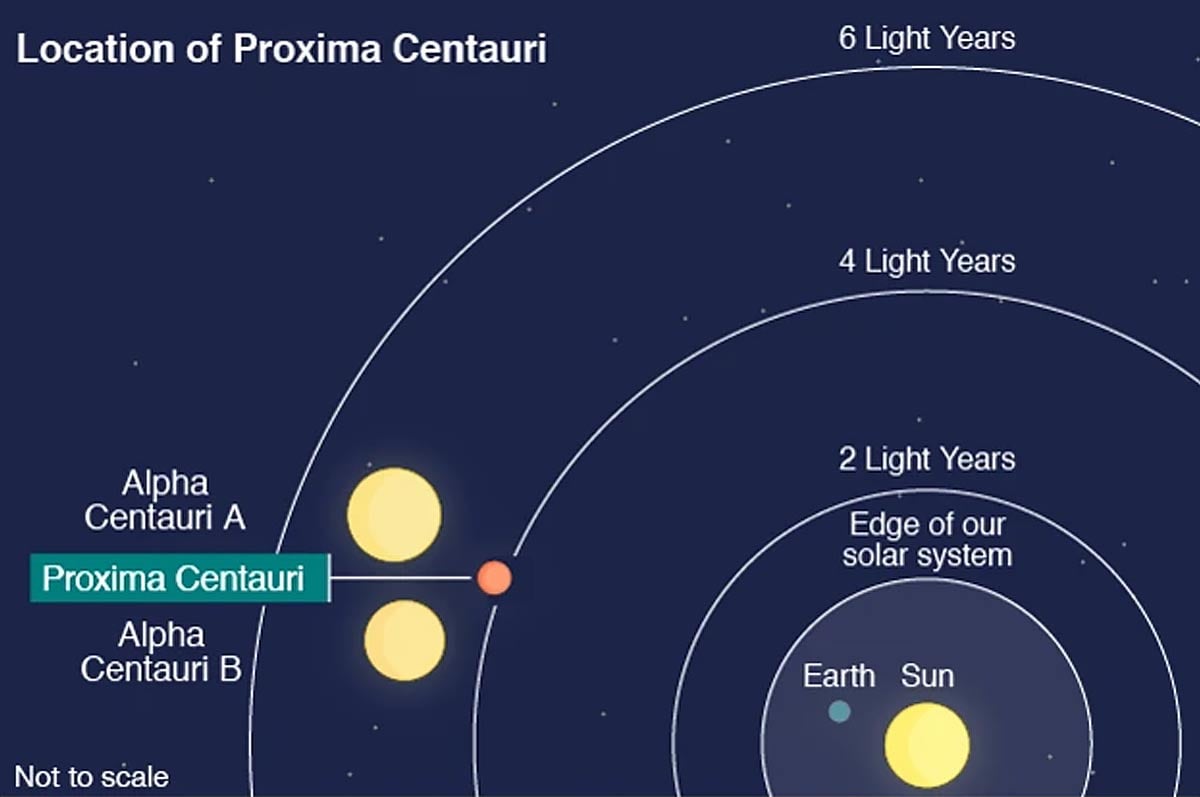
The diagram above illustrates the locations of the star systems closest to the sun. Image Credit: NASA Photojournal.
How Far is Proxima Centauri?
Proxima Centauri is located about 4.24 light-years from Earth. That’s roughly 40 trillion kilometers, give or take a few astronomical units.
It’s part of the Alpha Centauri star system, a triple-star system containing Alpha Centauri A and B (a Sun-like pair) and Proxima Centauri, a much smaller and cooler red dwarf orbiting the other two from afar.
A light-year is the distance light travels in one year, and light moves at an unfathomable 300,000 km per second. Even at that speed, it takes more than four years for a beam of light to reach us from Proxima Centauri.
For perspective, the Voyager 1 spacecraft, the farthest human-made object, would need tens of thousands of years to cover that same distance (more on that later).
One thing that often surprises people is that Proxima Centauri is not visually impressive. In fact, at magnitude 11, it’s invisible to the naked eye under any sky conditions and requires a reasonably capable telescope to observe.
If you want to see Proxima Centauri through a telescope, I recommend using a Dobsonian reflector with at least an 8-inch aperture under dark skies (during the new moon phase). Even then, it won’t be easy to pick out this mag. 11 star.
Backyard astronomers in southern latitudes have the best shot at spotting it, especially with a good star chart and patience. If you’ve ever imaged the rich stellar fields of Centaurus or the region around Alpha Centauri, Proxima is lurking in there, just far too faint to jump out on its own.

The Centaurus constellation with the bright Alpha Centauri star circled in red. Proxima Centauri is close by. Image Credit: NASA.
What makes Proxima truly special isn’t its brightness or appearance, but its relationship to us. Being our closest stellar neighbor, even by cosmic accident, has made it one of the most heavily studied red dwarfs in the sky.
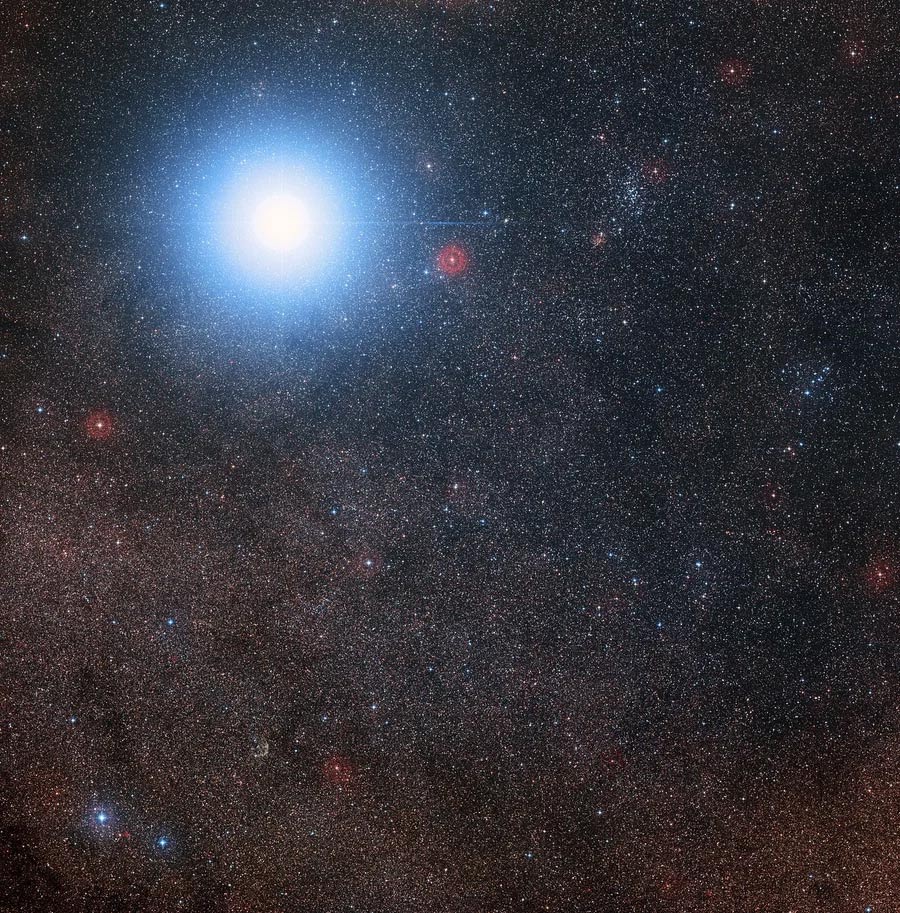
A view of the Alpha Centauri system shows the bright binary pair, Alpha Centauri A and B, at the upper left, while the much dimmer red dwarf Proxima Centauri appears faintly toward the lower right. Image Credit: ESO.
How Astronomers Measure Distance
How do we know the distance of Proxima Centauri so precisely?
The answer lies in one of the oldest and most reliable tools in astronomy: parallax. Astronomers measure how Proxima appears to shift against the background stars as Earth orbits the Sun.
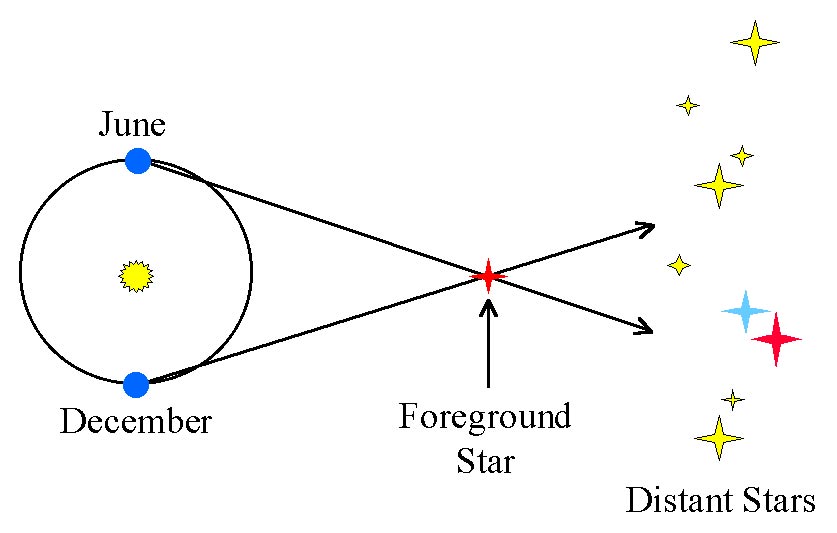
Stellar parallax is the apparent shift in a star’s position against distant background stars caused by Earth’s orbit around the Sun. Image Credit: Ohio State University.
The European Space Agency’s Gaia mission has pinned the distance extremely accurately at 4.2465 light-years, with uncertainties so small they almost don’t matter for amateur astronomy.
Proxima Centauri’s closeness makes it a key object for studying stellar behavior on small scales. Red dwarfs like Proxima are incredibly common, making up more than 70% of stars in the Milky Way. By studying one up close, we get a window into the most abundant type of star in the galaxy.
Recent high-precision measurements also help us understand Proxima’s motion. It’s slowly drifting across the sky relative to background stars at a noticeable pace (noticeable for astronomers, at least).
Over centuries, star positions shift, and future star maps will place Proxima in a different context than it appears today. But its distance won’t change dramatically anytime soon.
Does Proxima Centauri Have Planets?
Proxima Centauri has at least two, and possibly three.
Confirmed planets
Proxima Centauri b
- Earth-sized, habitable zone
- Discovered 2016
- The most widely studied planet in the system

Proxima Centauri c
- A “super-Earth” or mini-Neptune candidate
- About 7 Earth masses
- Discovered via radial velocity data and confirmed with follow-up observations in 2019–2022
- Orbits farther out and may have a cold, icy environment
Potential third planet
In 2022, researchers reported evidence for a possible Proxima Centauri d, a Mars-sized planet even closer to the star than Proxima b. Its detection is still being validated, but if confirmed, it would be one of the smallest exoplanets ever detected around a main-sequence star.
Why this system is so exciting
Proxima Centauri’s planets are close enough for future telescopes to directly image them. Not just detect them, actually photograph them. That’s unprecedented for a world beyond our solar system.
The combination of proximity and relatively favorable orbital geometry makes Proxima one of the most promising long-term targets for exoplanet science.
The Mysterious Proxima Centauri b
Proxima Centauri b is the closest known exoplanet to Earth, orbiting our nearest stellar neighbor at a distance of just 4.24 light-years. Discovered in 2016 through the radial-velocity method, this rocky world lies within the star’s habitable zone, where temperatures could in theory allow liquid water.
Proxima b is estimated to be slightly more massive than Earth and completes an orbit every 11.2 days, receiving a similar amount of stellar energy despite Proxima Centauri being a cool red dwarf.
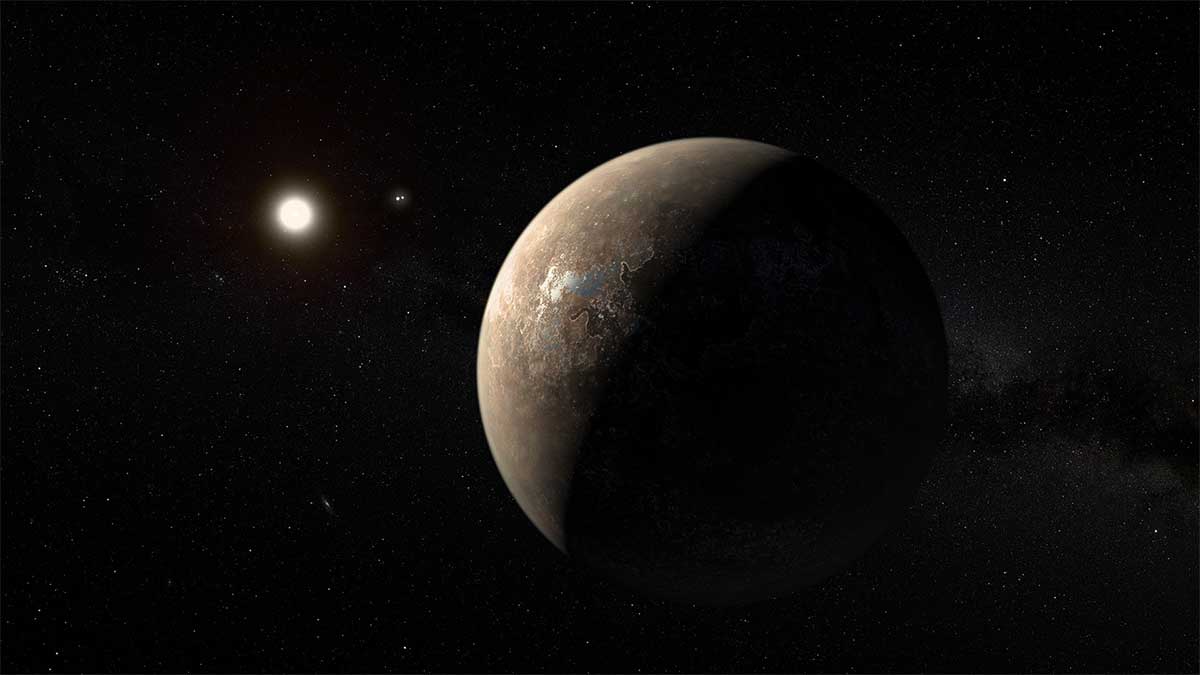
Artist’s impression of the exoplanet Proxima Centauri b, a rocky Super-Earth within the star’s habitable zone.
However, its potential habitability remains highly uncertain. No current observations confirm the presence of water or oxygen on Proxima b, and the planet is subjected to intense stellar flares that could strip or sterilize any atmosphere.
Future instruments (especially extremely large ground-based telescopes and upcoming space missions) may be capable of probing its atmosphere directly. For now, Proxima Centauri b remains an intriguing yet still mysterious neighbor in our galactic backyard.
How long would it take to get to Proxima Centauri?
Using today’s fastest spacecraft, it would take roughly 75,000 years to reach Proxima Centauri.
With current technology, that answer is not very encouraging. However, the speed depends entirely on the spacecraft used.
Voyager 1
- Speed: 17 km/s
- Time to Proxima Centauri: 75,000 years
That’s about the same time span separating us from the earliest humans to create cave paintings. Not ideal for a weekend road trip.
Breakthrough Starshot (a modern concept)
In 2016, a team of scientists and engineers proposed a radical idea: tiny, lightweight spacecraft propelled by powerful laser arrays, reaching up to 20% the speed of light. If successful (and it’s a big “if”), such a spacecraft could reach Proxima in around 20 years.
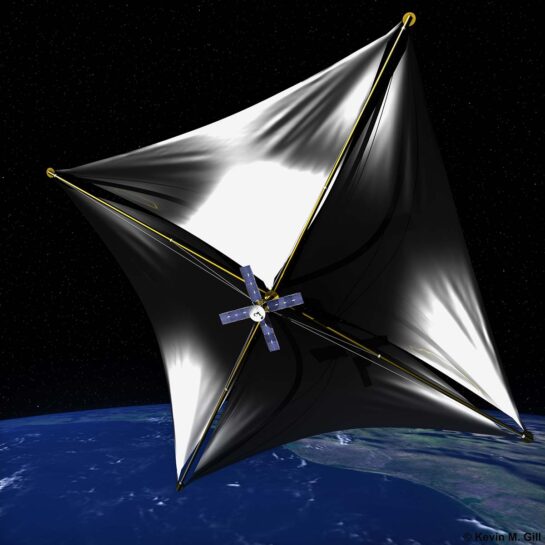
A Solar Sail concept artwork. Kevin Gill (Wikipedia)
This idea has gained renewed attention in 2023–2024 as optical sail technology and high-power laser development continue to advance. We’re still far from a full-scale system, but early tests have shown promising progress.
Future nuclear fusion concepts
Some designs, such as the Daedalus and Icarus concepts (revived in modern studies), could reach speeds of 10% the speed of light, putting Proxima within a 40–50 year travel window. These remain theoretical for now, though research is ongoing.
Realistically, today?
With technology currently in use, any spacecraft we launch would take tens of thousands of years to reach Proxima Centauri. But within the next century, things could change dramatically. For now, Proxima remains a scientific target rather than a travel destination.
This video explores the challenges of reaching Proxima Centauri’s planets, highlighting how interstellar travel isn’t just a technological problem, but a biological one.
Is Proxima Centauri B Habitable?
In 2016, astronomers announced the discovery of Proxima Centauri b, a roughly Earth-sized planet orbiting within the star’s habitable zone (the region where liquid water could theoretically exist). Since then, follow-up studies from 2020–2024 have been trying to determine whether it could actually be habitable.
The good news
- Size and mass: It’s about 1.1 Earth masses, so likely rocky.
- Orbital distance: Just 0.0485 AU from Proxima (about 20 times closer than Mercury is to the Sun), but because Proxima is so dim, that places the planet right in the temperate zone.
- Temperature: Models suggest surface temperatures could support liquid water under the right atmospheric conditions.
The challenges
Proxima Centauri is incredibly active. As a red dwarf, it frequently releases powerful stellar flares, much stronger relative to the star’s size than what our Sun produces.
Observations from 2022 onward (including data from the Hubble Space Telescope and ground-based observatories) show that Proxima produces ultraviolet and X-ray outbursts that could strip away a planet’s atmosphere over time.
For a planet like Proxima b to be habitable, it would need:
- An extremely strong magnetic field
- A thick, resilient atmosphere
- The ability to regenerate atmosphere lost to stellar activity
Current models suggest it could hang onto its atmosphere under specific conditions, but the jury is still out.
Tidal locking
Because it’s so close to its star, Proxima b is likely tidally locked, meaning one side always faces the star and the other is in perpetual darkness. This could create extreme temperature differences unless the atmosphere is thick enough to redistribute heat evenly.
What scientists are excited about
In 2023 and 2024, new studies highlighted the possibility of:
- Subsurface oceans
- Terminator zone habitability (the “twilight ring” between day and night sides)
- Atmospheric regeneration through volcanic activity
With next-generation telescopes like the ELT (Extremely Large Telescope) and continued observations with JWST, we may get real atmospheric data on Proxima b within the next decade.
The short answer: Proxima Centauri b has potential but faces major challenges. It’s one of the best candidates for studying habitability outside our solar system, but the environment is extremely harsh.
Final Thoughts
Proxima Centauri may be a small, faint red dwarf, but it has become one of the most important stars in modern astronomy. Its closeness gives us a front-row seat to the dynamics of red dwarf systems, the challenges of planetary habitability, and the future possibilities of interstellar exploration.
From Proxima Centauri b’s intriguing potential to the dream of one day sending a spacecraft to a nearby star, this little sun has captured the imagination of astronomers, scientists, and space fans around the world.
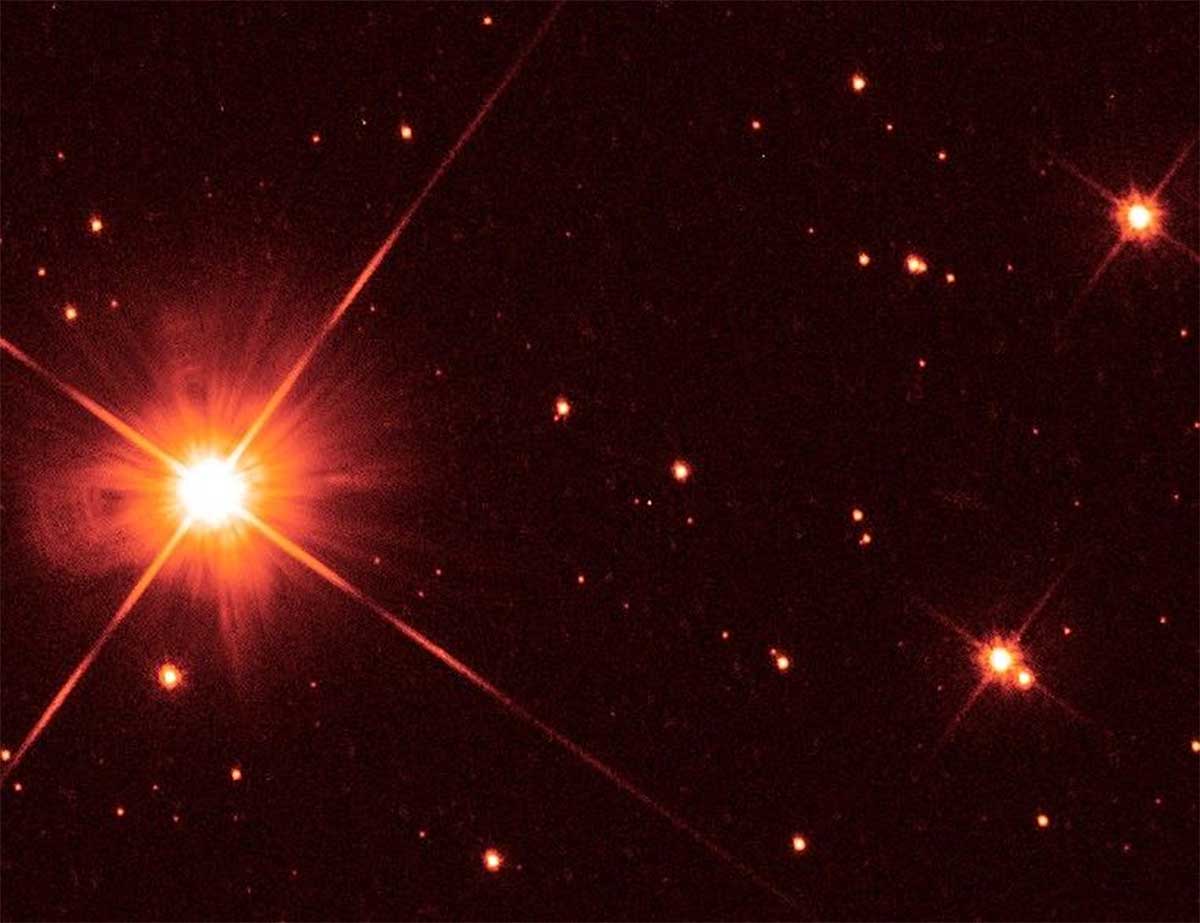
A photo of Proxima Centauri captured by the Hubble Space Telescope.
 Trevor Jones is an astrophotographer and a valued member of the RASC. His passion is inspiring others to start their astrophotography journey on YouTube so they can appreciate the night sky as much as he does. His images have been featured in astronomy books & online publications, including the NASA Astronomy Picture of the Day (APOD).