
How the Moon Affects the Tides

We know that Earth and the Moon are gravitationally tied, but how does the Moon affect the tides?
Earth is much bigger and heavier than the Moon, and the Moon travels around us in a slightly elliptical orbit.
Our celestial neighbor takes about 27.3 days to complete one orbit relative to the stars. However, the cycle from one new moon to the next takes about 29.5 days because Earth is also moving around the Sun.
The short answer: The Moon’s gravity pulls more strongly on the side of Earth closest to it and more weakly on the far side. This difference stretches the oceans into two broad tidal bulges as Earth rotates beneath them.
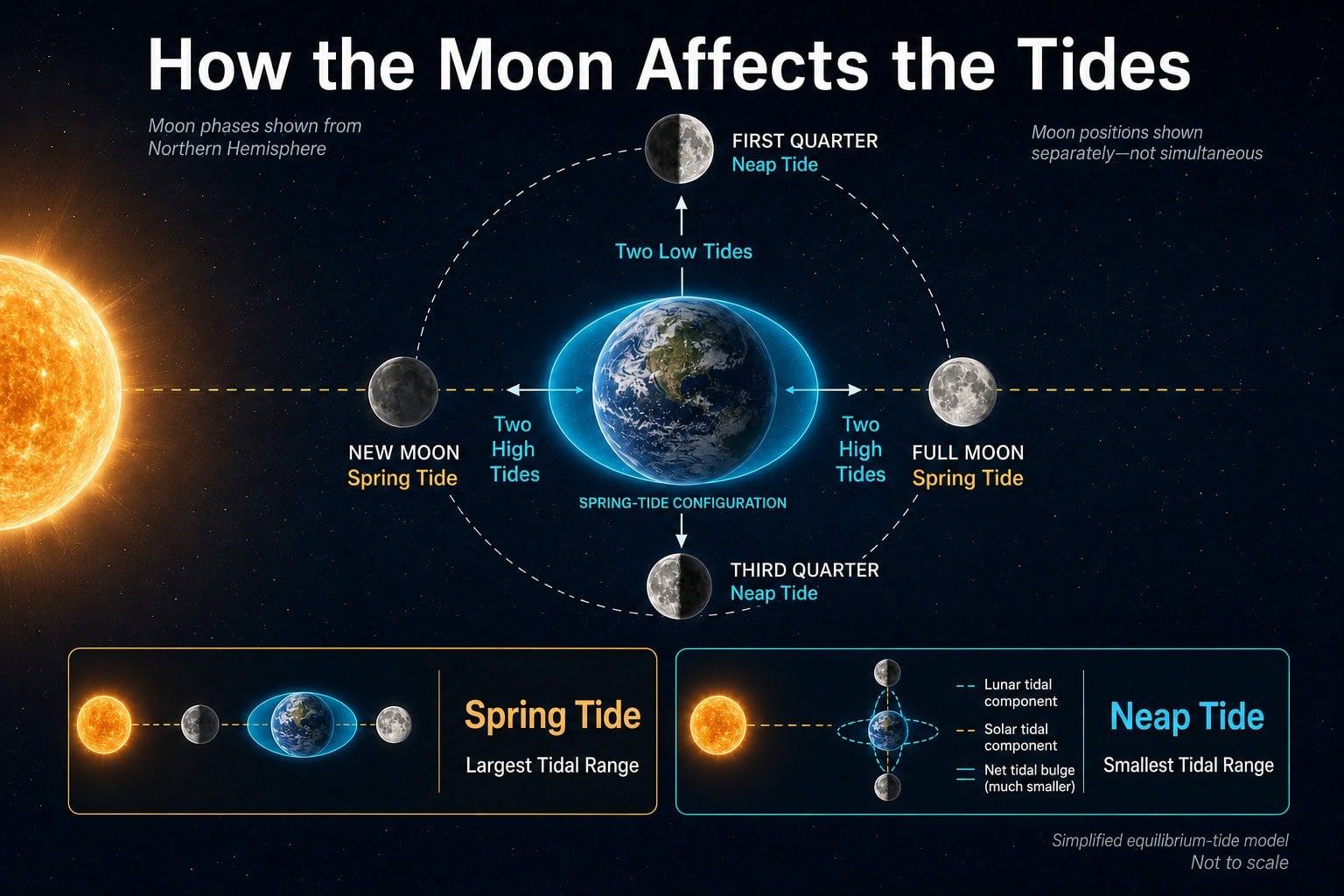
Tidal variations caused by the changing positions of the Moon and Sun.
How Does the Moon Affect the Tides?
Tides are very long-period waves that appear along coastlines as the regular rise and fall of ocean water. The Moon’s gravity is the main influence behind this repeating pattern.
The Moon is not pulling on the oceans like a magnet. Instead, its gravity acts slightly differently across Earth. The pull is strongest on the side facing the Moon, weaker at Earth’s center, and weaker still on the far side. This difference is called a tidal force.
Isaac Newton connected ocean tides with the universal law of gravitation—the same basic physics that keeps the Moon in orbit around Earth.
On the side of Earth facing the Moon, the stronger gravitational pull draws ocean water into a broad tidal bulge. A coastline passing through this region generally experiences high tide.
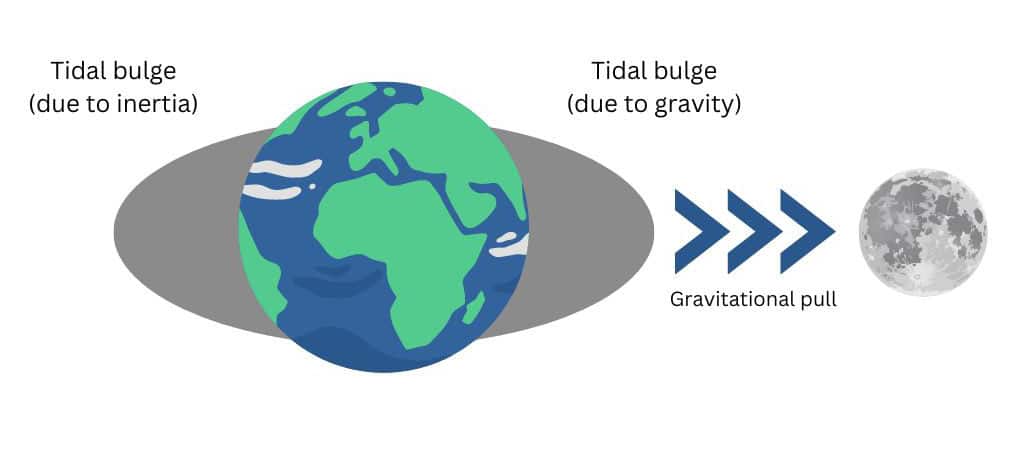
In the simplified tidal-bulge model, one bulge faces the Moon and another forms on the opposite side of Earth.
A second high-tide bulge forms on the far side of Earth. In the rotating Earth-Moon system, inertia and the Moon’s weaker pull on the far-side water help create this second bulge. The Moon is not repelling or pushing that water away.
Between the two high-tide regions are two low-tide regions, where the ocean surface is lower relative to the tidal bulges.
On a simplified, ocean-covered Earth, a location would pass through two high tides and two low tides during each 24-hour-and-50-minute lunar day. Real coastlines are more complicated. Some places experience two similar tides, some have two unequal tides, and others have only one high and one low tide per day.
This pattern explains how the gravitational pull of the Moon creates tides. The Sun also contributes, although its tide-generating influence is smaller than the Moon’s.
Video Resource: Why Do We Have Tides? (BBC)
How Does the Full Moon Affect the Tides?
A full moon does not create a separate kind of tide. Instead, it changes the tidal range, which is the difference in water level between high and low tide.
During a full moon or new moon, the Sun, Earth, and Moon are aligned. The solar and lunar tidal influences reinforce one another, producing higher high tides and lower low tides. This larger tidal range is called a spring tide.
Spring tides have nothing to do with the season of spring. The name refers to the water “springing” higher and lower than usual.
During the first-quarter and third-quarter Moon phases, the Sun and Moon appear at right angles from Earth. Their tidal influences partially offset each other, producing a smaller tidal range called a neap tide.
The Sun is vastly more massive than the Moon, but it is also much farther away. According to NOAA, the Sun’s tide-generating influence is about half as strong as the Moon’s. The Moon therefore remains the dominant influence on Earth’s tides.
Why Are Tides Higher in Some Places?
The Moon establishes the broad tidal rhythm, but it does not determine the exact tide height at every coastline. Ocean depth, seafloor shape, bays, inlets, continents, and local geography can amplify, delay, or weaken the incoming tidal wave. Wind and atmospheric pressure can change the observed water level even further.
The Bay of Fundy is a dramatic example. Its shape and natural resonance funnel and amplify the tide, producing a tidal range that can reach approximately 16 meters near the head of the bay.
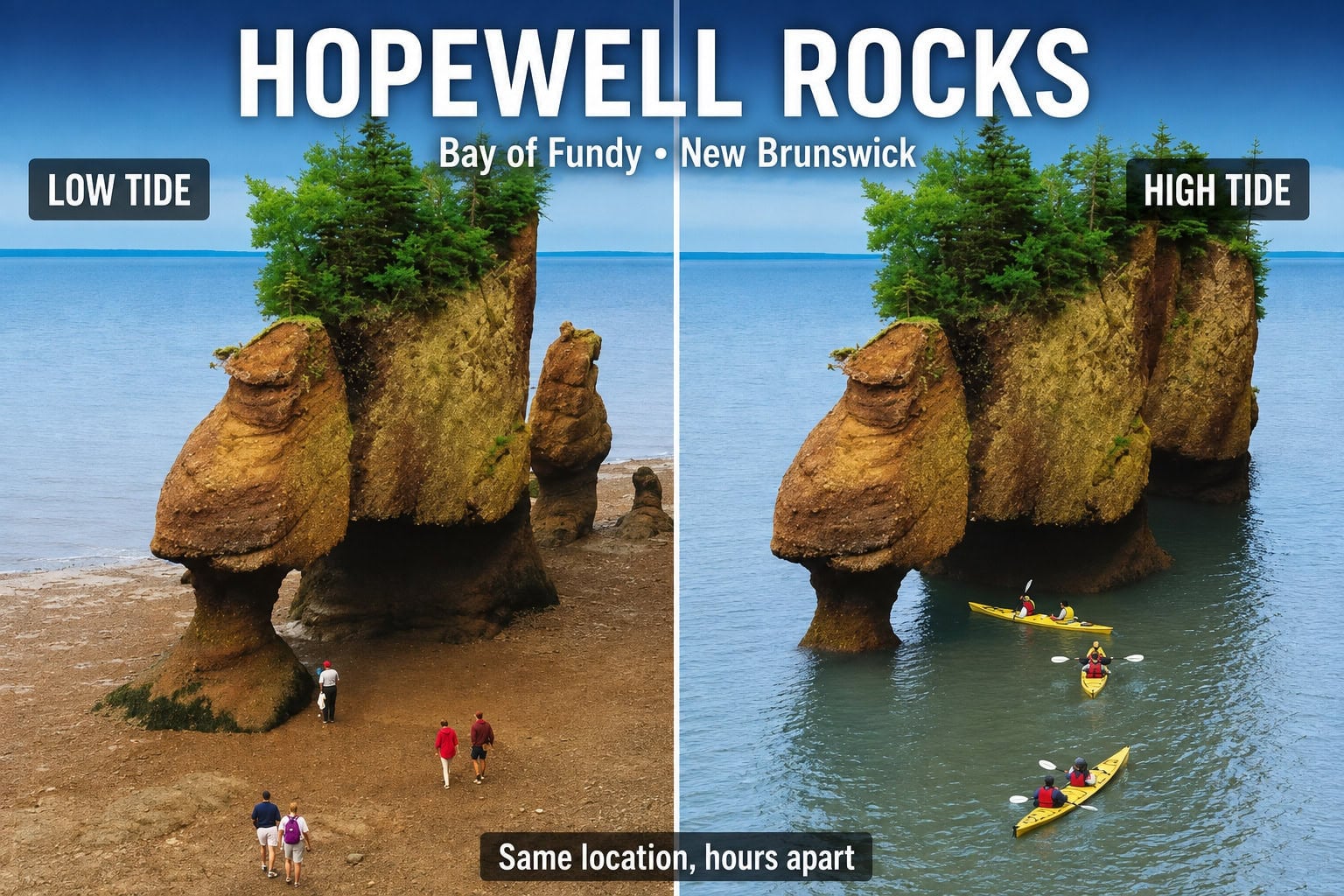
A dramatic example of low tide vs high tide at Hopewell Rocks in New Brunswick, Canada.
Why Tide Predictions Matter
Tide predictions are useful for fishing, sailing, kayaking, surfing, beachcombing, and exploring tide pools. They can also prevent someone from becoming stranded by rising water.
Photography tip: If you are planning a Moon photograph over a beach or shoreline, check the tide as carefully as the moonrise time. The tide can determine whether your foreground contains exposed rocks, reflective water, mudflats, or no accessible shoreline at all.
For locations in the United States, you can find predicted water levels by station using NOAA Tide Predictions. Elsewhere, use the official hydrographic or meteorological agency for your region.
Summary
- The Moon creates tides because its gravitational pull varies across Earth, producing two broad tidal bulges.
- Many coastlines experience two high tides and two low tides during a 24-hour-and-50-minute lunar day, but local tidal patterns vary.
- Full and new moons produce spring tides with a larger tidal range.
- First- and third-quarter moons produce neap tides with a smaller tidal range.
- The Sun contributes to tides, but the Moon has the stronger tide-generating influence.
- Coastline shape, ocean depth, seafloor geography, wind, and atmospheric pressure affect the timing and height of local tides.
Related Content
- List of Planets in Order From the Sun
- What Makes a Halo Around the Moon?
- Are the Sun and the Moon the Same Size?
- The Phases of the Moon Explained